
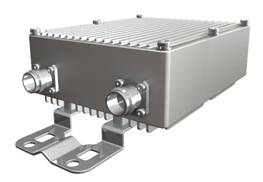
Hybrid Combiner Series
- Broadband – Covers 600 MHz to 6000 MHz
- Combines 2 Inputs into a Single Output
- Low Insertion Loss
- Low PIM Device, -160 dBc
- IBWave Supported
| Model Number | HC2X1 |
| Electrical Specifications | |
| Frequency Range (MHz) | 600-6000 |
| Insertion Loss (dB) | 3.2±1.2 |
| Port Isolation (dB) | ≥22 |
| Return Loss (dB) | ≥18 |
| 3rd PIM (dBc) | ≤-160@2×43dBm |
| Average Power (W) | ≤200 |
| Impedance (Ω) | 50 |
| Connector Type | 4.3-10 Female |
| Mechanical Specifications | |
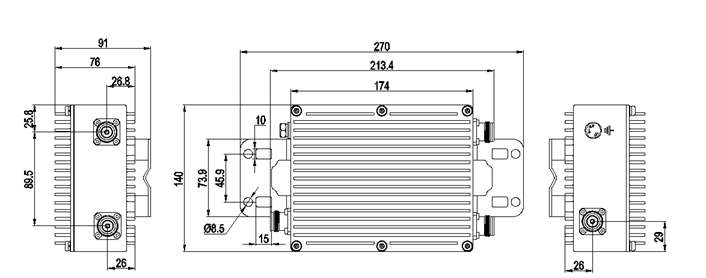
| Dimension (mm) | 174x140x76 (6.86x5.51x2.99in) |
| Weight (kg) | 2.5 |
| Ingress Protection | IP66(Outdoor) |
| Finish | Grey |
| Environmental Specifications | |
| Operating Temp. (℃) | -20 ~ +65 |
| Storage Temp. (℃) | -40 ~ +75 |
| Humidity | ≤95% |
Connector Options Available
- 3-10.0 Female (Add -43F to Model Number)
- 7-16 DIN Female (Add -DF to Model Number)
Hybrid Coupler, 2×1 – Model Number HC2X1
FAQ about Hybrid Combiners
What is a hybrid combiner?
A hybrid combiner is a passive RF device that combines or splits signals from multiple sources while maintaining isolation between them. It uses hybrid coupler technology (typically 3 dB, 90° or 180° hybrids) to ensure efficient power combining with minimal signal interference.
How does a hybrid combiner work?
A hybrid combiner uses phase shifting and coupling networks to combine two or more input signals. When the signals are equal in amplitude and phase, they combine constructively at the output port while unwanted components are isolated or terminated internally.
What are the main types of hybrid combiners?
The two most common types are:
-
90° hybrid combiners (quadrature hybrids) – use a 90° phase shift between ports.
-
180° hybrid combiners (rat-race hybrids) – use a 180° phase difference for combination.
Both are designed to provide equal amplitude outputs with specific phase relationships.
What is the difference between a hybrid combiner and a power combiner?
A hybrid combiner provides port isolation and maintains good VSWR and phase balance, making it ideal for combining non-coherent signals.
A power combiner, on the other hand, may not offer high isolation and is typically used when sources are phase-synchronized.
Why is port isolation important in a hybrid combiner?
Isolation ensures that energy from one transmitter does not feed back into another, which could cause intermodulation distortion or damage to sensitive equipment. High isolation protects system components and ensures signal purity.
What are typical applications of hybrid combiners?
Hybrid combiners are used in:
-
Cellular base stations (2G–5G)
-
Distributed Antenna Systems (DAS)
-
Broadcast transmitters
-
MIMO and diversity systems
-
Test and measurement setups
What is the insertion loss of a hybrid combiner?
Typical insertion loss ranges from 3.0 to 3.5 dB (due to power splitting/combining and internal dissipation). High-quality hybrids maintain low additional loss beyond the theoretical 3 dB combining loss.
What frequency ranges are hybrid combiners available for?
Hybrid combiners are available across a wide range—from VHF (100 MHz) up to microwave frequencies (6–40 GHz)—depending on the design and materials used.
What are Low PIM hybrid combiners?
Low PIM hybrid combiners are specially designed to minimize passive intermodulation distortion. They use non-ferromagnetic materials and precision assembly to support multi-carrier cellular and DAS applications with PIM ratings as low as −150 dBc or better.
What is amplitude balance in a hybrid combiner?
Amplitude balance refers to how evenly the hybrid combiner distributes or combines signal power between ports. Good amplitude balance ensures stable RF performance and is especially important in MIMO, beamforming, and balanced amplifier systems.
What happens if a port is left unterminated?
Leaving an unused port unterminated can cause signal reflections, degraded isolation, increased VSWR, and reduced overall system performance. Unused ports should always be terminated with the proper matched load.
Can a hybrid combiner be used as a signal splitter?
Yes. Hybrid combiners are reciprocal passive devices, meaning they can also operate as signal splitters while maintaining the same isolation and phase characteristics.
Are hybrid combiners suitable for outdoor installations?
Yes, many hybrid combiners are designed for outdoor telecom and industrial environments. These models typically feature weather-sealed housings, corrosion-resistant materials, and wide operating temperature ranges.
Why is phase balance important in a hybrid combiner?
Phase balance ensures that output signals maintain the intended phase relationship, which is critical in applications such as phased arrays, balanced amplifiers, and coherent signal combining systems.
How do you select the right hybrid combiner for your application?
When choosing a hybrid combiner, consider:
-
Frequency range (band coverage)
-
Power handling (average and peak)
-
Isolation and VSWR
-
PIM performance (for cellular systems)
-
Connector type (DIN, N, 4.3-10, SMA, etc.)
-
Environmental rating (indoor/outdoor use)
How can I order hybrid combiner from MCV Microwave?
To place an order for hybrid combiner please contact us and we will help you!