
GNSS Antenna
Designed to receive signals from global navigation satellite systems (GNSS), GNSS antennas are critical for accurate positioning, navigation, and timing applications. These antennas capture signals from multiple satellite constellations—such as GPS, GLONASS, Galileo, and BeiDou—to ensure robust and precise location data even in challenging environments.
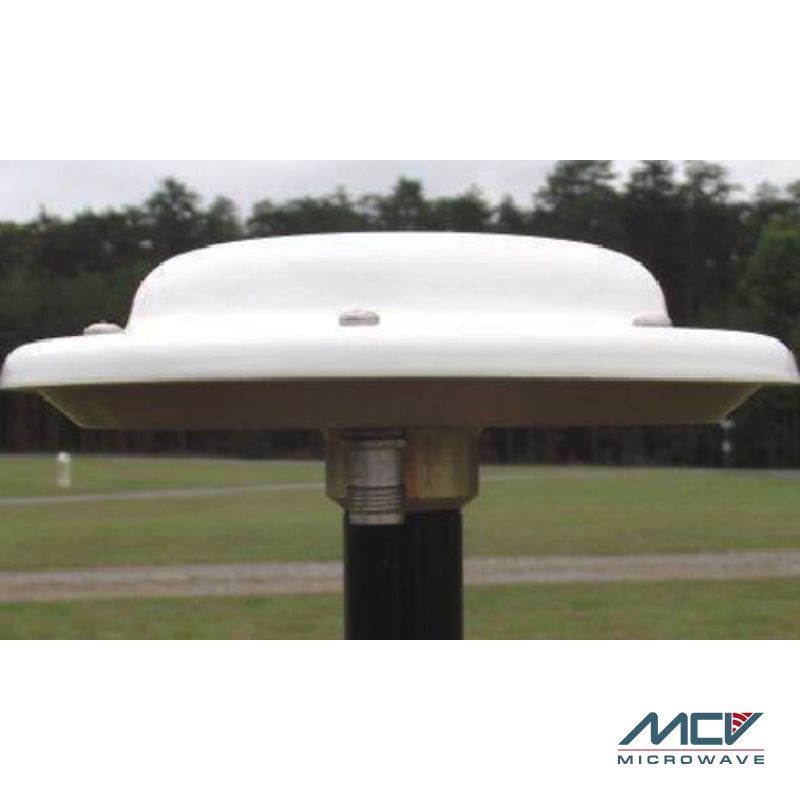
GNSS Antennas by MCV
MCV GNSS antennas offer high sensitivity, low noise, and excellent multipath rejection across all major GNSS frequency bands. Engineered for reliability and precision, our antennas are available in compact, ruggedized packages suitable for integration into a wide range of platforms, including UAVs, military systems, autonomous vehicles, surveying equipment, and IoT devices. Whether for land, sea, or air applications, MCV GNSS antennas deliver consistent, dependable performance where accurate timing and location are critical.
FAQ about GNSS antennas
What is a GNSS antenna?
A GNSS (Global Navigation Satellite System) antenna is a device designed to receive signals from navigation satellites such as GPS, GLONASS, Galileo, and BeiDou. It converts these radio signals into electrical signals that can be processed by a GNSS receiver to determine position, velocity, and time.
What are the main types of GNSS antennas?
The main types include:
-
Patch antennas – compact and cost-effective, commonly used in handheld devices.
-
Helical antennas – good multipath resistance, ideal for drones and mobile use.
-
Choke ring antennas – high precision and multipath rejection, often used in reference stations.
-
Geodetic antennas – designed for high-accuracy surveying and scientific applications.
What frequencies do GNSS antennas receive?
GNSS antennas can receive one or more frequency bands, typically:
-
L1 (around 1575 MHz)
-
L2 (around 1227 MHz)
-
L5/E5 (around 1176–1207 MHz)
Multi-frequency antennas improve accuracy and robustness by receiving multiple bands.
What is the difference between single-frequency and multi-frequency
-
Single-frequency antennas receive only one signal band (e.g., L1).
-
Multi-frequency antennas receive multiple bands (e.g., L1, L2, L5), allowing for faster signal acquisition, better accuracy, and reduced ionospheric error.
What is antenna gain and why is it important?
Antenna gain measures how well the antenna focuses received energy in a particular direction. Higher gain typically improves signal reception, especially in challenging environments, but may narrow the reception pattern.
What is multipath interference and how can it be minimized?
Multipath interference occurs when GNSS signals reflect off nearby surfaces before reaching the antenna, causing positioning errors.
It can be minimized by:
-
Using antennas with ground planes or choke rings
-
Mounting the antenna away from reflective surfaces
-
Using antennas designed for multipath rejection
How should a GNSS antenna be mounted?
For best performance:
-
Mount it on a stable, level surface
-
Ensure a clear view of the sky (minimum obstruction)
-
Use proper grounding and cable management
-
Avoid placing it near large metal objects or RF sources
What is a ground plane, and why is it needed?
A ground plane is a conductive surface placed beneath an antenna to reflect and shape the signal reception pattern. It improves signal strength, reduces multipath, and stabilizes phase center variation—especially for patch antennas.
What is the phase center of a GNSS antenna?
The phase center is the effective point from which the antenna receives signals. It may vary slightly depending on the satellite’s direction. For precise applications (e.g., surveying), antennas with stable and calibrated phase centers are used.
What is the difference between active and passive GNSS antennas?
Passive GNSS antennas only receive satellite signals and require an external low-noise amplifier (LNA). Active GNSS antennas include a built-in LNA that amplifies weak satellite signals before sending them to the receiver, improving performance over long cable runs.
What is a low-noise amplifier (LNA) in a GNSS antenna?
An LNA is an electronic amplifier integrated into many GNSS antennas to boost weak satellite signals while adding minimal noise. It improves signal quality and helps compensate for cable losses between the antenna and receiver.
Can one GNSS antenna support multiple satellite systems?
Yes. Many modern GNSS antennas are multi-constellation, meaning they can receive signals from GPS, GLONASS, Galileo, BeiDou, and other systems simultaneously. This improves coverage, positioning accuracy, and reliability.
How does weather affect GNSS antenna performance?
Rain, snow, ice, and extreme temperatures can slightly affect signal reception or physically obstruct the antenna. High-quality outdoor GNSS antennas are designed with weatherproof enclosures and durable materials to ensure reliable operation in harsh environments.
What is GNSS jamming and spoofing?
Jamming occurs when strong RF signals interfere with GNSS reception, while spoofing involves transmitting fake GNSS signals to mislead receivers. Specialized antennas and filtering technologies can help reduce vulnerability to these threats.
What factors affect GNSS antenna performance?
Performance can be influenced by:
-
Antenna design and quality
-
Mounting position and environment
-
Obstructions and reflections
-
Cable losses and connectors
-
Signal interference (e.g., RF noise or jamming)
How do I choose the right GNSS antenna for my application?
Consider factors like frequency bands required, gain, size, mounting method, environmental conditions, and whether the application is stationary or in motion.
How can I order GNSS antenna from MCV Microwave?
To place an order for GNSS antenna or any other RF antenna please contact us and we will help you!