
Patch Antenna
Patch antennas are compact, low-profile antennas that provide reliable directional RF performance in a small footprint. Often mounted directly on circuit boards, they are widely used in applications requiring space efficiency, moderate gain, and consistent performance across defined frequency ranges.
Patch Antennas by MCV
MCV patch antennas are precision-engineered for optimal performance in wireless, GNSS, and IoT systems. Designed to operate across various frequency bands, our patch antennas offer stable gain, low VSWR, and minimal signal loss. Available in both single-band and multi-band configurations, they are ideal for embedded systems, positioning modules, and compact communication devices. Built with durable materials and available in ruggedized housings, MCV patch antennas are suitable for integration into automotive systems, industrial electronics, and mission-critical RF applications.
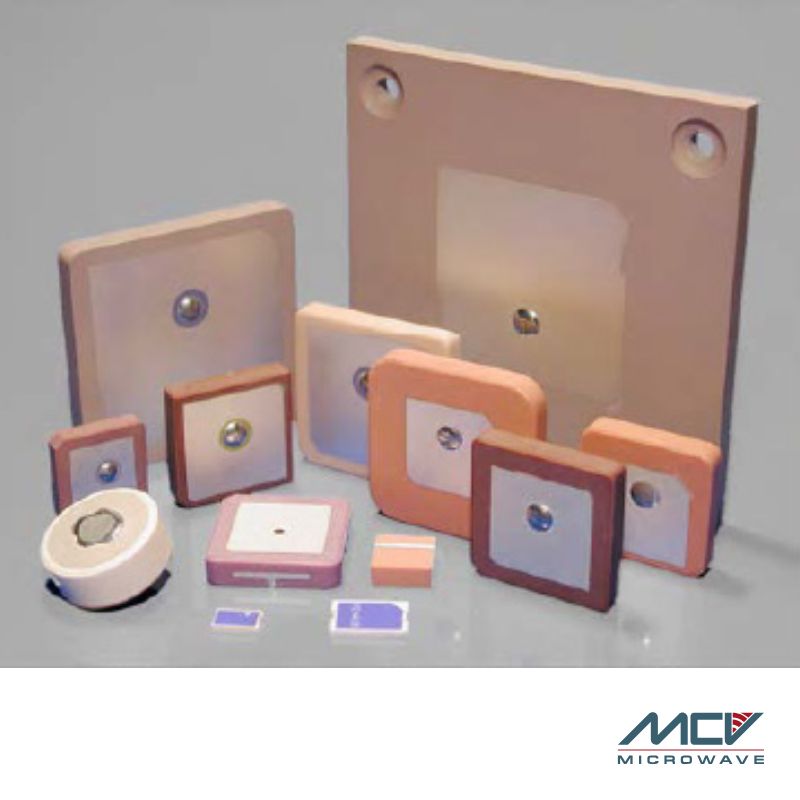
FAQ about patch antennas
What is a patch antenna?
A patch antenna (also called a microstrip antenna) is a low-profile, flat antenna consisting of a metallic patch mounted on a grounded dielectric substrate. It’s widely used for applications where compact size and ease of integration are important—such as GPS, Wi-Fi, RFID, and mobile devices.
How does a patch antenna work?
The metal patch acts as a resonator that radiates electromagnetic waves when excited by a signal. The signal is typically fed through a microstrip line, coaxial probe, or aperture coupling. The size and shape of the patch determine the operating frequency.
What are common shapes of patch antennas?
The most common shapes include:
-
Rectangular (most widely used)
-
Circular
-
Triangular
-
Elliptical
-
Ring or slot configurations
These shapes can be modified or combined to achieve specific bandwidth or polarization characteristics.
What are the advantages of using a patch antenna?
-
Compact and lightweight design
-
Easy to fabricate using PCB technology
-
Low manufacturing cost
-
Conformal to flat or curved surfaces
-
Suitable for array configurations
-
Good performance for portable or embedded devices
What are the limitations of patch antennas?
-
Narrow bandwidth (typically a few percent of the center frequency)
-
Low gain compared to larger directional antennas
-
Limited power handling
-
Susceptible to detuning due to nearby materials or moisture
What is the typical frequency range for patch antennas?
Patch antennas can be designed for a wide range of frequencies—from UHF (300 MHz) up to millimeter-wave bands (>30 GHz). Common examples include:
-
GPS L1 band: ~1.575 GHz
-
Wi-Fi: 2.4 GHz and 5 GHz
-
5G and radar: 24 GHz and above
What is the typical gain of a patch antenna?
Single patch antennas generally have a gain of 5–9 dBi. Higher gain can be achieved by combining multiple patches in an antenna array configuration.
What is polarization in a patch antenna?
Patch antennas can be designed for different polarizations:
-
Linear polarization (vertical or horizontal)
-
Circular polarization (right-hand or left-hand), achieved using specific feed or patch modifications.
Circular polarization is common in GPS and satellite communications.
How does substrate material affect patch antenna performance?
The substrate’s dielectric constant (εr) and thickness influence bandwidth, size, and efficiency.
-
Low εr → larger antenna, wider bandwidth
-
High εr → smaller antenna, narrower bandwidth
Common materials include FR4, Rogers, Teflon, and ceramic composites.
What are common applications of patch antennas?
Patch antennas are widely used in:
-
GNSS/GPS receivers
-
Wi-Fi routers and access points
-
RFID readers
-
5G and IoT devices
-
Aerospace and automotive radar systems
-
Wearable and embedded communication systems
What is a patch antenna array?
A patch antenna array consists of multiple patch elements arranged together to increase gain, improve directivity, or enable beam steering. Arrays are commonly used in radar systems, satellite communications, 5G infrastructure, and phased-array applications.
What is the bandwidth of a typical patch antenna?
Standard patch antennas usually have a relatively narrow bandwidth, often between 1% and 5% of the center frequency. Techniques such as stacked patches, slotting, or thicker substrates can be used to increase bandwidth.
Can patch antennas be used for MIMO systems?
Yes. Patch antennas are widely used in MIMO (Multiple-Input Multiple-Output) systems because they can be arranged in compact multi-element configurations with controlled spacing and polarization diversity to improve wireless performance.
What factors can detune a patch antenna?
Nearby metal objects, plastic enclosures, moisture, human contact, and PCB layout changes can shift the antenna’s resonant frequency and reduce efficiency. Proper grounding, spacing, and enclosure design are important to maintain performance.
How are patch antennas tested and measured?
Patch antennas are typically evaluated using network analyzers and anechoic chambers. Key measurements include return loss (S11), VSWR, gain, radiation pattern, bandwidth, and polarization characteristics.
How do patch antennas compare to other types of antennas?
Patch antennas offer a good balance of size, gain, and performance. They are less bulky than dish or Yagi antennas but provide more directionality than omnidirectional antennas.
Are MCV patch antennas suitable for outdoor or harsh environments?
Yes, MCV patch antennas are built with rugged materials and can be housed in weather-resistant enclosures, making them suitable for both indoor and outdoor use. Boka kiropraktor Stockholm och naprapat Stockholm.
How can I order patch antenna from MCV Microwave?
To place an order for patch antenna or any other RF antenna please contact us and we will help you!