
RF Capacitors
Engineered to store and manage electrical energy at high frequencies, RF capacitors are fundamental components in tuning, filtering, impedance matching, and signal coupling applications across RF and microwave systems. Designed for minimal loss and high stability, they help ensure optimal signal performance, efficiency, and reliability in both fixed and dynamic RF environments.
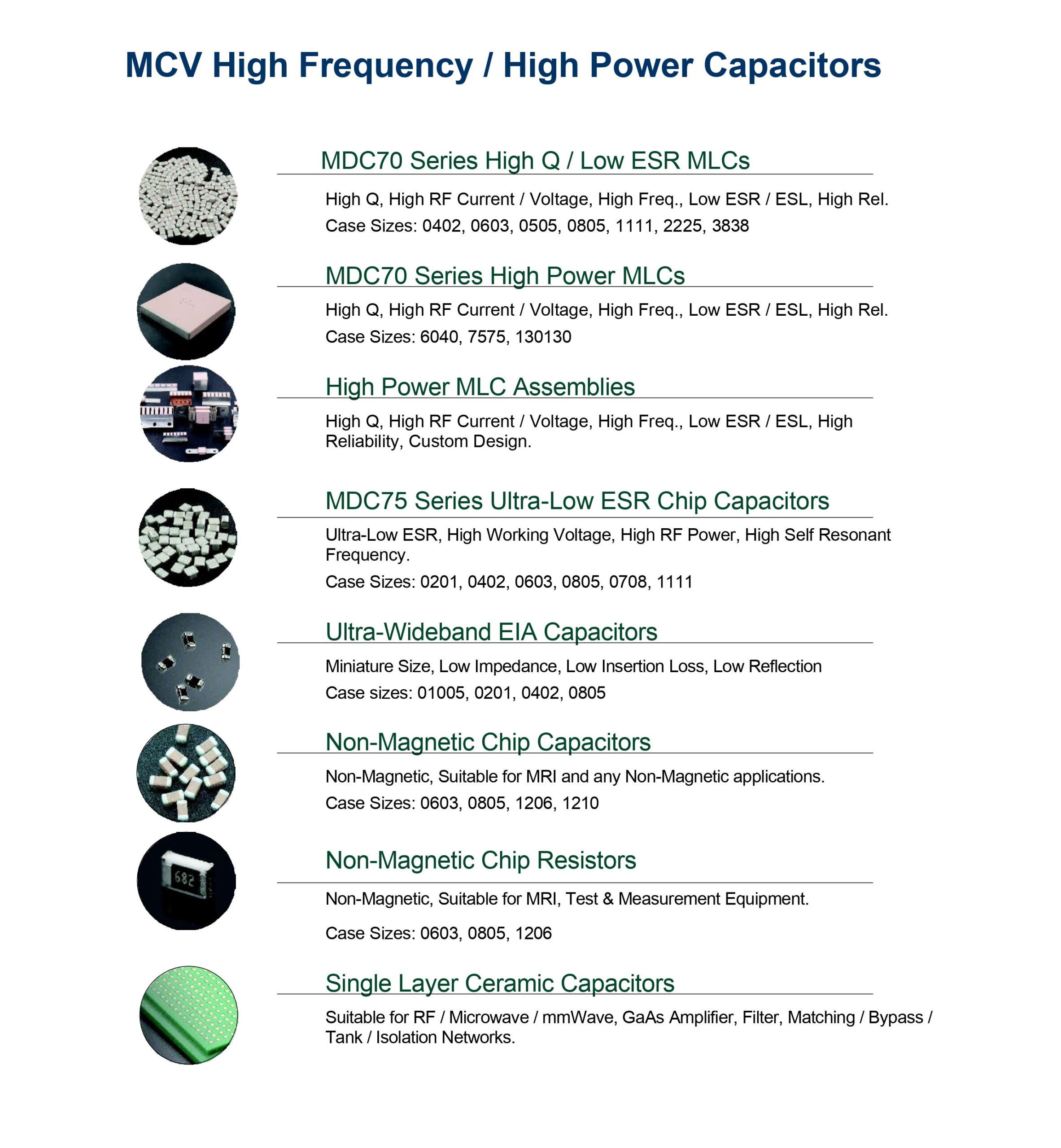
MCV High Frequency / High Power Capacitors
MCV RF capacitors are crafted for superior performance across a broad frequency spectrum—from kilohertz to gigahertz—making them ideal for use in demanding RF circuits and systems. These high-quality passive components are available in a range of capacitance values, voltage ratings, and package styles, including surface-mount and connectorized formats.
Built to meet the rigorous demands of industries such as telecommunications, aerospace, defense, medical electronics, and industrial automation, MCV capacitors offer low equivalent series resistance (ESR), high Q factors, and excellent temperature stability. Whether you’re designing a compact RF module or building a high-power RF amplifier, our capacitors ensure consistent performance and long-term reliability.
MCV’s capacitors are available as stand-alone components or integrated into larger assemblies and filter designs. Each unit undergoes strict quality control to guarantee precision and performance. From tuning RF circuits to suppressing unwanted noise, MCV RF capacitors are a trusted solution for engineers who demand accuracy and dependability in every application.
FAQ about Capacitors
What are RF capacitors?
RF capacitors are capacitors specifically designed to operate at radio frequencies (typically MHz to GHz). They feature low parasitic inductance, low ESR, and stable capacitance to ensure reliable high-frequency performance.
How do RF capacitors differ from standard capacitors?
Standard capacitors may suffer from high parasitic inductance and losses at high frequencies. RF capacitors are engineered with optimized geometries and materials to minimize parasitics and maintain functionality at high signal speeds.
What materials are RF capacitors typically made from?
RF capacitors commonly use ceramic dielectrics such as NP0/C0G, porcelain, or advanced temperature-stable materials. These provide low loss tangents and stable capacitance over wide temperature and frequency ranges.
What is the importance of ESR and Q-factor in RF capacitors?
-
Low ESR reduces heat generation and power loss.
-
High Q-factor enhances efficiency in resonant circuits.
These characteristics are critical for filters, matching networks, and oscillators.
What frequency range can RF capacitors support?
Depending on the design, RF capacitors can operate from tens of MHz up to tens of GHz, making them suitable for wireless, radar, and high-speed communication systems.
What types of RF capacitors are available?
Common types include:
-
Single-layer capacitors (SLCs)
-
Multi-layer ceramic capacitors (MLCCs)
-
High-Q porcelain capacitors
-
Chip capacitors
-
High-voltage RF capacitors
Where are RF capacitors used?
Typical applications include:
-
Impedance matching networks
-
RF power amplifiers
-
Filters and resonators
-
Antenna tuning circuits
-
Radar and microwave systems
-
5G and wireless communication modules
How do parasitic inductance and capacitance affect RF capacitor performance?
Parasitic inductance can limit the self-resonant frequency (SRF), while parasitic capacitance impacts impedance at high frequencies. RF capacitors are designed to reduce these effects to maintain predictable performance.
How do I choose the right RF capacitor for my application?
Key selection factors include:
-
Required capacitance value
-
Operating frequency and SRF
-
Q-factor and ESR
-
Voltage rating
-
Package size and layout compatibility
-
Temperature stability
Can RF capacitors handle high power?
Yes, specific RF capacitors—especially high-Q ceramic types—are designed to handle significant RF power levels. However, power handling depends on the capacitor’s dielectric rating, thermal properties, and physical construction.
What is self-resonant frequency (SRF) in an RF capacitor?
Self-resonant frequency (SRF) is the frequency at which the capacitor’s capacitive reactance equals its parasitic inductive reactance. Above the SRF, the capacitor begins to behave inductively, which can negatively affect RF circuit performance.
Why is temperature stability important in RF capacitors?
Temperature stability ensures that the capacitance value remains consistent across varying operating temperatures. Stable capacitance is critical in RF filters, oscillators, and matching networks where frequency accuracy is important.
How does PCB layout affect RF capacitor performance?
PCB layout has a major impact on RF performance. Long traces, poor grounding, and excessive lead lengths can introduce unwanted inductance and signal loss. Proper RF layout techniques help maintain high-frequency efficiency and minimize parasitic effects.
What voltage ratings are available for RF capacitors?
RF capacitors are available in a wide range of voltage ratings, from low-voltage surface-mount components to high-voltage capacitors designed for RF power amplifiers, plasma systems, and broadcast transmitters.
Are RF capacitors suitable for high-reliability applications?
Yes, many RF capacitors are designed for aerospace, defense, medical, and industrial systems where long-term reliability, thermal stability, and consistent RF performance are critical.
Do MCV RF capacitors support integration into custom assemblies?
Yes. MCV RF capacitors are not only available as stand-alone components but can also be integrated into customized assemblies such as filters, impedance matching networks, or other RF modules. This helps streamline design and improve overall system performance.
How can I order RF capacitor from MCV Microwave?
To place an order for RF capacitor please contact us and we will help you!