

Planar Filters
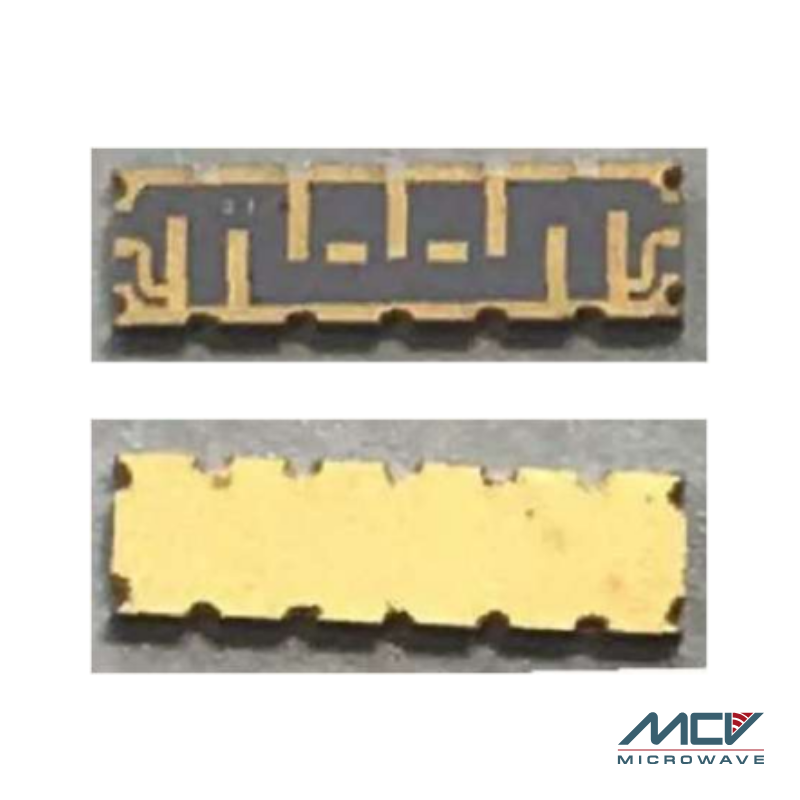
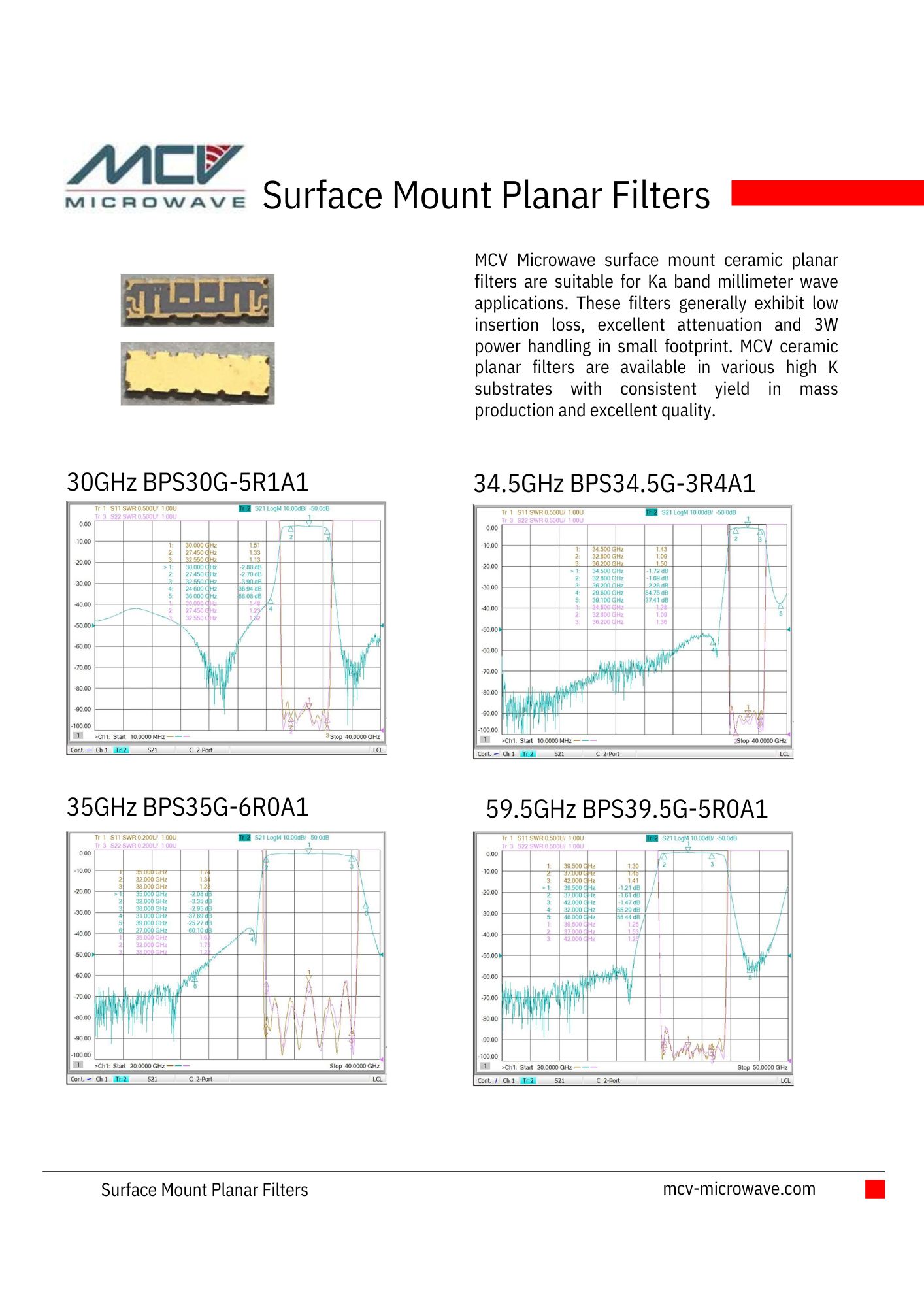
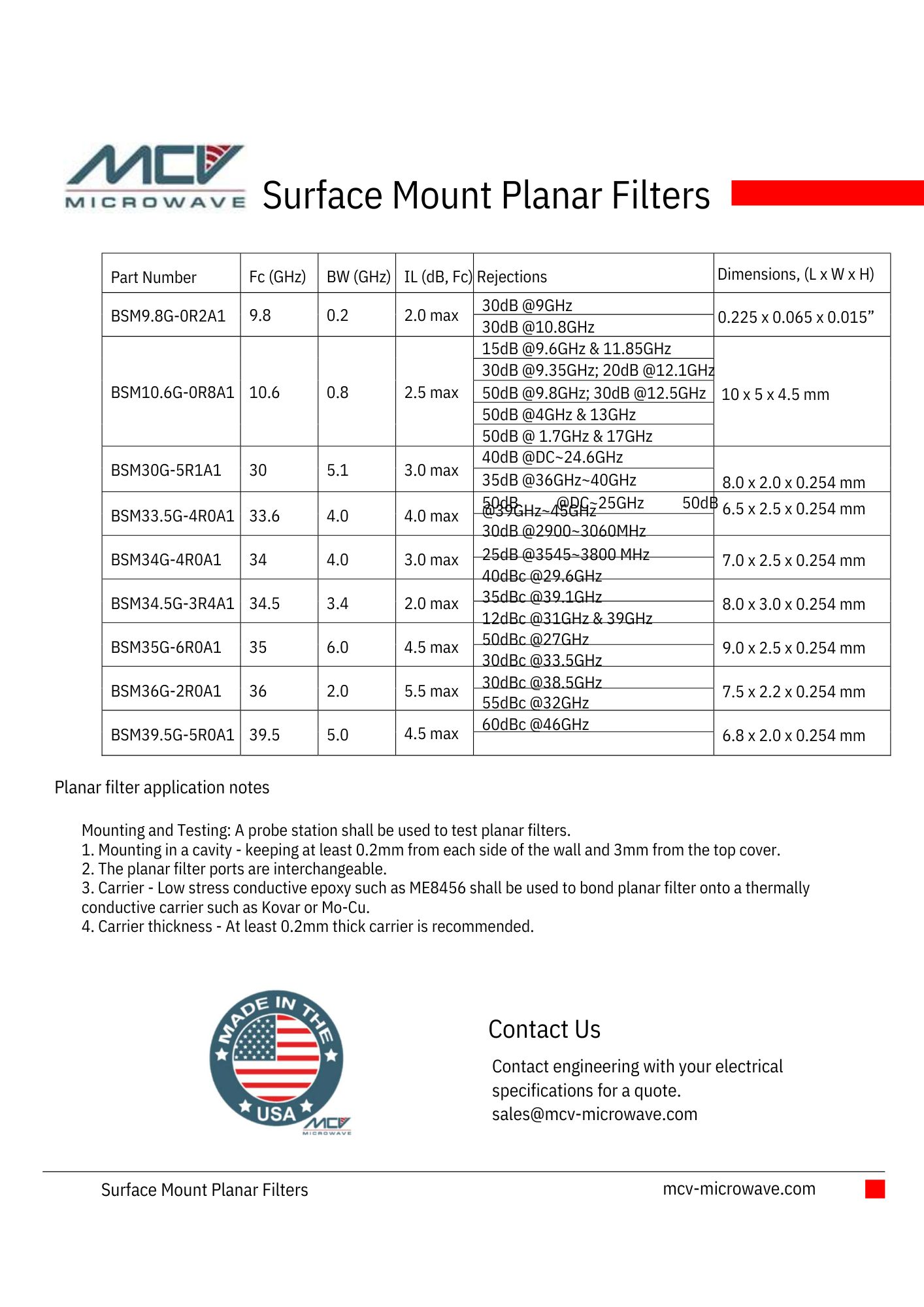
MCV Microwave surface mount ceramic planar filters are suitable for Ka band millimeter wave applications. These filters generally exhibit low insertion loss, excellent attenuation and 3W power handling in small footprint. MCV ceramic planar filters are available in various high K substrates with consistent yield in mass production and excellent quality.
FAQ about Planar Filters
What is a Planar Filter?
A planar filter is a type of electronic filter built using flat, planar transmission lines (like microstrip or stripline) on a dielectric substrate. These filters are compact and suitable for integration in printed circuit boards (PCBs).
What are the main types of Planar Filters?
Common types include:
-
Microstrip filters
-
Stripline filters
-
Coplanar waveguide filters
-
Substrate-integrated waveguide (SIW) filters
Each has different trade-offs in terms of size, performance, and manufacturing complexity.
Where are Planar Filters used?
They are widely used in:
-
Wireless communication systems
-
Satellite and radar systems
-
Mobile phones
-
RF/microwave circuits
-
Signal processing
What are the advantages of Planar Filters?
-
Compact size
-
Lightweight
-
Low cost for mass production
-
Easy integration into PCBs
-
Good repeatability and reliability
How are Planar Filters fabricated?
They are typically fabricated using standard PCB manufacturing techniques, such as photolithography and etching, on dielectric substrates like FR4, Rogers, or ceramic materials.
What frequency ranges do Planar Filters support?
Planar filters can be designed for a wide range of frequencies, from a few hundred MHz up to tens of GHz, depending on the technology and materials used.
What are typical design challenges with Planar Filters?
-
Losses due to dielectric and conductor materials
-
Unwanted coupling or spurious responses
-
Tight tolerance requirements for high-frequency applications
-
Thermal stability and performance variation with temperature
How are Planar Filters designed?
Design methods include:
-
Lumped-element modeling
-
Distributed element modeling
-
Full-wave electromagnetic (EM) simulation
-
Optimization algorithms for tuning performance
Tools like HFSS, CST, and ADS are commonly used.
What parameters define Planar Filter performance?
Key parameters include:
-
Center frequency
-
Bandwidth
-
Insertion loss
-
Return loss
-
Out-of-band rejection
-
Group delay
Can Planar Filters be reconfigurable or tunable?
Yes. By integrating varactors, MEMS, or PIN diodes, planar filters can be made tunable or reconfigurable, allowing frequency agility for modern communication systems.
How do Planar Filters compare to Cavity or Waveguide Filters?
Planar filters are smaller, lighter, and cheaper than cavity or waveguide filters, making them ideal for compact and mass-produced systems. However, cavity and waveguide filters typically offer higher Q-factor, lower insertion loss, and better power handling, making them preferable for high-power or ultra-high-performance applications such as base stations and radar.
What substrates are commonly used in planar filters?
Planar filters are commonly fabricated on substrates such as FR4, Rogers, PTFE, alumina, and ceramic materials. The substrate selection affects insertion loss, thermal stability, power handling, and overall RF performance. High-frequency applications typically use low-loss materials such as Rogers or ceramic substrates for improved signal integrity.
Are planar filters suitable for 5G and mmWave applications?
Yes. Planar filters are widely used in 5G, satellite, radar, and millimeter-wave systems due to their compact size and compatibility with PCB integration. Technologies such as substrate-integrated waveguide (SIW) enable improved Q-factor and reduced losses at frequencies above 24 GHz.
Can planar filters be integrated directly into PCB assemblies?
Yes. Planar filters are designed for direct integration into printed circuit boards, reducing assembly complexity and minimizing interconnect losses. This makes them ideal for compact wireless systems, aerospace electronics, and high-density RF modules.
What are the limitations of planar filters?
Compared to cavity or waveguide filters, planar filters may have lower Q-factor, higher insertion loss, and reduced power handling capability. Their performance can also be affected by substrate losses, manufacturing tolerances, and electromagnetic coupling at very high frequencies.
Can planar filters be custom designed?
Yes. Custom planar filters can be designed for specific frequency ranges, bandwidths, power levels, environmental conditions, and mechanical constraints. Customization is commonly required in aerospace, defense, satellite communication, and specialized wireless systems.
What is the Quality Factor (Q) in Planar Filters?
The quality factor (Q) measures how efficiently a filter stores energy relative to its losses. A higher Q results in:
-
Lower insertion loss
-
Sharper frequency selectivity
-
Better out-of-band rejection
Planar filters generally have lower Q than cavity filters due to dielectric and conductor losses, but advanced substrates and SIW technology can significantly improve Q.
How much power can Planar Filters handle?
Power handling depends on:
-
Substrate material
-
Conductor thickness
-
Line width and spacing
-
Thermal dissipation
Most planar filters are designed for low to moderate power levels (mW to a few watts). High-power applications may require wider traces, thicker copper, or alternative technologies like waveguide or cavity filters.
How do environmental factors affect Planar Filters?
Environmental conditions can impact performance:
-
Temperature changes can shift center frequency due to dielectric constant variation.
-
Humidity may affect certain substrates.
-
Vibration and mechanical stress can detune high-frequency filters.
For critical applications, temperature-stable substrates and protective enclosures are used to ensure consistent performance.
How are Planar Filters tested and characterized?
Planar filters are typically measured using a Vector Network Analyzer (VNA). Key measurements include:
-
S-parameters (S11, S21)
-
Insertion and return loss
-
Bandwidth and center frequency
-
Group delay
Measurements are often compared with EM simulation results to validate the design and identify fabrication tolerances or material variations.
How do I choose the right planar filter for my system?
Choosing the right planar filter for your system depends on several technical and practical factors. Here’s a step-by-step guide to help you select the appropriate filter:
1. Define System Requirements
Start by identifying your system’s core needs:
-
Center frequency (f₀) – What is the target frequency?
-
Bandwidth (BW) – How wide is the frequency range that should pass?
-
Filter type – Do you need a low-pass, high-pass, band-pass, or band-stop filter?
-
Rejection requirements – How much attenuation is needed outside the passband?
2. Choose Filter Technology Based on Frequency
Different planar filter types suit different frequency ranges:
-
Microstrip – Good for moderate to high frequencies (up to ~30 GHz)
-
Stripline – Offers better shielding, suitable for higher performance
-
SIW (Substrate Integrated Waveguide) – Excellent for high-Q filtering at mm-wave frequencies (>10 GHz)
-
Coplanar waveguide – Useful when tight coupling is required on a single layer
3. Consider Physical Constraints
-
Size – Limited board space? Microstrip and lumped-element filters are more compact.
-
Weight – Planar filters are lightweight, but SIW is bulkier than microstrip.
-
Substrate type – FR4 is cheap but lossy at high frequencies. Use Rogers or ceramic substrates for better performance at GHz+.
4. Analyze Performance Parameters
Use simulations or datasheets to evaluate:
-
Insertion Loss (S21) – How much signal is lost in the passband?
-
Return Loss (S11) – How much signal reflects back due to impedance mismatch?
-
Group Delay – Critical for systems where phase linearity matters (e.g., radar, communication)
-
Stopband attenuation – Are out-of-band signals sufficiently blocked?
5. Evaluate Manufacturing Capabilities
-
Is your PCB fabricator capable of producing fine features or high-frequency substrates?
-
Some filter designs may require tight tolerances or multilayer boards.
6. Consider Reconfigurability
Do you need a tunable or adaptive filter?
-
Choose varactor-loaded or MEMS-integrated planar filters for real-time reconfigurability in software-defined radios or multi-band systems.
7. Budget and Volume
-
Low-cost systems may use standard microstrip filters on FR4.
-
High-performance systems (e.g., aerospace) might require expensive materials and tight design control.
How can I order planar filters from MCV Microwave?
To place an order for planar filters please contact us and we will help you!