
Switched Filter Banks
Switched filter banks are integrated assemblies that combine multiple filters—such as bandpass, low pass, or high pass filters—into a single unit, with internal switches enabling selection between frequency bands. They provide flexible signal routing and frequency management in compact, efficient designs, making them ideal for dynamic RF systems.
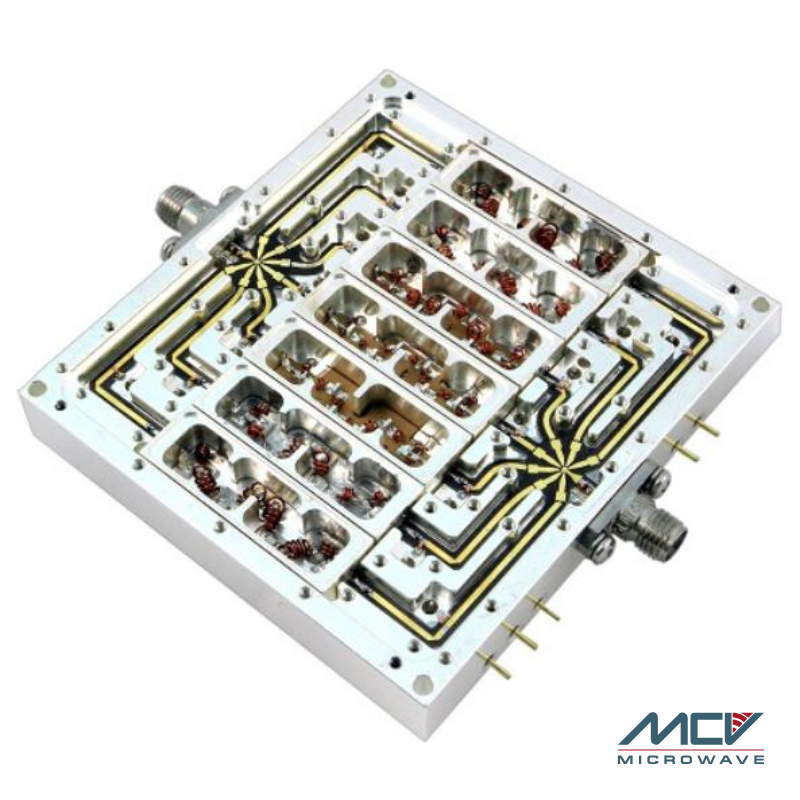
Switched Filter Banks by MCV Microwave
MCV Microwave switched filter banks offer either fast switching speeds with PIN diode switch, or low insertion loss with mechanical switch, with excellent isolation between channels and designed for reliability and performance.
Please send us your switched filter banks requirements today, and we will have a design and quote back to you very quickly.
FAQ about Switched Filter Banks
What is a switched filter bank?
A switched filter bank is a device that integrates multiple filters, typically bandpass, low pass, or high pass filters, into a single unit, using electronic switches to select the desired frequency path. This allows a system to operate across multiple bands with a single compact component.
How does a switched filter bank work?
It uses electronic switches (e.g., RF switches or relays) to direct the input signal to one of several bandpass, low-pass, or high-pass filters. Only one filter is typically active at a time, depending on the desired frequency band
What are the applications of switched filter banks?
They are widely used in:
-
Communications systems
-
Radar
-
Electronic warfare (EW)
-
Spectrum monitoring
-
Test and measurement equipment
Why use a switched filter bank instead of a tunable filter?
-
Faster switching between bands
-
Higher performance and selectivity
-
Reduced complexity compared to continuously tunable filters
-
Better isolation and out-of-band rejection
What types of filters are used in switched filter banks?
Common filter types include:
-
Bandpass filters
-
Low-pass filters
-
High-pass filters
-
Often custom-designed to match specific frequency bands and system requirements
What determines the switching speed of the filter bank?
Switching speed depends on:
-
Type of switching technology used (e.g., PIN diodes, MEMS, relays)
-
Control circuitry responsiveness
-
Typical speeds range from nanoseconds (RF switches) to milliseconds (mechanical relays)
Can multiple filters be active at the same time?
Typically, only one filter is active at a time, but advanced systems can allow parallel filtering using multiple signal paths or outputs, depending on the architecture.
How many channels or filters can a switched filter bank have?
There is no fixed limit. Common configurations range from 3 to 16 filters, but more can be implemented depending on:
-
System requirements
-
Space and cost constraints
-
Switch matrix complexity
What are the challenges in designing switched filter banks?
Design challenges include:
-
Maintaining signal integrity
-
Ensuring low insertion loss
-
Achieving high isolation between channels
-
Minimizing size and power consumption
-
Handling switching transients and RF leakage
What are the benefits of using switched filter banks?
Switched filter banks offer flexibility, space savings, and fast switching between frequency bands. They reduce the need for multiple discrete filters and are ideal for applications requiring agile frequency control, such as signal monitoring, communications, and electronic warfare.
What switching technologies are used in switched filter banks?
Common switching technologies include PIN diodes, relays, and solid-state switches. Each has trade-offs in terms of speed, power handling, insertion loss, and durability, depending on the application.
What frequency range do switched filter banks typically cover?
Switched filter banks are available in a wide range of frequencies—from below 10 MHz to 20 GHz or more—depending on the design and required filter types.
Can switched filter banks be used in both transmit and receive paths?
Yes, switched filter banks can be designed for receive-only, transmit-only, or bidirectional operation. Receive-path filter banks typically prioritize low insertion loss and noise performance, while transmit-path designs emphasize high power handling and robustness. Some systems use separate filter banks for TX and RX paths to optimize performance.
How do switched filter banks handle high-power signals?
High-power switched filter banks use robust switching technologies such as mechanical relays or high-power PIN diodes, along with filters designed for high current and voltage levels. Thermal management, power derating, and proper isolation are critical to prevent damage and maintain long-term reliability.
What control logic and fail-safe options are available?
Switched filter banks can be controlled via simple digital logic (TTL, GPIO) or advanced interfaces like SPI, Ethernet, or USB. Fail-safe designs may default to a known filter state during power loss or faults, which is especially important in safety-critical or military applications.
Do switched filter banks require calibration or tuning?
Most switched filter banks are factory-calibrated and do not require routine tuning. However, in high-frequency or precision applications, periodic verification may be needed to account for component aging, temperature effects, or mechanical drift, especially when using narrowband filters.
How scalable are switched filter banks for future frequency expansion?
Scalability depends on the switch matrix architecture and available physical space. Modular designs allow additional filter channels to be added later, while fixed architectures may limit expansion. Planning for future bands early in the design phase can reduce redesign costs.
What is the difference between a switched filter bank and a channelized filter bank?
A switched filter bank selects one filter path at a time using RF switches or relays, while a channelized filter bank processes multiple frequency channels simultaneously. Switched filter banks prioritize flexibility and compactness, whereas channelized architectures are designed for continuous multi-band monitoring and signal analysis.
Are switched filter banks suitable for 5G and wideband systems?
Yes. Switched filter banks are widely used in modern wideband RF systems, including 5G infrastructure, spectrum monitoring, and electronic warfare applications, where rapid band selection and high out-of-band rejection are required.
What isolation levels are typical in switched filter banks?
Isolation between channels typically ranges from 50 dB to over 80 dB depending on the switching technology, frequency range, and filter design. High isolation is critical to minimize signal leakage and prevent interference between inactive channels.
Can switched filter banks be remotely controlled?
Yes. Many switched filter banks support remote control interfaces such as Ethernet, USB, SPI, UART, or GPIO, allowing automated frequency selection and integration into software-defined or networked RF systems.
What are the trade-offs between relay-based and solid-state switched filter banks?
Relay-based filter banks typically offer lower insertion loss, higher isolation, and better power handling, but slower switching speeds. Solid-state switch designs provide much faster switching and longer operational life, though they may introduce higher insertion loss and lower isolation at some frequencies.
What key parameters should I consider when selecting a switched filter bank?
When selecting a switched filter bank, the right choice depends on your application’s requirements—especially frequency coverage, signal integrity, and switching performance. Here are the key parameters you should carefully evaluate:
1. Frequency Range
-
Definition: The total span of frequencies the filter bank must cover.
-
Why it matters: Ensures all desired channels/bands are within the filter bank’s capabilities.
-
Tip: Check both the start and stop frequency of each filter channel.
2. Number of Channels (Filters)
-
Definition: The number of distinct filters (paths) available.
-
Why it matters: More channels = more flexibility, but increases complexity, size, and cost.
-
Tip: Match the number of channels to the number of bands you need to access.
3. Bandwidth of Each Filter
-
Definition: The width (in Hz) of each filter’s passband.
-
Why it matters: Determines how much signal content can pass through each channel.
-
Tip: Ensure the bandwidth is wide enough for your signals but narrow enough to reject unwanted frequencies.
4. Insertion Loss
-
Definition: Signal loss (in dB) introduced by the filter bank path.
-
Why it matters: Lower insertion loss means better signal strength and system performance.
-
Typical Values: Ranges from 1–5 dB depending on design and components.
5. Return Loss (or VSWR)
-
Definition: A measure of impedance matching, typically in dB.
-
Why it matters: High return loss (or low VSWR) means less signal reflection and better power transfer.
-
Tip: Look for ≥ 14 dB return loss (VSWR < 1.5:1) for RF applications.
6. Switching Speed
-
Definition: Time it takes to switch from one filter to another.
-
Why it matters: Critical in fast-changing or real-time systems like radar, EW, or scanning receivers.
-
Range: From <1 µs (PIN diode/MEMS) to >10 ms (mechanical relays).
7. Isolation Between Channels
-
Definition: Degree to which one filter path is isolated from the others when not active.
-
Why it matters: Prevents signal leakage and interference between channels.
-
Typical Goal: ≥ 60 dB isolation for high-performance systems.
8. Power Handling
-
Definition: The maximum RF power the filter bank can safely handle.
-
Why it matters: Critical in transmit paths or high-power applications.
-
Units: Usually specified in watts (W) or dBm.
9. Control Interface
-
Definition: How the filter bank is switched or controlled (e.g., TTL, SPI, I2C, Ethernet).
-
Why it matters: Must be compatible with your system controller or automation requirements.
-
Tip: Some filter banks include microcontrollers or digital interfaces for remote control.
10. Physical Size and Packaging
-
Definition: Mechanical dimensions and form factor.
-
Why it matters: Affects integration into your system—especially in compact or airborne platforms.
-
Tip: Look for modular or custom-configurable packaging options if space is tight.
11. Environmental Specs
-
Definition: Operating temperature, vibration, shock, humidity, etc.
-
Why it matters: Especially critical for military, space, or outdoor deployments.
-
Tip: Look for compliance with MIL-STD-810, DO-160, or similar standards if needed.
How can I order Switched filter banks from MCV Microwave?
To place an order for switched filter banks please contact us and we will help you!