
Digital Attenuator
Engineered to precisely control signal amplitude, digital attenuators are essential components in RF systems requiring programmable or automated signal level adjustment. By allowing digital step control of attenuation, they offer superior accuracy, repeatability, and integration flexibility compared to fixed or manually adjustable attenuators.
Digital Attenuators by MCV
MCV digital attenuators are built for high-performance operation across a wide frequency range, delivering fine attenuation resolution, low insertion loss, and fast switching speeds. Available in various bit configurations and control interfaces, they are ideal for applications such as signal conditioning, automated test systems, and dynamic gain control in communication networks. Housed in robust, compact packages, MCV digital attenuators are designed to withstand demanding environments in telecommunications, aerospace, defense, and instrumentation systems.
- Wideband – Covers 600 to 6000 MHz
- Attenuation Values from 3 to 40 dB
- Low PIM Device, -160 dBc
- Weatherization to IP-67
- IBWave Supported
Connector Options Available
- 3-10.0 Female (Add -43F to Model Number)
- 3-10.0 Male (Add -43M to Model Number)
- 7/16 DIN Female (Add -DF to Model Number)
- 7/16 DIN Male (Add -DM to Model Number)
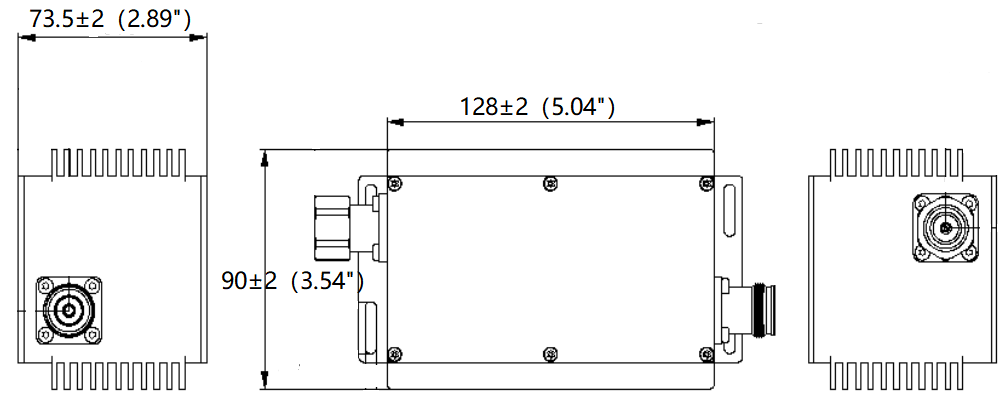
Outline Drawing AT Series Attenuators
FAQ about digital attenuators
What is a digital attenuator?
A digital attenuator is an electronic device that reduces (attenuates) the power level of a signal in discrete steps using digital control signals. It is commonly used in RF (radio frequency) and microwave systems to control signal strength precisely.
How does a digital attenuator work?
It operates by switching resistor networks, PIN diodes, or MMIC (monolithic microwave integrated circuit) components through digital logic signals—usually controlled via TTL, SPI, or parallel interfaces—to change the attenuation level in programmable steps.
What are the main applications of digital attenuators?
Digital attenuators are widely used in:
-
RF communication systems
-
Automatic gain control circuits
-
Test and measurement equipment
-
Radar systems
-
Wireless transmitters and receivers
What is the difference between a digital and an analog attenuator?
An analog attenuator provides continuous attenuation controlled by a variable voltage or mechanical adjustment, while a digital attenuator provides discrete attenuation steps controlled digitally, ensuring repeatable and programmable settings.
What are the common control interfaces for digital attenuators?
Typical interfaces include:
-
Parallel control (each bit corresponds to an attenuation step)
-
Serial interfaces such as SPI or I²C
-
TTL/CMOS logic for simple binary control
What is the typical attenuation range and step size?
The range depends on the model, but common values are:
-
Attenuation range: 0 to 31.5 dB or 0 to 63 dB
-
Step size: 0.25 dB, 0.5 dB, or 1 dB per bit
What factors affect the performance of a digital attenuator?
Key performance factors include:
-
Insertion loss
-
Return loss
-
Linearity (IP3)
-
Switching speed
-
Power handling capacity
-
Frequency range
What is insertion loss in a digital attenuator?
Insertion loss is the signal loss introduced by the attenuator when it is set to 0 dB attenuation. It represents the amount of power lost due to internal resistance and circuit components.
How fast can a digital attenuator switch between levels?
Switching speeds typically range from a few nanoseconds to a few microseconds, depending on the technology (e.g., PIN diode vs. MMIC-based designs).
What is attenuation accuracy in a digital attenuator?
Attenuation accuracy refers to how closely the actual attenuation matches the programmed value. High-precision digital attenuators maintain minimal error across all attenuation settings and operating frequencies.
What is attenuation resolution?
Attenuation resolution is the smallest change in attenuation the device can provide. For example, a digital attenuator with 0.5 dB resolution can adjust the signal level in 0.5 dB increments.
Can digital attenuators operate over wide frequency ranges?
Yes, many modern digital attenuators support broadband operation from MHz frequencies up to tens of GHz, depending on the design and semiconductor technology used.
Can multiple digital attenuators be cascaded together?
Yes, digital attenuators can be cascaded to achieve greater total attenuation or finer control resolution. However, designers must account for cumulative insertion loss, impedance matching, and signal degradation.
What happens to a digital attenuator during power loss?
The behavior depends on the device design. Some attenuators default to maximum attenuation for signal protection, while others retain the last programmed state or switch to a predefined safe setting.
How do you select the right digital attenuator for your application?
Consider the following parameters:
-
Frequency range
-
Attenuation range and step size
-
Power handling
-
Control interface type
-
Switching speed
-
Operating voltage and package type
Are MCV digital attenuators suitable for harsh environments?
Yes. MCV digital attenuators are built with ruggedized enclosures and are engineered for reliability in demanding applications such as aerospace, defense, and industrial systems. They maintain stable performance across wide temperature ranges and high-frequency operation.
How can I order digital attenuator from MCV Microwave?
To place an order for digital attenuator please contact us and we will help you!