
Fixed Attenuator
Designed to reduce signal power without distorting waveform integrity, fixed attenuators are essential passive components in RF systems. They provide precise and consistent attenuation levels, enabling proper signal level control, impedance matching, and protection of sensitive components from overpower conditions.
Fixed Attenuators by MCV
MCV fixed attenuators are engineered for dependable performance across a broad frequency range. Available in a variety of attenuation values and connector configurations, they are ideal for use in test and measurement environments, wireless communication systems, defense electronics, and broadcasting applications. Housed in durable, ruggedized enclosures, MCV attenuators offer high reliability and consistent attenuation in even the most demanding RF conditions.
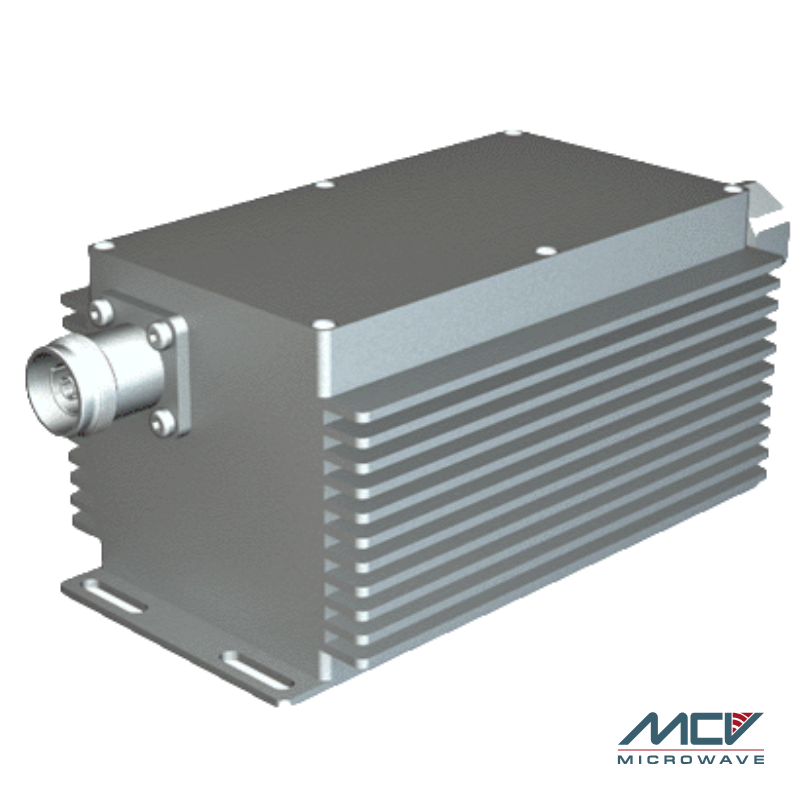
- Wideband – Covers 600 to 6000 MHz
- Attenuation Values from 3 to 40 dB
- Low PIM Device, -160 dBc
- Weatherization to IP-67
- IBWave Supported
Connector Options Available
- 3-10.0 Female (Add -43F to Model Number)
- 3-10.0 Male (Add -43M to Model Number)
- 7/16 DIN Female (Add -DF to Model Number)
- 7/16 DIN Male (Add -DM to Model Number)
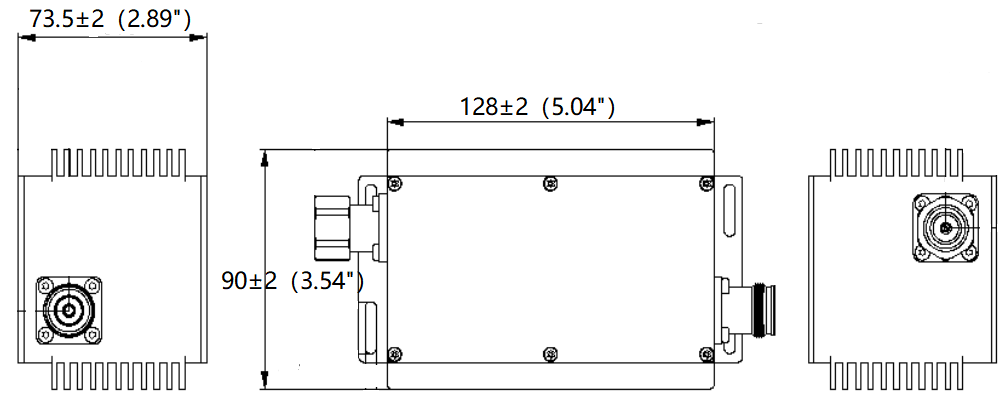
Outline Drawing AT Series Attenuators
FAQ about fixed attenuators
What is a fixed attenuator?
A fixed attenuator is a passive electronic device designed to reduce the power level of a signal by a specific, unchangeable amount. It helps control signal strength in RF, microwave, or optical systems.
How does a fixed attenuator work?
It works by introducing a known resistance network that dissipates part of the signal’s energy, resulting in a predictable decrease (attenuation) in signal amplitude or power.
What are the typical applications of fixed attenuators?
Common uses include:
-
Matching impedance between circuits
-
Protecting sensitive components from high signal levels
-
Calibrating measurement equipment
-
Improving signal-to-noise ratio in systems
How is attenuation measured?
Attenuation is measured in decibels (dB), representing the logarithmic ratio of input power to output power. Typical values range from 1 dB to 30 dB or higher.
What are the main types of fixed attenuators?
They come in several formats, such as:
-
Coaxial fixed attenuators (for RF/microwave use)
-
Waveguide attenuators
-
Optical fixed attenuators (for fiber optic systems)
-
SMD or chip attenuators (for PCB applications)
What frequency ranges can fixed attenuators handle?
Depending on the design and connector type, they can operate from DC up to 110 GHz or more in high-frequency microwave systems.
How do I choose the right fixed attenuator?
Consider:
-
Desired attenuation value (in dB)
-
Frequency range
-
Power handling capability
-
Impedance (typically 50 Ω or 75 Ω)
-
Connector type and physical size
What materials are used in fixed attenuators?
They typically use resistive elements made from thin-film, thick-film, or metal film materials, enclosed in housings made of brass, stainless steel, or aluminum for durability and RF shielding.
What is the difference between a fixed and variable attenuator?
A fixed attenuator provides a constant level of signal reduction, while a variable attenuator allows the user to adjust attenuation as needed—either manually or electronically.
Can fixed attenuators handle high power levels?
Yes, certain models are designed for high-power applications (tens or hundreds of watts). However, always check the power rating to prevent overheating or damage.
What impedance values are most common for fixed attenuators?
The most common impedance values are 50 Ω and 75 Ω.
50 Ω attenuators are widely used in RF and microwave systems, while 75 Ω versions are common in video, broadcast, and CATV applications.
Can fixed attenuators be used in both directions?
Yes, fixed attenuators are typically bidirectional and can be installed in either direction without affecting performance, as long as the connectors match and the rated power and frequency specifications are observed.
Do fixed attenuators affect signal quality?
A properly designed fixed attenuator minimizes signal reflections and distortion while maintaining impedance matching. However, excessive attenuation can reduce signal strength below usable levels, especially in low-power systems.
What connectors are available for coaxial fixed attenuators?
Common connector types include SMA, N-type, BNC, TNC, 2.92 mm, and 2.4 mm connectors. The choice depends on the operating frequency, power level, and application requirements.
Can fixed attenuators be used outdoors or in harsh environments?
Yes, many fixed attenuators are designed for rugged environments and feature weather-resistant housings, corrosion-resistant materials, and wide operating temperature ranges for outdoor or industrial use.
Why is VSWR important in a fixed attenuator?
Voltage Standing Wave Ratio (VSWR) indicates how well the attenuator matches the system impedance. A low VSWR helps minimize signal reflections and ensures efficient signal transmission in RF and microwave systems.
How can I order fixed attenuator from MCV Microwave?
To place an order for fixed attenuator please contact us and we will help you!