
Receive Filters
Receive filters are precision RF components designed to block unwanted signals and noise while allowing only the desired frequency band to pass through to a receiver. By improving selectivity and reducing interference from adjacent or strong out-of-band signals, receive filters play a critical role in protecting sensitive receiver front-ends and maintaining clear, accurate signal reception.
- Provide Interference Rejection
- Small, cost-effective packaging
- Outdoor and indoor configurations
- Use for Spectrum Clearing
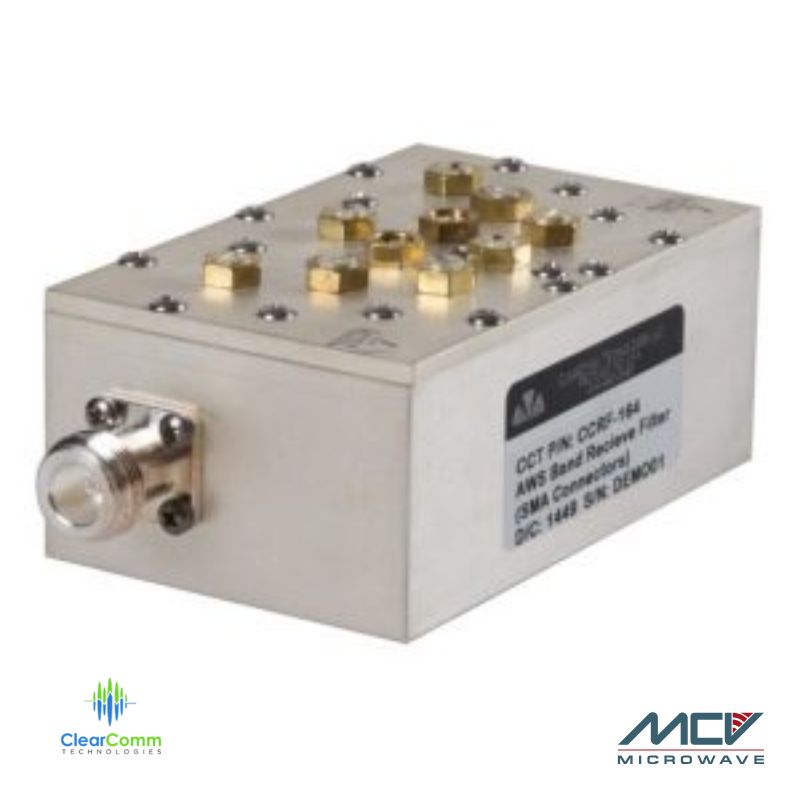
ClearComm Receive Filters (Uplink) by MCV
ClearComm receive filters by MCV are engineered for high-performance signal conditioning, offering low insertion loss, sharp skirt selectivity, and high out-of-band rejection. Available in various topologies including cavity, ceramic, and LC designs, our receive filters are built to support mission-critical applications in defense, aerospace, wireless infrastructure, satellite communication, and industrial RF systems.
Ruggedized for harsh environments and available in surface mount or connectorized formats, MCV receive filters ensure dependable performance and signal clarity where it matters most.
Receive Filter models and band types
FAQ about receive filters
What is an RF Receive Filter?
An RF receive filter is an electronic component or circuit used in RF receivers to allow only desired frequency bands to pass through while rejecting unwanted signals or interference.
Why is an RF Receive Filter important in communication systems?
It helps improve signal quality and receiver performance by:
-
Reducing noise and interference.
-
Preventing adjacent channel interference.
-
Enhancing selectivity of the receiver.
How does an RF Receive Filter work?
It operates by using resonant circuits (like LC filters, SAW filters, or cavity filters) to pass signals within a specific frequency range and attenuate signals outside of that range (stopband).
What types of RF Receive Filters are commonly used?
Common types include:
-
Bandpass filters – pass a specific frequency range.
-
Low-pass filters – pass frequencies below a cutoff.
-
High-pass filters – pass frequencies above a cutoff.
-
Notch filters – reject a narrow frequency band.
-
SAW filters (Surface Acoustic Wave) – used for high-frequency precision filtering.
Where are RF Receive Filters used?
They are used in a variety of RF systems, including:
-
Radios (AM/FM, shortwave)
-
Mobile phones
-
Satellite receivers
-
Radar systems
-
Wireless communication devices (Wi-Fi, Bluetooth, etc.)
How is an RF Receive Filter different from a Transmit Filter?
-
A Receive Filter cleans the signal coming into the receiver by rejecting unwanted frequencies.
-
A Transmit Filter ensures that the outgoing signal does not include unwanted harmonics or out-of-band emissions.
What are the key performance parameters of an RF Receive Filter?
Important parameters include:
-
Center frequency
-
Bandwidth
-
Insertion loss
-
Rejection (attenuation)
-
Return loss
-
Group delay
Can RF Receive Filters be tuned?
Yes, some filters are tunable or programmable, especially in software-defined radios (SDRs) or advanced RF systems. Others are fixed and designed for a specific frequency band.
How does an RF Receive Filter improve receiver sensitivity?
By rejecting unwanted signals and out-of-band noise before they reach the receiver front end, an RF receive filter helps prevent receiver desensitization. This allows the receiver to better detect weak desired signals, improving overall system performance.
What is a preselector filter?
A preselector filter is an RF receive filter placed at the front end of a receiver to limit the range of frequencies entering the system. It helps protect the receiver from strong off-frequency signals and improves selectivity in congested RF environments.
Can RF Receive Filters help reduce interference from nearby transmitters?
Yes. RF receive filters are commonly used to suppress interference from nearby transmitters operating on adjacent or unrelated frequencies. This is especially important in co-located communication sites where multiple radios, repeaters, or cellular systems operate in close proximity.
Are RF Receive Filters suitable for outdoor and harsh environments?
Many RF receive filters are designed for demanding environments and can be supplied with weather-resistant housings, corrosion-resistant materials, and wide operating temperature ranges. Environmental specifications should be reviewed when selecting a filter for outdoor or mission-critical applications.
Can RF Receive Filters be customized for specific frequency requirements?
Yes. RF receive filters can be custom-designed to meet specific frequency ranges, bandwidths, rejection levels, insertion loss requirements, and environmental conditions. Custom solutions are often used in public safety, military, broadcast, and wireless infrastructure applications.
What is insertion loss and why does it matter in RF Receive Filters?
Insertion loss is the amount of signal power lost when the filter is inserted into the signal path. Lower insertion loss is critical because excessive loss can weaken the received signal and reduce overall system sensitivity.
What is selectivity in an RF Receive Filter?
Selectivity refers to the filter’s ability to distinguish between desired signals and nearby unwanted frequencies. Higher selectivity means better rejection of adjacent channel interference, which is especially important in crowded RF environments.
Can multiple RF Receive Filters be used together in a system?
Yes, filters are often cascaded to achieve better performance. For example, a wideband preselector may be followed by a narrowband filter to improve overall rejection and selectivity.
How does group delay affect RF Receive Filter performance?
Group delay measures how different frequency components are delayed as they pass through the filter. Variations in group delay can distort signals, which is particularly important in high-speed data and modulation-sensitive systems.
What is the difference between passive and active RF filters?
Passive RF filters use components like inductors and capacitors and do not require power. Active filters include amplifying components (such as transistors or op-amps), can provide gain, and are often used at lower frequencies or in integrated designs.
What causes poor performance in an RF Receive Filter?
Common issues include:
-
Component aging or drift
-
Physical damage or misalignment
-
Poor shielding or grounding
-
Incorrect filter design for the application
How do I choose the right RF Receive Filter for my system?
Consider the following:
-
Operating frequency and required bandwidth
-
Adjacent channel interference levels
-
Insertion loss tolerance
-
Physical size and cost constraints
-
Environmental conditions (temperature, vibration, etc.)
What makes MCV's ClearComm receive filters unique?
MCV’s ClearComm receive filters are optimized for low insertion loss, high rejection, and rugged reliability, making them ideal for demanding environments that require consistent and high-quality signal reception.
How can I order ClearComm receive filters from MCV Microwave?
To place an order for ClearComm receive filters or any other RF products please contact us and we will help you!