
Low PIM Duplexers
Low PIM cavity filters are often used in cellular networks where Passive InterModulation (PIM) caused by multiple transmit frequencies result in undesirable RF emissions. MCV low PIM filters typically achieve PIM performance of -163 dBc. For test bench and more demanding applications, an even lower PIM of -173 dBc is available. Low PIM duplexers are essential for high-performance RF systems where signal integrity and clarity are critical.
Low PIM Duplexers by MCV
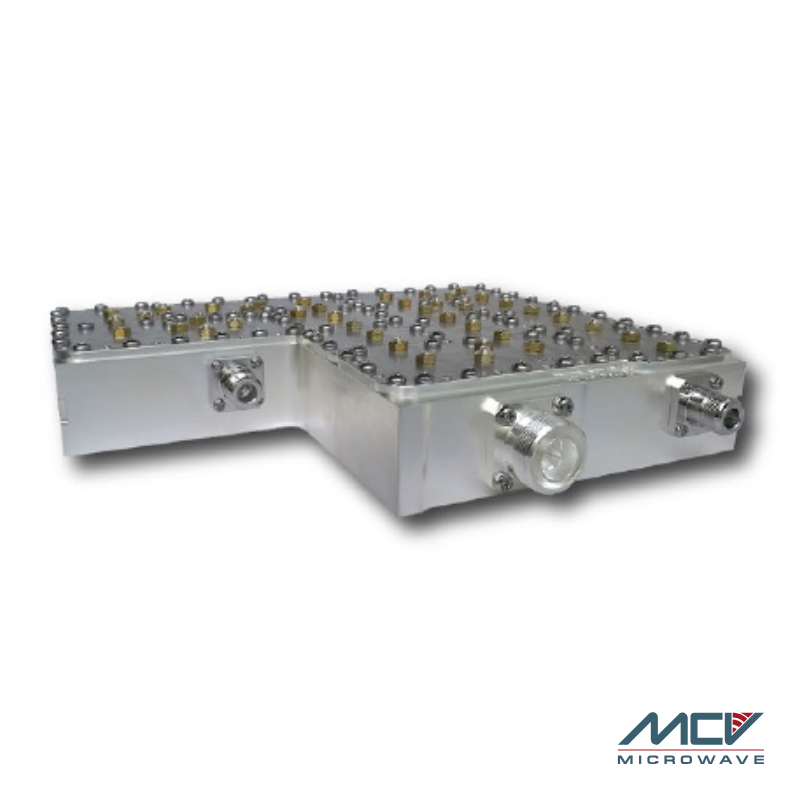
MCV Low PIM duplexers are designed for demanding environments, offering exceptional electrical performance with superior isolation and low insertion loss. Optimized for use in distributed antenna systems (DAS), wireless infrastructure, and public safety networks, they are available in robust connectorized packages to meet the mechanical and electrical demands of mission-critical applications.
| wdt_ID | Part Number | Low Band Frequency Range | Low Band Insertion Loss | Low Band Ripple | Low Band Return Loss | Low Band Attenuation | High Band Frequency Range | High Band Insertion Loss | High Band Ripple | High Band Return Loss | High Band Attenuation | Input Power (W) (can drop) | Dimensions (mm) | PIM number (dBc) and test condition | Connectors | Keep this part? | Data sheet exists? | Band type |
|---|---|---|---|---|---|---|---|---|---|---|---|---|---|---|---|---|---|---|
| 1 | DCCM1732-2132-45A1 | 1710~1755 | 1.50 | 1 | 20 | 95 @ 2110~2155 | 2110~2155 | 1.50 | 1 | 20 | 110 @ 1710~1755 | 200 | 290x145x56 | 170 min, (2 tones 43 dBm) | 7/16 DIN @ com Port, N-female @ TX/RX Ports | Y | LTE band-4 | |
| 2 | DCCM1747-1842-75B1 | 1710~1785 | 1.50 | 20 | 95 @ 1805~1880 | 1805~1880 | 1.50 | 20 | 110 @ 1710~1785 | 200 | 325.0x145.0x56.0 | 170 min, (2 tones 43 dBm) | DIN, N | Y | LTE band-3 | |||
| 3 | DCCM1747-1842-75C1 | 1710~1785 | 1.50 | 20 | 91 @ 1805~1880 | 1805~1880 | 1.50 | 20 | 91 @ 1710~1785 | 200 | 255.0x170.0x55.0 | 170 min, (2 tones 43 dBm) | 7/16 DIN @ com Port, N-female @ TX/RX Ports | Y | LTE band-3 | |||
| 4 | DCCM1747-1842-75C2 | 1710~1785 | 1.00 | 20 | 90 @ 1805~1880 | 1805~1880 | 1.00 | 20 | 90 @ 1710~1785 | 200 | 255.0x170.0x55.0 | 173 min, (2 tones 43 dBm) | 7/16 DIN @ com Port, N-female @ TX/RX Ports | Y | LTE Band-3 | |||
| 5 | DCCM1747-1842-75C2-N | 1710~1785 | 1.00 | 18 | 90 @ 1805~1880 | 1805~1880 | 1.00 | 18 | 90 @ 1710~1785 | 150 | 236.0x168.0x45.0 | - | N-female all ports | Y | LTE Band-3 | |||
| 6 | DCCM1747-1842-75C3 | 1710~1785 | 1.00 | 18 | 90 @ 1805~1880 | 1805~1880 | 1.00 | 18 | 90 @ 1710~1785 | 100 | 236.0x168.0x45.0 | - | SMA-female all ports | Y | LTE Band-3 | |||
| 7 | DCCM1747-1842-75F1 | 1710~1785 | 1.50 | 18 | 95 @ 1805~1880 | 1805~1880 | 1.50 | 18 | 110 @ 1710~1785 | 150 | 235x137x48 | 170 min, 173 typ in Rx band, Ant port, (2 tones 43 dBm) | 7/16 DIN female @ Ant Port, N-female @ TX/RX Ports | Y | LTE Band-3 | |||
| 8 | DCCM1880-1960-60C1 | 1850~1910 | 1.00 | 1 | 20 | 90 @ 1930~1990 | 1930~1990 | 1.00 | 1 | 20 | 90 @ 1850~1910 | 200 | 255x170x55 | 170 min, (2 tones 43 dBm) | 7/16 DIN @ com Port, N-female @ TX/RX Ports | Y | LTE band-2 | |
| 9 | DCCM1882-1962-65A1 | 1850~1915 | 1.50 | 1 | 20 | 90 @ 1930~1995 | 1930~1995 | 1.50 | 1 | 20 | 90 @ 1850~1915 | 200 | 255x170x55 | 170 min, (2 tones 43 dBm) | 7/16 DIN @ com Port, N-female @ TX/RX Ports | Y | LTE band-25 | |
| 10 | DCCM1950-2140-60C1 | 1920~1980 | 1.50 | 1 | 20 | 90 @ 2110~2170 | 2110~2170 | 1.50 | 1 | 20 | 90 @ 1920~1980 | 200 | 255x170x55 | 170 min, (2 tones 43 dBm) | 7/16 DIN @ com Port, N-female @ TX/RX Ports | Y | LTE band-1 | |
| 11 | DCCM1950-2140-60D1 | 1920~1980 | 0.40 | 0 | 20 | 91 @ 2110~2170 | 2110~2170 | 0.40 | 0 | 20 | 91 @ 1920~1980 | 50 | 146.0x111.0x45.0 | 160 min, (2 tones 43 dBm) | DIN, N | Y | LTE band-1 | |
| 12 | DCCM1950-2140-60E1 | 1920~1980 | 1.50 | 1 | 20 | 95 @ 2110~2170 | 2110~2170 | 1.50 | 1 | 20 | 95 @ 1920~1980 | 50 | 262.0x118.0x46.0 | 123 min, (2 tones 43 dBm) | SMA | Y | LTE band-1 | |
| 13 | DCCM2000-2140-160A1 | 1920~2080 | 1.50 | 18 | 95 @ 2110~2170 | 2110~2170 | 1.50 | 18 | 110 @ 1920~2080 | 150 | 235x137x48 | 170 min, 173 typ in Rx band, Ant port, (2 tones 43 dBm) | 7/16 DIN female @ Ant Port, N-female @ TX/RX Ports | Y | LTE band-65 | |||
| 14 | DCCM2010-2021-0A1 | 2010 | 5.00 | 1 | 20 | 90 @ 2017.5~2025 | 2017.5~2025 | 2.00 | 1 | 20 | 90 @ 2010 | 100 | 255x155x52 | 165 min, (2 tones 43 dBm) | 7/16 DIN @ com Port, N-female @ TX/RX Ports | Y | LTE band-34 | |
| 15 | DCCM2535-2655-70A1 | 2500~2570 | 1.00 | 1 | 20 | 90 @ 2620~2690 | 2620~2690 | 1.00 | 1 | 20 | 90 @ 2500~2570 | 200 | 213x170x52 | 168 min, (2 tones 43 dBm) | 7/16 DIN @ com Port, N-female @ TX/RX Ports | Y | LTE band-7 | |
| 16 | DCCM3450-3552-80A1 | 3410~3490 | 2.00 | 20 | 90 @ 3510~3594 | 3510~3594 | 2.00 | 20 | 90 @ 3410~3490 | 200 | 255x170x55 | 168 min, 171 typ in Rx band, Ant port, (2 tones 43 dBm) | 7/16 DIN female @ Ant Port, N-female @ TX/RX Ports | Y | UMTS band-22 | |||
| 17 | DCCM3650-3750-80A1 | 3610~3690 | 2.00 | 18 | 95 @ 3710~3790 | 3710~3790 | 2.00 | 18 | 110 @ 2610~3690 | 150 | 235x137x48 | 170 min, 173 typ in Rx band, Ant port, (2 tones 43 dBm) | 7/16 DIN female @ Ant Port, N-female @ TX/RX Ports | Y | TD band-43 | |||
| 18 | DCCM3800-4700-800A1 | 3400~4200 | 1.00 | 18 | 90 @ 4400~5000 | 4400~5000 | 1.00 | 18 | 90 @ 3400~4200 | 200 | 210x135x48 | 170 min, 173 typ in Rx band, Ant port, (2 tones 43 dBm) | 7/16 DIN female all ports | Y | NR n77/n79 | |||
| 19 | DCCM3850-3950-80A1 | 3810~3890 | 2.00 | 18 | 95 @ 3910~3990 | 3910~3990 | 2.00 | 18 | 110 @ 3810~3890 | 150 | 235x137x48 | 170 min, 173 typ in Rx band, Ant port, (2 tones 43 dBm) | 7/16 DIN female @ Ant Port, N-female @ TX/RX Ports | Y | C-band | |||
| 20 | DCCM4522-4592-45A1 | 4500~4545 | 2.00 | 18 | 95 @ 4656~4620 | 4565~4620 | 2.00 | 18 | 110 @ 4500~4545 | 150 | 235x237x48 | 170 min, 173 typ in Rx band, Ant port, (2 tones 43 dBm) | 7/16 DIN female @ Ant Port, N-female @ TX/RX Ports | Y | C-band | |||
| 21 | DCCM453-463-6A1 | 450~455.75 | 1.60 | 20 | 90 @ 460~465.75 | 460~465.75 | 1.60 | 20 | 90 @ 450~455.75 | 200 | 314.0x314.0x95.0 | 168 min, (2 tones 43 dBm) | DIN, N | Y | LTE band-31 | |||
| 22 | DCCM454-466-8A1 | 450~458 | 1.60 | 20 | 90 @ 462~470 | 462~470 | 1.60 | 20 | 90 @ 450~458 | 200 | 314.0x314.0x90.0 | 168 min, (2 tones 43 dBm) | DIN, N | Y | LTE band-31 | |||
| 23 | DCCM4822-2892-45A1 | 4800~4845 | 2.00 | 18 | 95 @ 4865~4920 | 4865~4920 | 2.00 | 18 | 110 @ 4800~4845 | 150 | 235x137x48 | 170 min, 173 typ in Rx band, Ant port, (2 tones 43 dBm) | 7/16 DIN female @ Ant Port, N-female @ TX/RX Ports | Y | C-band | |||
| 24 | DCCM634-680-35A1 | 617~652 | 1.50 | 20 | 110 @ 663~698 | 663~698 | 1.50 | 20 | 90 @ 617~652 | 200 | 295x198x85 | 173 min, (2 tones 43 dBm) | Y | LTE band-71 | ||||
| 25 | DCCM710-740-12A1 | 704~716 | 1.50 | 5 | 23 | 110 @ 734~746 | 734~746 | 1.50 | 1 | 23 | 110 @ 704~716 | 20 | 238.0x145.0x55.0 | 170 min, (2 tones 43 dBm) | 7/16 DIN @ com Port, N-female @ TX/RX Ports | Y | LTE band-17 | |
| 26 | DCCM751-782-10A1 | 746~756 | 1.50 | 1 | 20 | 100 @ 777~787 | 777~787 | 1.50 | 1 | 20 | 95 @ 746~756 | 200 | 282x190x55 | 170 min, (2 tones 43 dBm) | 7/16 DIN @ com Port, N-female @ TX/RX Ports | Y | LTE band-13 | |
| 27 | DCCM763-793-10A1 | 758~768 | 1.00 | 1 | 20 | 85 @ 788~798 | 788~798 | 1.00 | 1 | 20 | 85 @ 758~768 | 150 | 190x145x56 | 170 min, (2 tones 43 dBm) | 7/16 DIN @ com Port, N-female @ TX/RX Ports | Convert | Y | LTE band-14 |
| 28 | DCCM806-847-30A1 | 791~821 | 1.50 | 1 | 20 | 110 @ 832~862 | 832~862 | 1.50 | 1 | 20 | 95 @ 791~821 | 200 | 325x145x56 | 173 typ, 170 min (2 tones 43 dBm) | 7/16 DIN @ com Port, N-female @ TX/RX Ports | Y | LTE band-20 | |
| 29 | DCCM806-847-30C1 | 791~821 | 1.20 | 1 | 20 | 90 @ 832~862 | 832~862 | 1.20 | 1 | 20 | 90 @ 791~821 | 200 | 255x170x76 | 168 min (2 tones 43 dBm) | 7/16 DIN @ com Port, N-female @ TX/RX Ports | Y | LTE band-20 | |
| 30 | DCCM822-867-15A1 | 815~830 | 1.20 | 1 | 20 | 95 @ 860~875 | 860~875 | 1.20 | 1 | 20 | 100 @ 815~830 | 200 | 282x222x55 | 170 min, (2 tones 43 dBm) | 7/16 DIN @ com Port, N-female @ TX/RX Ports | Y | LTE band-18 | |
| 31 | DCCM822-867-15B1 | 815~830 | 1.00 | 1 | 20 | 90 @ 860~875 | 860~875 | 1.00 | 1 | 20 | 90 @ 815~830 | 200 | 255x170x76 | 170 min, (2 tones 43 dBm) | 7/16 DIN @ com Port, N-female @ TX/RX Ports | Y | LTE band-18 | |
| 32 | DCCM836-881-25B2 | 824~849 | 1.50 | 1 | 20 | 90 @ 869~894 | 869~894 | 1.80 | 1 | 20 | 120 @ 824~849 | 200 | 325x145x56 | 170 min, (2 tones 43 dBm) | 7/16 DIN @ com Port, N-female @ TX/RX Ports | Y | LTE band-5 | |
| 33 | DCCM836-881-25C1 | 824~849 | 1.00 | 1 | 20 | 90 @ 869~894 | 869~894 | 1.00 | 1 | 20 | 90 @ 824~849 | 200 | 255x170x76 | 170 min, (2 tones 43 dBm) | 7/16 DIN @ com Port, N-female @ TX/RX Ports | Y | LTE band-5 | |
| 34 | DCCM837-882-15A1 | 830~845 | 1.50 | 1 | 20 | 95 @ 875~890 | 875~890 | 1.50 | 1 | 20 | 100 @ 830~845 | 200 | 282x222x56 | 170 min, (2 tones 43 dBm) | 7/16 DIN @ com Port, N-female @ TX/RX Ports | Y | LTE band-19 | |
| 35 | DCCM837-882-15B1 | 830~845 | 1.00 | 1 | 20 | 90 @ 875~890 | 875~890 | 1.00 | 1 | 20 | 90 @ 830~845 | 200 | 255x170x76 | 170 min, (2 tones 43 dBm) | 7/16 DIN @ com Port, N-female @ TX/RX Ports | Y | LTE band-19 | |
| 36 | DCCM897-942-35A1 | 880~915 | 1.50 | 1 | 20 | 95 @ 925~960 | 925~960 | 1.50 | 1 | 20 | 100 @ 880~915 | 200 | 282x222x56 | 170 min | 7/16 DIN @ com Port, N-female @ TX/RX Ports | Y | LTE band-8 | |
| 37 | DCCM897-942-35B1 | 880~915 | 1.50 | 1 | 20 | 95 @ 925~960 | 925~960 | 1.50 | 1 | 20 | 110 @ 880~915 | 200 | 325x145x56 | 170 min | 7/16 DIN @ com Port, N-female @ TX/RX Ports | Y | Low PIM LTE | |
| 38 | DCCM897-942-35C1 | 880~915 | 1.00 | 1 | 20 | 90 @ 925~960 | 925~960 | 1.00 | 1 | 20 | 90 @ 880~915 | 200 | 255x170x76 | 170 min | 7/16 DIN @ com Port, N-female @ TX/RX Ports | Y | LTE band-8 |
FAQ about Low PIM Duplexers
What is a Low PIM duplexer?
A Low PIM duplexer is a type of duplexer specifically designed to have very low Passive Intermodulation (PIM). This helps maintain signal quality by preventing unwanted mixing of signals that can cause interference and degrade system performance.
What does PIM mean in RF systems?
PIM (Passive Intermodulation) refers to the generation of unwanted signals when two or more high-power signals mix in passive components (like connectors or cables), producing spurious frequencies that can interfere with the receiver.
Why is Low PIM important in duplexers?
Low PIM is essential in duplexers because:
-
It prevents intermodulation distortion in the receive path
-
It protects signal integrity
-
It is critical in high-density, high-power, or shared-antenna systems like cellular networks, DAS (Distributed Antenna Systems), and public safety systems
Where are Low PIM duplexers commonly used?
They are widely used in:
-
Cellular base stations (e.g., LTE, 5G)
-
Distributed Antenna Systems (DAS)
-
Public safety and emergency communications
-
In-building RF systems
-
High-performance wireless networks
What causes high PIM in a duplexer?
High PIM is often caused by:
-
Poor-quality materials
-
Loose or corroded connectors
-
Ferromagnetic metals (e.g., steel) in the signal path
-
Contaminants or oxidation
-
Mechanical stress at contact points
What are typical PIM performance levels for a Low PIM duplexer?
Low PIM duplexers are typically rated for:
-
−140 dBc or better (at two 43 dBm tones)
-
The lower the dBc value, the better the PIM performance
-
−150 dBc or better is ideal for modern networks
How is PIM measured in duplexers?
PIM is measured using a PIM analyzer, which injects two high-power tones and measures the resulting 3rd, 5th, or higher-order intermodulation products. Units are expressed in dBc (decibels below carrier).
What materials are used in Low PIM duplexers?
To reduce PIM, high-quality materials are used:
-
Silver- or gold-plated connectors
-
Aluminum or brass housings (non-ferromagnetic)
-
Teflon or PTFE insulators
-
Carefully designed mechanical interfaces to prevent micro-arcing or loose contacts
What happens if I use a high PIM duplexer in a low-PIM system?
Using a high-PIM duplexer can:
-
Introduce noise and interference
-
Degrade signal-to-noise ratio (SNR)
-
Cause dropped calls, reduced throughput, or failed connections
-
Be non-compliant with carrier-grade performance requirements
How do I ensure my system maintains Low PIM performance?
-
Use certified Low PIM components (duplexers, cables, connectors)
-
Ensure clean, tight, and corrosion-free connections
-
Avoid using ferromagnetic materials
-
Perform regular PIM testing and maintenance
-
Install equipment carefully to avoid mechanical stress or bending
How does installation affect the PIM performance of a Low PIM duplexer?
Installation quality has a major impact on PIM. Incorrect torque, misaligned connectors, over-tightening, or mechanical stress can introduce micro-gaps and nonlinear contact points, significantly increasing PIM even in certified Low PIM duplexers.
Why can field PIM performance differ from laboratory specifications?
Laboratory PIM measurements are taken under controlled conditions. In the field, factors such as cable routing, temperature changes, vibration, contamination, and connector wear can degrade PIM performance, resulting in higher real-world PIM levels.
How does connector torque influence PIM levels?
Improper torque can cause poor metal-to-metal contact or mechanical deformation, both of which increase PIM. Always use calibrated torque wrenches and follow manufacturer torque specifications to maintain Low PIM performance.
Do Low PIM duplexers degrade over time?
Yes, PIM performance can degrade due to connector wear, oxidation, thermal cycling, and mechanical movement. Regular inspection, cleaning, and periodic PIM testing help ensure long-term system performance.
What is the difference between Low PIM duplexers and Low PIM filters?
A Low PIM duplexer separates transmit and receive paths on a single antenna, while a Low PIM filter is typically used to suppress specific unwanted frequencies. Both must meet Low PIM standards, but duplexers require especially high isolation and mechanical stability due to simultaneous high-power TX and sensitive RX paths.
Can Low PIM duplexers be used outdoors?
Yes. Many Low PIM duplexers are specifically designed for outdoor installations such as cellular towers, rooftop systems, and DAS networks. Outdoor-rated models typically feature weather-resistant housings, corrosion-resistant materials, and IP-rated sealing to withstand moisture, temperature changes, and harsh environmental conditions.
Can cable quality affect duplexer PIM performance?
Yes. Even if the duplexer itself has excellent Low PIM performance, poor-quality coaxial cables or damaged connectors can introduce significant PIM into the system. All RF components in the signal chain must be Low PIM rated to maintain optimal overall performance.
Are Low PIM duplexers required for 5G systems?
In most high-performance 5G deployments, Low PIM duplexers are strongly recommended or required. 5G networks use higher bandwidths, denser antenna systems, and more sensitive receivers, making them especially vulnerable to interference caused by passive intermodulation.
How often should Low PIM testing be performed?
PIM testing should typically be performed:
- During initial installation
- After maintenance or cable replacement
- After severe weather or mechanical impact
- During periodic network maintenance
Carrier-grade systems often include scheduled PIM testing to ensure ongoing network reliability and compliance.
What connector types are commonly used with Low PIM duplexers?
Common connector types include:
- 4.3-10
- 7/16 DIN
- N-Type (Low PIM versions)
Among these, 4.3-10 and 7/16 DIN connectors are widely preferred in modern cellular and DAS systems because they provide excellent PIM performance, mechanical stability, and high-power handling.
What key parameters should I consider when selecting a Low PIM duplexer?
When selecting a Low PIM duplexer, it’s crucial to focus on both RF performance and PIM characteristics, especially for high-reliability or carrier-grade systems like LTE, 5G, DAS, or public safety. Here are the key parameters to consider:
1. PIM Performance (Passive Intermodulation)
-
Definition: Measurement of unwanted intermodulation products (usually 3rd order) generated by passive components.
-
What to look for:
-
PIM rating of –140 dBc or better (at 2 x 43 dBm test tones)
-
–150 dBc or better for critical applications like DAS or 5G
-
-
Why it matters: High PIM levels degrade receiver sensitivity, causing dropped connections and lower throughput.
2. Frequency Range (TX and RX Bands)
-
Definition: The operating frequency bands the duplexer is designed to work with.
-
What to look for:
-
Duplexers tuned to your exact uplink and downlink frequencies (e.g., LTE Band 5, Band 12, etc.)
-
-
Why it matters: Mismatch can lead to increased insertion loss and poor isolation.
3. Bandwidth
-
Definition: The range of frequencies the duplexer can handle within each port (TX and RX).
-
What to look for:
-
Adequate bandwidth to cover your frequency allocations (e.g., 75 MHz for some LTE bands)
-
-
Why it matters: Too narrow a bandwidth can block or distort parts of your signal.
4. Insertion Loss
-
Definition: The signal loss introduced by the duplexer in each path (TX and RX).
-
What to look for:
-
Low insertion loss (<1.5 dB typical for high-quality Low PIM duplexers)
-
-
Why it matters: Lower insertion loss means stronger signals and better system efficiency.
5. Isolation (TX-to-RX)
-
Definition: How well the duplexer separates the transmit and receive paths.
-
What to look for:
-
High isolation, typically ≥ 50 dB
-
-
Why it matters: Prevents TX signal from leaking into RX path and overloading the receiver.
6. Return Loss / VSWR
-
Definition: Indicates how well the duplexer matches the system impedance (usually 50 ohms).
-
What to look for:
-
Return Loss > 18 dB or VSWR < 1.3:1
-
-
Why it matters: Good impedance matching minimizes signal reflections and power loss.
7. Power Handling
-
Definition: Maximum RF power the duplexer can safely handle.
-
What to look for:
-
Ratings like 100W, 200W, or higher, depending on your system
-
-
Why it matters: Prevents component overheating or failure under high transmission power.
8. Connectors and Materials
-
Definition: Connector type and material quality, which affect both performance and PIM.
-
What to look for:
-
Low PIM-rated connectors (e.g., DIN 7/16, 4.3-10)
-
Non-ferromagnetic materials (e.g., brass, aluminum, silver-plated contacts)
-
-
Why it matters: Poor materials or bad connectors are major sources of PIM.
9. Environmental Robustness
-
Definition: Ability to operate under temperature changes, humidity, and mechanical stress.
-
What to look for:
-
Operating temperature range (e.g., −40°C to +65°C)
-
IP-rated enclosures for outdoor use
-
-
Why it matters: Ensures long-term stability and reliability in field deployments.
10. Form Factor and Mounting Options
-
Definition: Physical size and mounting configuration (rack, wall, pole, etc.)
-
What to look for:
-
Duplexer form that fits your installation (especially for DAS or rooftop setups)
-
-
Why it matters: Easier integration and reduced installation cost/complexity.
How can I order Low PIM duplexers from MCV Microwave?
To place an order for Low PIM duplexers please contact us and we will help you!