
DUPLEXERS
Reliability, performance and durability with RF & microwave duplexer
We offer a comprehensive range of duplexers engineered to provide superior signal isolation and minimal loss for two-way communication systems. Our duplexers are trusted across industries where reliability, performance, and durability are essential.
-
Cavity Duplexers: Designed for high-power applications, our cavity duplexers offer excellent isolation and low insertion loss, making them ideal for mission-critical systems.
-
Ceramic Duplexers: Compact and highly stable, our ceramic duplexers deliver precise filtering in space-constrained designs without compromising performance.
-
LC Duplexers: Our LC duplexers combine flexibility and efficiency, providing reliable performance in a variety of electronic and RF applications.
-
Low PIM Duplexers: Built for advanced wireless and DAS networks, our low PIM duplexers ensure high signal purity, supporting the demands of modern, high-data-rate systems.
Discover the right duplexer solution to power your network with confidence.
MCV Microwave Duplexers to power your network
Cavity Duplexers

Ceramic Duplexers

LC Duplexers

Low PIM Duplexers
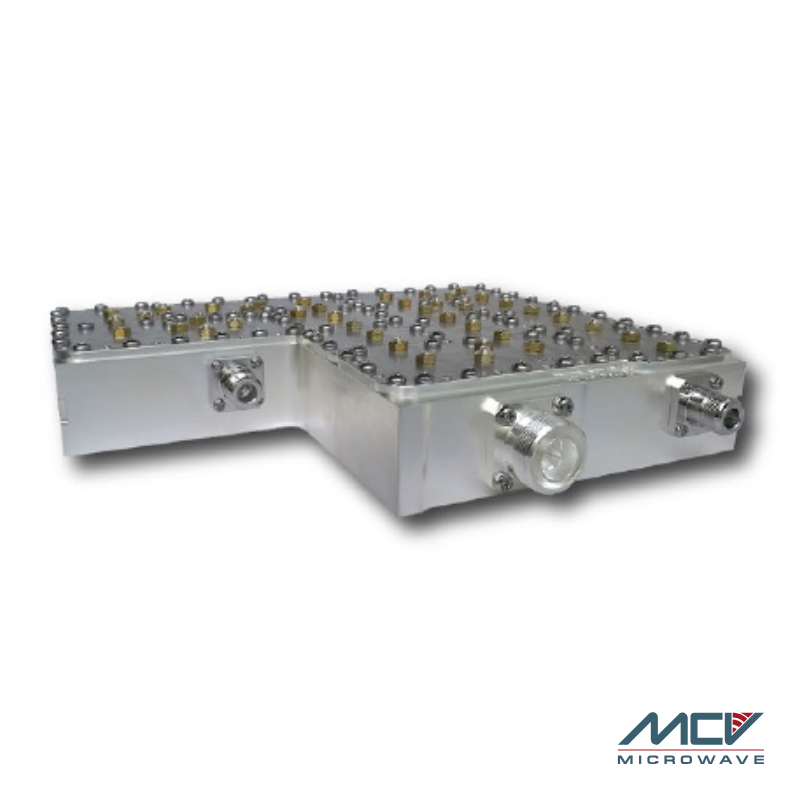
FAQ about Duplexers
What is a duplexer?
A duplexer is an electronic device that allows simultaneous transmission and reception of radio signals through a single antenna without interference. It separates the transmit (TX) and receive (RX) paths using filters.
Where are duplexers commonly used?
Duplexers are widely used in:
-
Two-way radios
-
Cellular base stations
-
Repeaters
-
Radar systems
-
Wireless communication systems
They are essential in systems that share a single antenna for both transmitting and receiving.
How does a duplexer work?
A duplexer uses filters (bandpass, bandstop, or notch filters) to route high-power transmit signals to the antenna while isolating and protecting the sensitive receive circuitry from that high power. It ensures both paths don’t interfere with each other.
What is the difference between a duplexer and a diplexer?
-
A duplexer separates signals that are close in frequency but traveling in opposite directions (TX and RX).
-
A diplexer combines or splits signals of different frequency bands (e.g., combining VHF and UHF onto one antenna).
Can a duplexer work with any frequency?
No. Duplexers are tuned to specific frequency ranges and spacing. Using one outside of its design range can result in poor performance or equipment damage.
What is frequency separation in a duplexer?
Frequency separation is the minimum difference between the transmit and receive frequencies that the duplexer can effectively isolate. Typical values range from a few MHz in commercial radios to hundreds of MHz in cellular systems.
Why is isolation important in a duplexer?
Isolation prevents the high-power transmit signal from leaking into the receive path, which could cause receiver desensitization, interference, or even damage to sensitive components.
What types of duplexers are available?
Common types include:
-
Cavity duplexers (used in VHF/UHF repeaters)
-
Ceramic duplexers (used in mobile and small devices)
- LC duplexers (based on inductors and capacitors for smaller systems)
- Low PIM duplexers
How do I tune a duplexer?
Tuning a duplexer requires specialized equipment like a spectrum analyzer and tracking generator. You adjust the filters for:
-
Minimum insertion loss on TX and RX paths
-
Maximum isolation between them
It’s typically done by RF professionals.
What happens if a duplexer is not working properly?
Symptoms include:
-
Weak transmission or reception
-
Overheating of radio equipment
-
Interference
-
Poor signal quality
Improper tuning or damage can lead to these issues, often requiring recalibration or replacement.
What is insertion loss in a duplexer?
Insertion loss is the amount of signal power lost as the signal passes through the duplexer’s filters. Lower insertion loss means better performance, as more of the original signal reaches the antenna or receiver. High-quality duplexers are designed to minimize this loss.
How much power can a duplexer handle?
Power handling depends on the duplexer’s design and materials.
Cavity duplexers often support higher power levels (e.g., tens to hundreds of watts), while ceramic duplexers are designed for lower-power applications such as mobile devices. Always verify the duplexer’s rated transmit power to prevent overheating or damage.
What is the difference between a duplexer and a circulator or isolator?
A circulator routes RF energy in a single direction between ports (e.g., port 1 ➜ port 2 ➜ port 3).
An isolator is a circulator with one port terminated, protecting equipment from reflected signals.
A duplexer, on the other hand, separates transmit and receive signals based on frequency, allowing shared-antenna operation.
Do duplexers require maintenance?
Most duplexers are passive devices and require minimal maintenance. However, cavity duplexers may need periodic retuning due to temperature changes, vibration, or component aging. Regular inspection ensures stable performance in mission-critical systems.
Can duplexers be customized for specific applications?
Yes, we offer custom duplexers tailored to exact frequency bands, power levels, form factors, isolation requirements, or environmental specs. Custom designs are common in aerospace, defense, and high-performance telecom applications.
Can a duplexer enable simultaneous transmit and receive?
Yes. A duplexer is specifically designed to allow simultaneous transmit and receive operation through a shared antenna. It isolates the transmit and receive frequencies so both paths can operate at the same time without significant interference.
What is receiver desensitization in duplexer systems?
Receiver desensitization occurs when transmit signal leakage raises the receiver noise floor, reducing its ability to detect weak incoming signals. Proper duplexer isolation helps prevent desensitization and maintains receiver sensitivity.
How does VSWR affect duplexer performance?
Poor VSWR (Voltage Standing Wave Ratio) can cause signal reflections, increased insertion loss, reduced power transfer, and potential stress on transmit amplifiers. Maintaining good impedance matching is important for optimal duplexer performance.
Are duplexers used in 5G and modern wireless networks?
Yes. Duplexers are widely used in modern wireless infrastructure, including 4G LTE, 5G NR, public safety systems, and distributed antenna systems (DAS). They help support simultaneous transmit and receive operation while minimizing interference in dense RF environments.
What connector types are commonly used with duplexers?
Common connector types include N-type, SMA, TNC, 7/16 DIN, and 4.3-10 connectors. The connector choice depends on operating frequency, power level, environmental requirements, and system size constraints.
What makes MCV duplexers stand out?
MCV duplexers are built for high-performance and low insertion loss, with excellent isolation and compact form factors. Available in ceramic and waveguide configurations, they are optimized for demanding environments in telecom, defense, and aerospace sectors.
How can I order duplexers from MCV Microwave?
To place an order for duplexers please contact us and we will help you!