
Cavity Filters
Compared to other filter types, cavity filters feature low insertion loss, high rejection and steep skirt selectivity, and high power handling capabilities. They are typically bandpass or band reject (notch) filters.
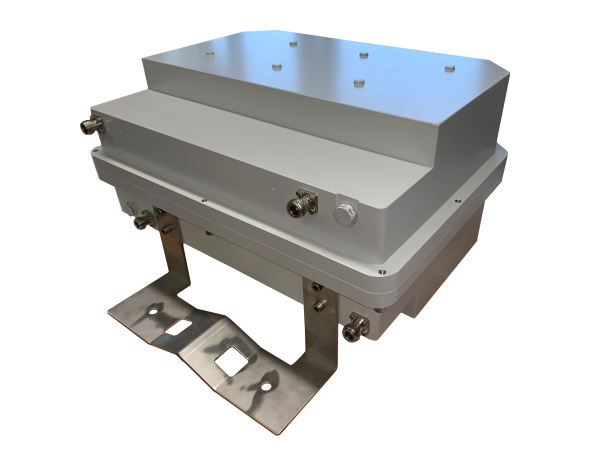
Cavity Filters by MCV
MCV offers a comprehensive range of cavity filters: cavity band pass, band reject, multiplexers, dual duplexers, combline band pass, interdigital, waveguide bandpass and dielectric resonator loaded cavity filters.
FAQ about Cavity Filters
What is a cavity filter?
A cavity filter is a type of RF filter that uses one or more resonant cavities to select or reject specific frequency ranges. These filters operate based on the physical dimensions of the cavities, which determine the resonant frequencies. They offer excellent performance in terms of selectivity, low insertion loss, and high power handling.
How does a cavity filter work?
Cavity filters operate on the principle of resonance. Each cavity resonates at a specific frequency, allowing signals at that frequency to pass while attenuating others. The physical dimensions of the cavities determine the center frequency and bandwidth.
What applications are cavity filters used in?
Cavity filters are commonly used in telecommunications, military, aerospace, and public safety systems where signal clarity and interference rejection are critical. They are ideal for base stations, repeaters, and high-power RF environments.
What frequency ranges do cavity filters cover?
Cavity filters can be designed to operate from VHF to microwave frequencies, typically from 30 MHz up to several GHz, depending on the application and design specifications.
What are the advantages of using cavity filters?
Cavity filters offer:
-
High Q factor (low insertion loss)
-
Excellent selectivity
-
High power handling
-
Good thermal and frequency stability
-
Low insertion loss over narrow bandwidths
Can cavity filters handle high power?
Yes. Due to their metallic construction and high-Q design, cavity filters can handle significant RF power levels, making them ideal for transmitter and repeater systems.
What are the common types of cavity filters?
-
Bandpass filters
-
Bandstop (notch) filters
-
Combline filters
-
Interdigital filters
-
Waveguide cavity filters
What is the difference between a cavity filter and a lumped-element filter?
-
Cavity filters use physical resonators (cavities) and are ideal for high-frequency and high-power applications.
-
Lumped-element filters use capacitors and inductors, are smaller, and better for low-frequency or compact systems but offer lower Q.
What is filter order in a cavity filter, and why does it matter?
Filter order refers to the number of resonant cavities used in the filter. Higher-order cavity filters provide steeper roll-off and better out-of-band rejection, but they also increase size, weight, and cost. Selecting the right order is a balance between performance and physical constraints.
How are cavity filters tuned?
Cavity filters are tuned using adjustable screws, plungers, or posts inside the cavities. Tuning is performed during manufacturing to precisely set the center frequency and bandwidth. Once tuned, cavity filters are mechanically stable and usually require minimal adjustment over their lifetime.
Can cavity filters be customized for specific applications?
Yes, cavity filters can be fully customized in terms of frequency range, bandwidth, insertion loss, physical size, and mounting options to meet the specific requirements of different systems and environments.
How are cavity filters tested and verified?
Cavity filters are typically tested using a Vector Network Analyzer (VNA) to measure parameters such as insertion loss, return loss, bandwidth, and rejection. High-power filters may also undergo thermal, vibration, and power stress testing to ensure reliable operation.
How do environmental factors affect cavity filter performance?
Temperature changes can cause slight frequency shifts due to thermal expansion of the cavity. Vibration, humidity, and mechanical shock can also affect performance in harsh environments. Ruggedized designs and temperature compensation are often used in military and outdoor applications.
When should I choose a cavity filter over planar or ceramic filters?
Cavity filters are the preferred choice when your system requires high power handling, very low insertion loss, and excellent selectivity. Planar or ceramic filters are better suited for compact, low-power, or cost-sensitive applications where size and weight are critical.
What materials are used in cavity filters?
Cavity filters are typically manufactured from aluminum, copper, brass, or silver-plated metals to achieve high conductivity and low RF losses. The material selection affects insertion loss, thermal stability, weight, corrosion resistance, and overall filter performance.
Are cavity filters suitable for 5G and microwave systems?
Yes. Cavity filters are widely used in 5G base stations, microwave backhaul, radar systems, and satellite communications because they provide excellent selectivity, low insertion loss, and high power handling at microwave frequencies.
Why do cavity filters have low insertion loss?
Cavity filters achieve low insertion loss because their resonant structures have very high Q factors and low conductor losses. Unlike PCB-based filters, cavity resonators confine electromagnetic energy efficiently, minimizing signal dissipation.
What is the difference between combline and interdigital cavity filters?
Combline filters use resonators that are shorted at one end and capacitively loaded, allowing compact designs with good bandwidth control. Interdigital filters use quarter-wave resonators with alternating grounding, providing high selectivity and low insertion loss over wider bandwidths.
Can cavity filters be used outdoors or in harsh environments?
Yes. Many cavity filters are designed for outdoor and rugged environments with sealed housings, corrosion-resistant finishes, and vibration-resistant mechanical structures. These filters are commonly used in military, aerospace, telecom, and industrial applications.
What key parameters should I consider when selecting a cavity filter?
-
Center frequency
-
Bandwidth
-
Insertion loss
-
Return loss
-
Rejection (attenuation)
-
Power handling
-
Size and weight
-
Environmental ruggedness
How can I order cavity filters from MCV Microwave?
To place an order for cavity filters please contact us and we will help you!