
LC Filters
Comprised of capacitors and inductors, the LC or lumped element filter is perhaps the most common type of filter, and can function as high pass filters, low pass filters, band pass filters, band reject (notch) filters, tunable filters and multiplexers.
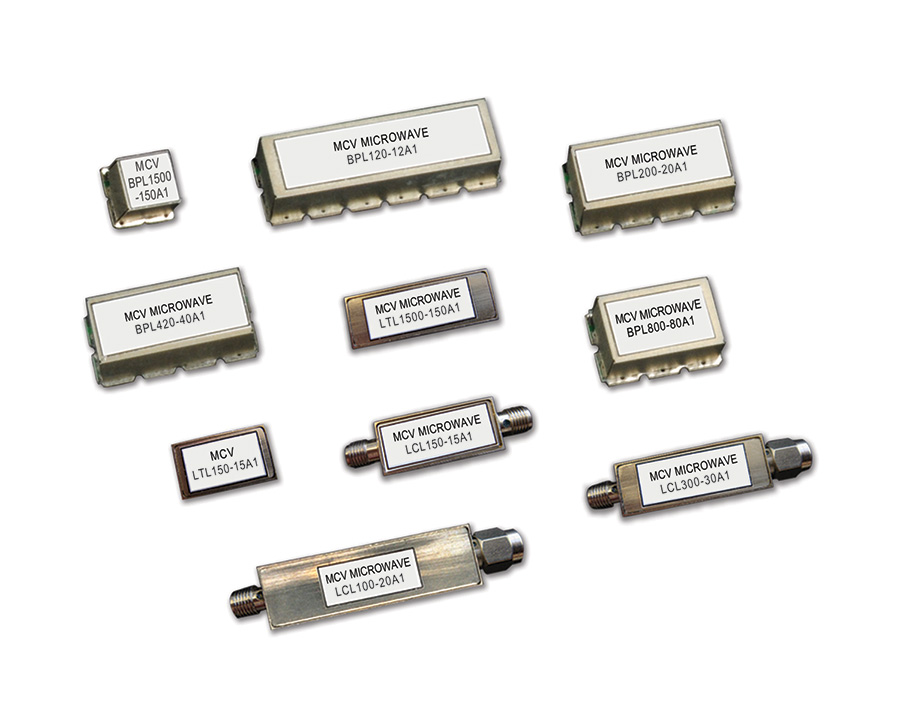
LC Filters by MCV
MCV LC filters feature center frequencies from 100 kHz to 10 GHz with excellent environmental performance in rugged surface mount and connectorized package.
| wdt_ID | Part Number | Type | Center Frequency (MHz) | Bandwidth (MHz) | I.L. in BW (dB)(max) | Ripple in BW (dB)(max) | VSWR or R.L. (min) | Attenuation @ MHz (dB)(min) | Dimensions (LxWxH)(mm) | Input Power | Connector type | Keep this part? | Data sheet exists? | Band type | Frequency |
|---|---|---|---|---|---|---|---|---|---|---|---|---|---|---|---|
| 1 | ABCL460-20A1 | Band Pass | 460.00 | 450~470 | 2.50 | 0.80 | 15.00 | 15 @ 401 50 @ 936 |
35.1 x 16.5 x 10.2 | 2 | SMA | Y | UHF | Low | |
| 2 | BCL10-10A1 | Band Pass | 10.00 | 5~15 | 2.00 | 11.70 | 40 @ DC~3 40 @ 17 |
60.5 x 25.4 x 19.1 | 15 | SMA | Y | Missing | Low | ||
| 3 | BCL113-24A1 | Band Pass | 113.33 | 101.33~125.33 | 3.00 | 14.00 | 30 @ 97.5, 130 | 50.8 x 14.0 x 10.2 | 50 | SMA | Y | VHF | Low | ||
| 4 | BCL120-40A1 | Band Pass | 120.00 | 100~140 | 2.00 | 0.80 | 14.00 | 60 @ DC~60 50 @ 180~1000 |
44.5x14.0x10.2 | 3 | SMA | Y | VHF | Low | |
| 5 | BCL130-22A1 | Band Pass | 130.00 | 119~141 | 2.00 | 15.00 | 50 @ DC~78, 183~1000 | 44.5 x 14.0 x 10.2 | 1 | SMA | Y | VHF | Low | ||
| 6 | BCL159-6A1 | Band Pass | 159.00 | 155.75~162.25 | 5.50 | 1.50 | 15.00 | 45 @ 150, 168 | 50.8 x 14.0 x 10.2 | 1 | SMA | Y | VHF | Low | |
| 7 | BCL159-7A1 | Band Pass | 159.00 | 155.5~162.5 | 2.50 | 0.80 | 15.00 | 60 @ 120, 220 | 44.5 x 14.0 x 10.2 | 1 | SMA | Y | VHF | Low | |
| 8 | BCL160-20A1 | Band Pass | 160.00 | 150~170 | 2.50 | 0.60 | 15.00 | 30 @ 130, 190 55 @ DC~110, 215~2000 |
38.1 x 25.4x 12.7 | SMA | Convert | Y | Low | ||
| 9 | BCL188-60A1 | Band Pass | 188.00 | 158~218 | 3.00 | 1.00 | 14.00 | 70 @ DC~121, 242 | 44.5 x 14.0 x 10.2 | 5 | SMA | Y | VHF | Low | |
| 10 | BCL256-27A1 | Band Pass | 256.50 | 243~270 | 3.00 | 0.50 | 15.00 | 40 @ 210, 300 | 53.4 x 16 x 13 | SMA | Convert | Y | Low | ||
| 11 | BCL275K-450K-A1 | Band Pass | 0.28 | 0.05~0.5 | 2.00 | 10.00 | 15 @ 0.04. 60 @ 1.5 | 101.6x50.8x25.4 | 1 | BNC | Y | MF | Low | ||
| 12 | BCL354-200A75 | Band Pass | 354.00 | 254~454 | 2.00 | 12.00 | 40 @ 5~224, 504~1500 | - | 2 | F | Convert | Y | UHF | Low | |
| 13 | BCL405-50A1 | Band Pass | 405.00 | 380~430 | 3.00 | 15.00 | 40 @ DC~250 75 @ > 600 |
47.0x14.0x10.2 | 2 | SMA | Y | UHF | Low | ||
| 14 | BCL425-49A1 | Band Pass | 425.40 | 401~450 | 2.50 | 1.50 | 15.00 | 20 @ 463 | 47.0x14.0x10.2 | 2 | SMA | Y | UHF | Low | |
| 15 | BCL44-15A1 | Band Pass | 44.00 | 36.5~51.5 | 2.10 | 0.00 | 60 @ 22, 50 @ 66 | 57.15 x - x 15.24 | Convert | Y | Low | ||||
| 16 | BCL50-2A1 | Band Pass | 50.00 | 49~51 | 8.00 | 14.00 | - | 38.1x 12.7 x 10.2 | SMA | Y | Missing | Low | |||
| 17 | BCL525K-950K-A1 | Band Pass | 525.00 | 50~1000 | 2.50 | 14.00 | 60 @ 0.04, 1.5 | 101.6x50.8x25.4 | 1 | BNC | Y | MF | Low | ||
| 18 | BCL546-200A75 | Band Pass | 546.00 | 446~646 | 2.00 | 12.00 | 40 @ 5~396, 706~1500 | Φ21x81 | 2 | F | Y | UHF | Low | ||
| 19 | BCL550-320A1 | Band Pass | 550.00 | 390~710 | 1.50 | 2.00 | 1.00 | 25 dBc @ 755 ~ 2105 MHz 25 dBc @ 200~355 45 dBc @ 2490~2800 |
50.8 x 14.0 x 10.2 | 30 | SMA | Y | UHF | Low | |
| 20 | BCL600-80A1 | Band Pass | 600.00 | 560~640 | 3.00 | 1.00 | 14.00 | 50 @ DC~500 50 @ 700~2000 |
50.8 x 14.0 x 10.2 | 37 | SMA | Y | UHF | Low | |
| 21 | BCL63-4A1 | Band Pass | 63.00 | 61~65 | 8.50 | 15.00 | 38.1 x 12.7 x 9.9 | RF pin | Convert | Y | Low | ||||
| 22 | BCL70-12A1 | Band Pass | 70.00 | 64~76 | 2.50 | 20.00 | 35 @ 50, 90 | 44.5 x 14.0 x 10.2 | 1 | SMA | Y | VHF | Low | ||
| 23 | BCL70-20A1 | Band Pass | 70.00 | 60~80 | 3.00 | 1.00 | 14.00 | 50 @ 30, 110 60 @ 20, 120 |
44.5 x 14.0 x 10.5 | SMA | Y | VHF | Low | ||
| 24 | BCL70-40A1 | Band Pass | 70.00 | 50~90 | 1.00 | 17.00 | 20 @ 20, 35 @ 235 | 31.8x14.0x10.2 | 1 | SMA | Y | VHF | Low | ||
| 25 | BCL70-8A1 | Band Pass | 70.00 | 66~74 | 3.00 | 20.00 | 50 dBc @ 60, 80 70 dBc @ 20, 120 |
95.3x25.4x19.1 | 2 | SMA | Y | VHF | Low | ||
| 26 | BCL720-400A1 | Band Pass | 720.00 | 520~920 | 2.00 | 18.00 | 5 @ 325, 35 @ 1310 | 57.2x12.7x11.2 | 1 | SMA | Y | S Band | Low | ||
| 27 | BCL720-480A1 | Band Pass | 720.00 | 480~960 | 3.00 | 1.50 | 14.00 | 40 @ 385, 1055 60 @ 345, 1095 |
50.8 x 14.0 x 10.2 | SMA | Y | UHF | Low | ||
| 28 | BCL720-96A1 | Band Pass | 720.00 | 672~768 | 3.00 | 1.50 | 14.00 | 40 @ 577, 863 60 @ 537, 903 |
50.8 x 14.0 x 10.2 | SMA | Y | UHF | Low | ||
| 29 | BCL738-200A75 | Band Pass | 738.00 | 638~838 | 2.50 | 12.00 | 40 @ 5~588, 898~1500 | Φ21x81 | 2 | F | Y | UHF | Low | ||
| 31 | BCL798-34A1 | Band Pass | 798.00 | 781~815 | 5.50 | 12.00 | 60 @ 0~621 55 @ 710, 886.5 60 @ 975.5~1595 |
30.5 x12.7x10.2 | Convert | Y | Low | ||||
| 32 | BCL80-40A1 | Band Pass | 80.00 | 60~100 | 1.00 | 15.00 | 40 @ DC~30 40 @ 140~1000 |
31.8x14.0x10.2 | 2 | SMA | Y | VHF | Low | ||
| 33 | BCL80-4A1 | Band Pass | 80.00 | Fc± 20 min | 1.00 | 15.00 | 31.75 x 14.0 x 10.2 | Low | |||||||
| 34 | BCL810-160A1 | Band Pass | 810.00 | 730~890 | 1.70 | 0.80 | 7.40 | 35 @ DC~501 25 @ 655 50 @ 1310 |
31.75 x 14.0 x 10.2 | SMA | Y | UHF | Low | ||
| 35 | BCL930-200A75 | Band Pass | 930.00 | 830~1030 | 2.50 | 12.00 | 40 @ 5~588, 898~1500 | Φ21x81 | 2 | F | Y | UHF | Low | ||
| 36 | BCL950-520A1 | Band Pass | 950.00 | 690~1210 | 2.00 | 0.70 | 14.00 | 25 @ dBc 345~605 25 @dBc 1295~1990 35 @ dBc 1990~2510 |
50.8 x 14.0 x 10.2 | 30 | SMA | Y | L Band | Low | |
| 37 | BCL1000-10A1 | Band Pass | 1,000.00 | 995~1005 | 4.00 | 2.00 | 18 @ DC~970 8 @ 985, 1015 18 @ 1030~3000 20 @ 3001~6000 |
19.1x12.7x8.9 | 1 | Y | L Band | Low | |||
| 38 | BPL1000-500A1 | Band Pass | 1,000.00 | Fc± 250 min | 2.00 | 15.00 | 10@ 675MHz / 1325MHz | 47.0 x 15.0 x 7.5 | Low | ||||||
| 39 | BPL100-10A1 | Band Pass | 100.00 | Fc± 5 min | 3.50 | 15.00 | 30 @ 80MHz / 120MHz | 25.4 x 12.7 x 7.0 | Low | ||||||
| 40 | BPL100-1A1 | Band Pass | 100.00 | 99.5~100.5 | 2.00 | 0.50 | 15.00 | 55 @ 50, 150 | 25.4 x 12.7 x 6.7 | 1 | Convert | Y | Low | ||
| 41 | BPL10-6A1 | Band Pass | 10.00 | Fc± 3 min | 1.50 | 15.00 | 20 @ Fc± 8MHz | 25.4 x 12. 7 x 7.0 | Low | ||||||
| 42 | BPL113-10A1 | Band Pass | 113.00 | 108~118 | 5.00 | 15.00 | 30 @ 100 15 @ 102, 104 10 @ 106, 122 5 @ 107 20 @ 126 |
80.0 x 62.0 x 10 | 3 | Convert | Y | Low | |||
| 43 | BPL125-100A1 | Band Pass | 125.00 | Fc± 50 min | 2.00 | 15.00 | 50 @ 1MHz / 50 @ 400MHz | 20.5 x 12.5 x 8.0 | Low | ||||||
| 44 | BPL128-22A1 | Band Pass | 128.00 | 117~139 | 3.00 | 1.00 | 14.00 | 60 @ 84, 50 @ 172 | 47.0 x 15.0 x 7.5 | 1 | Convert | Y | Low | ||
| 45 | BPL140-10A1 | Band Pass | 140.00 | 135~145 | 3.00 | 1.00 | 15.00 | 40 @ 100, 180 | 25.4 x 12.7 x 6.7 | 1 | Convert | Y | Low | ||
| 46 | BPL140-15A1 | Band Pass | 140.00 | 132.5~147.5 | 2.50 | 1.00 | 16.00 | 20 @ 120, 160 40 @ 100, 180 |
25.4 x 12.7 x 6.7 | 1 | Convert | Y | Low | ||
| 47 | BPL140-15B1 | Band Pass | 140.00 | 132.5~147.5 | 3.00 | 1.00 | 15.00 | 20 @ 120, 160 40 @ 100, 180 |
47.0 x 15.0 x 7.5 | 1 | Convert | Y | Low | ||
| 48 | BPL140-20A1 | Band Pass | 140.00 | 130~150 | 2.00 | 1.50 | 60 @ 100, 208 | 38.1 x 12.7 x 8.9 | 2 | RF pin | Y | VHF | Low | ||
| 49 | BPL140-30A1 | Band Pass | 140.00 | 125~155 | 2.00 | 1.00 | 16.00 | 20 @ 110, 170 40 @ 80, 200 |
25.4 x 12.7 x 6.7 | 1 | Convert | Y | Low | ||
| 50 | BPL140-30B1 | Band Pass | 140.00 | 125~155 | 2.50 | 1.00 | 15.00 | 20 @ 110, 170 40 @ 80, 200 |
47.0 x 15.0 x 7.5 | 1 | Convert | Y | Low | ||
| 51 | BPL140-40A1 | Band Pass | 140.00 | 120~160 | 1.50 | 1.50 | 60 @ 80, 216 | 38.1 x 12.7 x 8.9 | 2 | RF pin | Y | VHF | Low | ||
| 52 | BPL140-60A1 | Band Pass | 140.00 | 110~170 | 3.20 | 10.00 | 48 @ 5~70 48 @ 210~1000 |
38.1 x 12.7 x 6.5 | 1 | Convert | Y | Low | |||
| 53 | BPL150-20A1 | Band Pass | 150.00 | 140~160 | 3.00 | 1.00 | 15.00 | 20 @ 120, 180 | 25.4 x 12.7 x 7.5 | Convert | Y | Low | |||
| 54 | BPL160-108A1 | Band Pass | 160.00 | 106~214 | 1.50 | 15.00 | 70 @ DC~52, 268~1000 | 38.1 x 12.7 x 8.9 | 1 | Y | VHF | Low | |||
| 55 | BPL160-20A1 | Band Pass | 160.00 | Fc± 10 min | 1.60 | 15.00 | 40 @ Fc± 30MHz | 25.4 x 12.7 x 7.0 | Low | ||||||
| 56 | BPL160-42A1 | Band Pass | 160.00 | 139~181 | 2.50 | 15.00 | 30 @ 122, 197 | 38.1x12.7x8.9 | 1 | Y | VHF | Low | |||
| 57 | BPL160-5A1 | Band Pass | 160.00 | Fc± 2.5 min | 5.50 | 12.00 | 30 @ 145MHz ~ 175MHz | 25.4 x 12.7 x 7.0 | Low | ||||||
| 58 | BPL180-100A1 | Band Pass | 180.00 | Fc± 50 min | 2.00 | 15.00 | 60.0 x 15.0 x 7.5 | Low | |||||||
| 59 | BPL180-100B1 | Band Pass | 180.00 | Fc± 50 min | 2.00 | 15.00 | 50 @ Fc± 100MHz | 25.4 x 12.7 x 7.0 | Low | ||||||
| 60 | BPL190-10A1 | Band Pass | 190.00 | Fc± 5 min | 4.50 | 12.00 | 40 @ 120 MHz ~ 260 MHz | 47.0 x 15.0 x 7.5 | Low | ||||||
| 61 | BPL193-46A1 | Band Pass | 193.00 | 170~216 | 2.50 | 1.00 | 15.00 | 40 @ 1~145, 450~3000 | 25.4 x 12.7 x 6.7 | 2 | Convert | Y | Low | ||
| 62 | BPL200-10A1 | Band Pass | 200.00 | 195~205 | 1.50 | 1.00 | 15.00 | 40 @ 105, 440 | 19.1 x 12.7 x 8.9 | 1 | Convert | Y | Low | ||
| 63 | BPL200-40A1 | Band Pass | 200.00 | Fc± 25 min | 3.00 | 15.00 | 47.0 x 15.0 x 7.5 | Low | |||||||
| 64 | BPL20-10A1 | Band Pass | 20.00 | Fc± 5 min | 2.00 | 15.00 | 40 @ 1MHz ~ 45MHz | 25.4 x 12.7 x 7.0 | Low | ||||||
| 65 | BPL20-11A1 | Band Pass | 20.20 | 14.7~25.7 | 1.70 | 1.00 | 15.00 | 35 @ 10, 30 | 47.0 x 15.0 x 7.5 | Convert | Y | Low | |||
| 66 | BPL20-15A1 | Band Pass | 20.00 | 12.5~27.5 | 2.00 | 0.00 | 40 @ 10, 30 | 38.1 x 12.7 x 7.6 | Convert | Y | Low | ||||
| 67 | BPL220-160A1 | Band Pass | 220.00 | Fc± 80 min | 1.50 | 15.00 | 30 @ 20MHz / 60 @ 400MHz | 47.0 x 15.0 x 7.5 | Low | ||||||
| 68 | BPL220-40A1 | Band Pass | 220.00 | Fc± 20 min | 2.50 | 15.00 | 55 @ Fc± 70 MHz | 38.1 x 12.7 x 8 | Low | ||||||
| 69 | BPL233-15A1 | Band Pass | 233.00 | 225.5~240.5 | 2.00 | 0.50 | 14.00 | 40 dBc @ DC~195 35 dBc @ 300~1000 |
25.4x12.7x6.9 | 2 | Y | UHF | Low | ||
| 70 | BPL237-30A1 | Band Pass | 237.00 | Fc ± 15 min | 2.50 | 15.00 | 40 @ 177MHz ~ 297MHz | 25.4 x 12.7 x 7.0 | Low | ||||||
| 71 | BPL240-40A1 | Band Pass | 240.00 | Fc± 2.5 min | 4.00 | 12.00 | 40 @ 310MHz | 25.4 x 12.7 x 7.0 | Low | ||||||
| 72 | BPL250-110A1 | Band Pass | 250.00 | 195~305 | 1.50 | 0.50 | 15.00 | 40 @ 105, 440 | 19.1x12.7x6.9 | 1 | Y | UHF | Low | ||
| 73 | BPL255-111A1 | Band Pass | 255.00 | 199.5~310.5 | 1.50 | 1.00 | 10.00 | 45 @ 105 28 @ 435 |
25.4 x 12.7 x 7.5 | 2 | Convert | Y | Low | ||
| 74 | BPL260-10A1 | Band Pass | 260.00 | Fc± 6.5 min | 7.50 | 19.00 | 38.1 x 12.7 x 10.2 | Low | |||||||
| 75 | BPL300-10A1 | Band Pass | 300.00 | 295~305 | 1.50 | 1.00 | 15.00 | 40 @ 205, 540 | 19.1 x 12.7 x 8.9 | 1 | Convert | Y | Low | ||
| 76 | BPL310-10A1 | Band Pass | 310.00 | 305~315 | 4.00 | 15.00 | 40 @ 240, 380 | 25.9 x 13.2 x 7.3 | 1 | Y | UHF | Low | |||
| 77 | BPL31-11A1 | Band Pass | 31.60 | 26.1~37.1 | 2.00 | 14.00 | 60 @ 22, 41 | 38.1 x 12.7 x 7.0 | 2 | RF pin | Y | VHF | Low | ||
| 78 | BPL31-04A1 | Band Pass | 31.60 | 29.6~33.6 | 4.00 | 14.00 | 50 @ 28, 37 | 25.4 x 12.7 x 7.6 | 1 | Y | VHF | Low | |||
| 79 | BPL330-40A1 | Band Pass | 330.00 | Fc ± 20 min | 3.50 | 15.00 | 45 @ Fc± | 80MHz | Low | ||||||
| 80 | BPL337-225A1 | Band Pass | 337.50 | 225~450 | 2.50 | 0.50 | 14.00 | 50 @ 130.8, 544.2 | 47.0 x 15.0 x 7.5 | 1 | Convert | Y | Low | ||
| 81 | BPL350-110A1 | Band Pass | 350.00 | 295~405 | 1.00 | 2.00 | 15.00 | 40 @ 205, 540 | 19.1 x 12.7 x 8.9 | 1 | Convert | Y | Low | ||
| 82 | BPL350-24A1 | Band Pass | 350.00 | Fc± 12 min | 4.50 | 12.00 | 10 @ 320 MHz ~ 380 MHz | 25.4 x 12.7 x 7.0 | Low | ||||||
| 83 | BPL355-110A1 | Band Pass | 355.00 | 299.75~410.25 | 1.70 | 1.00 | 10.00 | 43 dBc @ 185 37 dBc @ 590 |
19.1 x 12.7 x 8.9 | 2 | Convert | Y | Low | ||
| 84 | BPL368-70A1 | Band Pass | 368.00 | Fc± 35 min | 3.00 | 15.00 | 40 @ 288 MHz ~ 448 MHz | 47.0 x 15.0 x 7.5 | Low | ||||||
| 85 | BPL373-58A1 | Band Pass | 373.00 | 344~402 | 3.00 | 1.00 | 14.00 | 60 @ 257 50 @ 489 |
47.0 x 15.0 x 7.5 | 1 | Convert | Y | Low | ||
| 86 | BPL38-6A1 | Band Pass | 37.90 | 34.9~40.9 | 3.00 | 12.00 | 1.5 dBc @ 34.6 3.0 dBc @ 41.2 50 dBc @ 31.1 60 dBc @ 45.4 |
38.1x12.7x7.62 | Convert | Y | VHF | Low | |||
| 87 | BPL380-10A1 | Band Pass | 375.00 | Fc± 5 min | 7.00 | 15.00 | 40 @ 310 MHz ~ 450 MHz | 25.4 x.12.7 x 7.0 | Low | ||||||
| 88 | BPL391-12A1 | Band Pass | 391.00 | 385~397 | 4.50 | 1.50 | 14.00 | 20 @ 367, 421 | 20x10x7 | 10 | Y | UHF | Low | ||
| 89 | BPL4.5-0.5A1 | Band Pass | 4.50 | 4.25~4.75 | 2.60 | 14.00 | 30 @ 3.35, 5.6 | 25.4x 12.7x 8.9 | 2 | Convert | Y | Low | |||
| 90 | BPL400-10A1 | Band Pass | 400.00 | 395~405 | 1.50 | 1.00 | 15.00 | 40 @ 305, 640 | 19.1 x 12.7 x 8.9 | 1 | Convert | Y | Low | ||
| 91 | BPL401-16A1 | Band Pass | 401.00 | 393~409 | 3.00 | 1.00 | 14.00 | 20 @ 369, 445 | 28x17x9.5 | 3 | Convert | Y | UHF | Low | |
| 92 | BPL40-10A1 | Band Pass | 30.00 | Fc± 5 min | 2.50 | 15.00 | 30 @ 20MHz ~ 60MHz | 25.4 x 12.7 x 7.0 | Low | ||||||
| 93 | BPL410-120A1 | Band Pass | 410.00 | 350~470 | 1.00 | 15.00 | 40 @ 280, 650 | 19.1x12.7x6.6 | 1 | Y | VHF | Low | |||
| 94 | BPL425-53A1 | Band Pass | 425.00 | 398.5~451.5 | 1.50 | 14.00 | 40 dBc @ 200 35 dBc @ 260, 580 25 dBc @ 310 42 dBc @ 630 45 dBc @ 700 |
12.7 x 12.7 x 8.9 | 2 | Convert | Y | Low | |||
| 95 | BPL425-65A1 | Band Pass | N | Low | |||||||||||
| 96 | BPL43-10A1 | Band Pass | 43.25 | 37.75~54.25 | 2.70 | 1.00 | 15.00 | 25 @ 10, 30 | 25.4 x 12.7 x 7.5 | Convert | Y | Low | |||
| 97 | BPL440-60A1 | Band Pass | 440.00 | 410~470 | 2.50 | 1.00 | 14.00 | 40 @ 340, 540 10 @ 390, 490 40 @ 540~1200 |
25.4 x 12.7 x 6.9 | 1 | Y | UHF | Low | ||
| 98 | BPL450-110A1 | Band Pass | 450.00 | 395~505 | 1.00 | 2.00 | 15.00 | 40 @ 305, 640 | 19.1 x 12.7 x 8.9 | 1 | Convert | Y | Low | ||
| 99 | BPL455-111A1 | Band Pass | 455.00 | 399.15~510.85 | 1.90 | 1.00 | 10.00 | 42 dBc @ 260 35 dBc @ 660 |
19.1 x 12.7 x 8.9 | 2 | Convert | Y | Low | ||
| 100 | BPL460-160A1 | Band Pass | 460.00 | Fc± 80 min | 1.50 | 15.00 | 20 @ 660~2000 MHz | 13.0 x 12.0 x 7.0 | Low | ||||||
| 101 | BPL470-100A1 | Band Pass | 470.00 | 420~520 | 1.00 | 15.00 | 40 @ 345, 690 | 19.1x12.7x6.6 | 1 | Y | VHF | Low | |||
| 102 | BPL475-450A1 | Band Pass | 475.00 | 250~700 | 0.60 | 0.60 | 19.00 | 60 @ 8 | 19.1 x 12.7 x 10.2 | RF pin | Y | Missing | Low | ||
| 103 | BPL500-10A1 | Band Pass | 500.00 | 495~505 | 1.70 | 1.00 | 15.00 | 40 @ 405, 740 | 19.1 x 12.7 x 8.9 | 1 | Convert | Y | Low | ||
| 104 | BPL500-2A1 | Band Pass | 500.00 | 499~501 | 13.00 | 10.00 | 30 @ DC~299 23 @ 300~490 3 @ 498, 502 23 @ 510~1000 20 @ 1001~3000 |
25.4 x 12.7 x 8.9 | 1 | Y | UHF | Low | |||
| 105 | BPL500-80A1 | Band Pass | 500.00 | 460~540 | 2.50 | 1.00 | 15.00 | 40 @ 1~350, 700~3000 | 25.4 x 12.7 x 6.7 | 2 | Convert | Y | Low | ||
| 106 | BPL50-15A1 | Band Pass | 50.00 | 42.5~57.5 | 2.50 | 1.00 | 15.00 | 40 @ 35, 65 | 47.0 x 15.0 x 7.5 | 1 | Convert | Y | Low | ||
| 107 | BPL50-15B1 | Band Pass | 50.00 | 42.5~57.5 | 2.50 | 1.00 | 15.00 | 10 @ 35, 65 | 25.4 x 12.7 x 6.7 | 1 | Convert | Y | Low | ||
| 108 | BPL50-2A1 | Band Pass | 50.00 | Fc± 1min | 7.00 | 11.00 | 20 @ Fc± 5MHz | 25.4 x 12.7 x 7.0 | Low | ||||||
| 109 | BPL510-08A1 | Band Pass | 510.00 | 506~514 | 9.50 | 14.00 | 10 @ 495, 540 20 @ 490, 540 30 @ 480, 550 40 @ 470, 575 60 @ 450, 600 |
25.4x12.7x10.2 | 1 | RF pin | Y | Low | |||
| 110 | BPL518-80A1 | Band Pass | 518.00 | Fc ±40 min | 3.00 | 15.00 | 25.4 x 12.7 x 7.0 | Low | |||||||
| 111 | BPL550-110A1 | Band Pass | 550.00 | 495~605 | 1.20 | 2.00 | 15.00 | 40 dBc @ 405, 740 | 19.1 x 12.7 x 8.9 | 1 | Convert | Y | Low | ||
| 112 | BPL555-111A1 | Band Pass | 555.00 | 499.5~610.5 | 1.50 | 1.00 | 10.00 | 45 dBc @ 350 28 dBc @ 715 |
19.1 x 12.7 x 8.9 | 2 | Convert | Y | Low | ||
| 113 | BPL56-10A1 | Band Pass | 56.00 | 51~61 | 3.00 | 1.00 | 16.00 | 35 @ 25, 122 | 25.4 x 12.7 x 8.9 | 2 | Convert | Y | Low | ||
| 114 | BPL580-80A1 | Band Pass | 580.00 | 540~620 | 2.50 | 1.00 | 15.00 | 40 @ 1~430, 780~3000 | 25.4 x 12.7 x 6.7 | 2 | Convert | Y | Low | ||
| 115 | BPL600-10A1 | Band Pass | 600.00 | 595~605 | 1.60 | 1.00 | 15.00 | 40 @ 505, 840 | 19.1 x 12.7 x 8.9 | 1 | Convert | Y | Low | ||
| 116 | BPL60-2A1 | Band Pass | 60.00 | Fc± 1min | 3.00 | 15.00 | 60 @ 40MHz | 25.4 x 12.7 x 7.0 | Low | ||||||
| 117 | BPL60-04A1 | Band Pass | 60.00 | 58~62 | 5.50 | 0.50 | 19.00 | 40 @ 1~49.5 60 @ 49.5~50 40 @ 70~200 |
90.9 x 25.4 x 19.1 | RF pin | Y | VHF | Low | ||
| 118 | BPL60-6A1 | Band Pass | 60.00 | Fc± 3 min | 3.50 | 15.00 | 20 @ Fc± 6MHz | 25.4 x 12.7 x 7.0 | Low | ||||||
| 119 | BPL60-6B1 | Band Pass | 60.00 | 57~63 | 3.50 | 1.00 | 18.00 | 80 @ 35 | 47.0 x 15.0 x 6.5 | 1 | Convert | Y | Low | ||
| 120 | BPL640-420A1 | Band Pass | 640.00 | Fc± 210 min | 0.70 | 15.00 | 25.4 x 12.7 x 7.0 | Low | |||||||
| 121 | BPL650-110A1 | Band Pass | 650.00 | 595~705 | 1.50 | 2.00 | 15.00 | 40 @ 505, 840 | 19.1 x 12.7 x 8.9 | 1 | Convert | Y | Low | ||
| 122 | BPL655-110A1 | Band Pass | 655.00 | 599.75~710.25 | 1.70 | 1.00 | 10.00 | 43 @ 430 | 37 @ 880 | 2 | Convert | Y | Low | ||
| 123 | BPL660-80A1 | Band Pass | 660.00 | 620~700 | 2.50 | 1.00 | 15.00 | 40 @ 1~510, 860~3000 | 25.4 x 12.7 x 6.7 | 2 | Convert | Y | Low | ||
| 124 | BPL700-10A1 | Band Pass | 700.00 | 695~705 | 1.60 | 1.00 | 15.00 | 40 @ 605, 940 | 19.1 x 12.7 x 8.9 | 1 | Convert | Y | Low | ||
| 125 | BPL70-10A1 | Band Pass | 70.00 | 65~75 | 5.50 | 10.00 | 50 @ 5~54, 88~1000 | 38.1 x 12.7 x 6.5 | 1 | Convert | Y | Low | |||
| 126 | BPL70-10B1 | Band Pass | 70.00 | Fc± 5 min | 3.00 | 12.00 | 35 @ 40 MHz ~ 100 MHz | 25.4 x 12.7 x 7.0 | Low | ||||||
| 127 | BPL70-10C1 | Band Pass | 70.00 | Fc± 10 min | 2.00 | 15.00 | 40 @ Fc± 25MHz | 38.1 x 12.7 x 8.0 | Low | ||||||
| 128 | BPL70-14A1 | Band Pass | 70.00 | 63~77 | 10.00 | 14.00 | 70 @ 56.5, 83.5 | 38.1 x 12.7 x 8.9 | 2 | RF pin | Y | VHF | Low | ||
| 129 | BPL70-20A1 | Band Pass | 70.00 | 60~80 | 3.00 | 10.00 | 46 @ 5~40, 100~1000 | 38.1 x 12.7 x 6.5 | 1 | Convert | Y | Low | |||
| 130 | BPL70-20B1 | Band Pass | 70.00 | 60~80 | 3.00 | 1.00 | 15.00 | 30 @ 50, 90 | 47.0 x 15.0 x 7.5 | Convert | Y | Low | |||
| 131 | BPL70-28A1 | Band Pass | 70.00 | 56~84 | 1.90 | 14.00 | 60 @ 42, 132 | 38.1 x 12.7 x 8.9 | 2 | Convert | Y | Low | |||
| 132 | BPL70-30A1 | Band Pass | 70.00 | Fc± 15 min | 2.00 | 15.00 | 60 @ 30MHz / 140MHz | 47.0 x 15.0 x 7.0 | Low | ||||||
| 133 | BPL70-35A1 | Band Pass | 70.00 | 52.5~87.5 | 3.00 | 10.00 | 48 @ 5~33 50 @ 115~1000 |
38.1 x 12.7 x 6.5 | 1 | Convert | Y | Low | |||
| 134 | BPL70-40A1 | Band Pass | 70.00 | 50~90 | 1.90 | 14.00 | 60 dBc @ 42, 132 | 38.1 x 12.7 x 8.9 | 2 | Convert | Y | Low | |||
| 135 | BPL70-5A1 | Band Pass | 70.00 | 67.5~72.5 | 7.00 | 10.00 | 50 @ 5~54, 88~1000 | 38.1 x 12.7 x 8.0 | 1 | Convert | Y | Low | |||
| 136 | BPL70-5B1 | Band Pass | 70.00 | Fc± 3 max | 7.00 | 10.00 | 38.1 x 12.7 x 6.5 | N | Low | ||||||
| 137 | BPL70-60A1 | Band Pass | 70.00 | Fc± 30 min | 1.00 | 14.00 | 38.1 x 12.7 x 8.9 | N | Low | ||||||
| 138 | BPL750-110A1 | Band Pass | 750.00 | 695~805 | 1.50 | 2.00 | 15.00 | 40 dBc @ 605, 940 | 19.1 x 12.7 x 8.9 | 1 | Convert | Y | Low | ||
| 139 | BPL750-22A1 | Band Pass | 750.00 | 739~761 | 7.00 | 14.00 | 55 @ 680, 40 @ 800 | 36.8 x 9.5 x 9.5 | 1 | RF pin | Y | UHF | Low | ||
| 140 | BPL750-500A1 | Band Pass | 750.00 | 500~1000 | 0.50 | 15.00 | 40 @ DC~150, 4000~18000 | 19.1 x 12.7 x 6.6 | 1 | Convert | Y | UHF | Low | ||
| 141 | BPL750-540A1 | Band Pass | 750.00 | Fc± 270 min | 1.50 | 15.00 | 32 @ 390MHz / 1250MHz | 25.4 x 12.7 x 7.0 | Low | ||||||
| 142 | BPL755-111A1 | Band Pass | 755.00 | 699.15~810.85 | 1.90 | 1.00 | 10.00 | 42 @ 500, 35 @ 980 | 19.1 x 12.7 x 8.9 | 2 | Convert | Y | Low | ||
| 143 | BPL76-39A1 | Band Pass | 76.00 | 60~93 | 1.50 | 1.00 | 12.00 | 30 @ DC~46 3 @ 56, 95 40 @ 120~500 |
38.1 x 12.7 x 8.9 | 0 | Convert | Y | Low | ||
| 144 | BPL80-4A1 | Band Pass | 80.00 | Fc± 2 min | 5.00 | 12.00 | 35 @ 65MHz / 30 @ 95MHz | 25.4 x 12.7 x 7.0 | Low | ||||||
| 145 | BPL880-200A1 | Band Pass | 880.00 | Fc ± 100 min | 1.50 | 15.00 | 32 @ 630MHz / 1 200MHz | 25.4 x 12.7 x 7.0 | Low | ||||||
| 146 | BPL90-3A1 | Band Pass | 90.00 | Fc± 1.5 min | 3.50 | 15.00 | 40 @ 70MHz / 30 @ 110MHz | 25.4 x 12.7 x 7.0 | Low | ||||||
| 147 | BPL996-157A1 | Band Pass | 996.50 | 918~1075 | 2.50 | 1.00 | 12.00 | 40 @ 461.625~535 40 @ 1384.875~1605 |
19.1 x 12.7 x 8.9 | 1 | Y | UHF | Low | ||
| 148 | BTL159-2A1 | Band Pass | 159.00 | 158~160 | 3.50 | 0.50 | 14.00 | 60 @ DC~125 50 @ 125~140 50 @ 180~205 |
31.5 x 10.9 x 7.6 | 20 | RF pin | Y | VHF | Low | |
| 149 | BTL159-6A1 | Band Pass | 159.50 | 156.5~162.5 | 3.50 | 0.50 | 14.00 | 60 @ DC~125 50 @ 125~140 50 @ 180~205 |
31.5 x 10.9 x 7.6 | 20 | RF pin | Y | VHF | Low | |
| 150 | BTL180-9A1 | Band Pass | 180.00 | 175.5~184.5 | 7.50 | 19.00 | 40 @ 170, 190 80 @ 240 |
38.1 x 12.7 x 10.2 | 20 | RF pin | Y | VHF | Low | ||
| 151 | BTL220-11A1 | Band Pass | 220.00 | 214.5~225.5 | 8.00 | 19.00 | 80 @ 240 40 @ 208, 232 |
38.1 x 12.7 x 10.2 | RF pin | Y | VHF | Low | |||
| 152 | BTL240-20A1 | Band Pass | 240.00 | 230~250 | 2.90 | 19.00 | 45 @ 200, 280 | 25.4 x 9.65 x 9.65 | RF pin | Y | VHF | Low | |||
| 153 | BTL260-13A1 | Band Pass | 260.00 | 253.5~266.5 | 7.50 | 19.00 | 80 @ 240 40 @ 246, 274 |
25.4 x 12.7 x 10.2 | RF pin | Y | VHF | Low | |||
| 154 | BTL300-15A1 | Band Pass | 300.00 | 292.5~307.5 | 7.50 | 19.00 | 40 @ 284, 316 80 @ 240 |
38.1 x 12.7 x 10.2 | RF pin | Y | VHF UHF | Low | |||
| 155 | BTL420-32A1 | Band Pass | 420.00 | 404~436 | 3.00 | 19.00 | 20 @ 390, 450 40 @ 380~475 60 @ 350~515 |
25.4 x 12.7 x 10.2 | RF pin | Y | UHF | Low | |||
| 156 | BTL455-10A1 | Band Pass | 455.00 | 450~460 | 5.75 | 14.00 | 20 @ 446, 465 30 @ 445, 468 40 @ 440, 475 50 @ 435, 480 60 @ 430, 485 |
63.5 x 9.7 x 17.5 | RF pin | Y | UHF | Low | |||
| 157 | BTL465-10A1 | Band Pass | 465.00 | 460~470 | 7.00 | 19.00 | 40 @ 450, 480 75 @ 420 |
57.2 x 8.6x 17.5 | RF pin | Y | UHF | Low | |||
| 158 | BTL475-450A1 | Band Pass | 450.00 | 250~700 | 0.60 | 0.60 | 19.00 | 60 @ 8 | 19.1 x 12.7 x 10.2 | RF pin | Y | UHF | Low | ||
| 159 | BTL475-8A1 | Band Pass | 475.00 | 470.85~479.15 | 7.00 | 19.00 | 20 @ 485 40 @ 450, 490 75 @ 420 |
57.2 x 8.6x 17.5 | RF pin | Y | UHF | Low | |||
| 160 | BTL480-26A1 | Band Pass | 480.00 | 467~493 | 5.00 | 19.00 | 50 @ 420, 540 60 @ 360, 600 60 @ 270, 690 |
38.1 x 9.7 x 12.7 | RF pin | Y | UHF | Low | |||
| 161 | BTL485-10A1 | Band Pass | 485.00 | 480~490 | 7.00 | 19.00 | 20 @ 475 40 @ 470. 500 75 @ 420 |
57.2 x 8.6x 17.5 | RF pin | Y | UHF | Low | |||
| 162 | BTL50-20A1 | Band Pass | 50.00 | 40~60 | 1.25 | 19.00 | 35 dBc @ 30, 110 40 @ 2.5, 97.5 |
25.4 x 12.7 x 10.2 | RF pin | Y | VHF | Low | |||
| 163 | BTL510-08A1 | Band Pass | 510.00 | 506~514 | 9.50 | 14.00 | 10 @ 495, 530 20 @ 490, 540 30 @ 480, 550 40 @ 470, 575 60 @ 450, 600 |
25.4 x 12.7 x 10.2 | RF pin | Y | UHF | Low | |||
| 164 | BTL525-28A1 | Band Pass | 525.00 | 511~539 | 5.00 | 19.00 | 38 @ 495 36 @ 555 48 @ 565 50 @ 485 |
31.5 x 10.9 x 7.6 | RF pin | Y | UHF | Low | |||
| 165 | BTL535-28A1 | Band Pass | 535.00 | 521~549 | 5.00 | 0.40 | 19.00 | 38 @ 505 36 @ 565 48 @ 575 50 @ 495 |
31.5 x 10.9 x 7.6 | RF pin | Y | UHF | Low | ||
| 166 | BTL545-28A1 | Band Pass | 545.00 | 531~559 | 5.00 | 0.40 | 19.00 | 38 @ 515 36 @ 575 48 @ 585 50 @ 505 |
31.5 x 10.9 x 7.6 | RF pin | Y | UHF | Low | ||
| 167 | BTL555-28A1 | Band Pass | 555.00 | 541~569 | 5.00 | 0.40 | 19.00 | 38 @ 525 36 @ 585 48 @ 595 50 @ 515 |
31.5 x 10.9 x 7.6 | RF pin | Y | UHF | Low | ||
| 168 | BTL560-08A1 | Band Pass | 560.00 | 556~564 | 9.50 | 14.00 | 10 @ 545, 580 20 @ 540, 590 30 @ 530, 600 40 @ 520, 625 60 @ 500, 650 |
25.4 x 12.7 x 10.2 | 1 | RF pin | Y | UHF | Low | ||
| 169 | BTL60-04A1 | Band Pass | 60.00 | 58~62 | 4.50 | 0.25 | 14.00 | 50 @ 50, 70 | 31.5 x 10.9 x 7.6 | 1 | RF pin | Y | VHF | Low | |
| 170 | BTL60-08A1 | Band Pass | 60.00 | 56~64 | 3.80 | 1.00 | 14.00 | 60 @ 49.5~50 40 @ DC~49.5 39 @ 70~210 |
38.1x 12.7 x 10.2 | RF pin | Y | VHF | Low | ||
| 171 | BTL610-8A1 | Band Pass | 610.00 | 606~614 | 9.50 | 14.00 | 10 @ 595, 630 20 @ 590, 640 30 @ 580, 650 40 @ 570, 675 60 @ 550, 700 |
25.4 x 12.7 x 10.2 | 1 | RF pin | Y | UHF | Low | ||
| 172 | BTL660-8A1 | Band Pass | 660.00 | 656~664 | 9.50 | 14.00 | 10 @ 645, 680 20 @ 640, 690 30 @ 630, 700 40 @ 620, 725 60 @ 600, 750 |
25.4 x 12.7 x 10.2 | 1 | RF pin | Y | UHF | Low | ||
| 173 | MBPL310-20A1 | Band Pass | 310.00 | 300~320 | 4.10 | 9.50 | 48 @ 260, 31 @ 360 | 16.5 x 6.4 x 3.6 | Y | UHF | Low | ||||
| 174 | RCL345-30A1 | Band Reject (notch) | 345.00 | 330~360 reject 30~310 pass 380~512 pass | 1.00 | 0.50 | 15.00 | - | 50.8x30.5x20.3 | 10 | SMA | Y | UHF | Low | |
| Type |
FAQ about LC Filters
What is an LC filter?
An LC filter is an electronic circuit that uses inductors (L) and capacitors (C) to filter specific frequencies from a signal. It’s commonly used to block or pass certain frequency ranges in power supplies, audio systems, and RF applications.
What are the main types of LC filters?
There are four main types:
-
Low-pass filter (LPF) – passes low frequencies, blocks high.
-
High-pass filter (HPF) – passes high frequencies, blocks low.
-
Band-pass filter (BPF) – passes a specific frequency band.
-
Band-stop (notch) filter – blocks a specific frequency band.
How does an LC filter work?
LC filters work by exploiting the frequency-dependent impedance of inductors and capacitors:
-
Inductors resist changes in current (block high frequencies).
-
Capacitors resist changes in voltage (block low frequencies).
By arranging them properly, certain frequencies are allowed to pass while others are attenuated.
What are LC filters used for?
Common applications include:
-
Power supply filtering
-
Audio signal conditioning
-
Radio frequency (RF) circuits
-
Noise suppression
-
Signal demodulation
How do you design an LC filter?
Design involves:
-
Selecting a cutoff frequency
-
Choosing the filter type (low-pass, high-pass, etc.)
-
Calculating L and C values using standard equations
-
Considering impedance matching and component tolerances
What are the advantages of LC filters?
-
High efficiency (low power loss)
-
Better performance at high frequencies
-
Steeper roll-off compared to RC filters
-
No power dissipation in ideal components (L and C)
What are the disadvantages of LC filters?
-
Inductors can be bulky and expensive
-
Magnetic interference from inductors
-
Sensitive to component tolerances and parasitics
Can LC filters be cascaded for better performance?
Yes, multiple LC stages can be cascaded to create higher-order filters, which provide steeper roll-off and better selectivity, at the cost of increased complexity and component count.
How do LC filters compare to RC and active filters?
LC filters offer lower power loss and better high-frequency performance than RC filters, but require inductors, which can be bulky. Compared to active filters, LC filters do not need power supplies and can handle higher signal power, but active filters offer better tunability and gain at low frequencies.
What frequency range are LC filters best suited for?
LC filters are most effective from tens of kilohertz to several gigahertz, depending on component quality and layout. At very low frequencies, inductors become impractically large, while at very high frequencies, parasitic effects limit performance.
What common problems occur when using LC filters?
Common issues include:
-
Resonance and ringing
-
Sensitivity to component tolerances
-
EMI caused by inductors
-
Performance degradation due to parasitic resistance and capacitance
These issues can often be mitigated with damping resistors, proper layout, and simulation.
How important is PCB layout for LC filters?
PCB layout is critical, especially at high frequencies. Poor layout can introduce parasitic inductance and capacitance that significantly alter the filter response. Short traces, solid ground planes, and proper component placement are essential for predictable performance.
Can LC filters be used in RF applications?
Yes. LC filters are widely used in RF circuits for impedance matching, harmonic suppression, and signal filtering. They are commonly found in transmitters, receivers, oscillators, and antenna matching networks.
What is the difference between passive and active filters?
Passive filters use only inductors, capacitors, and resistors and do not require external power. Active filters use amplifying components such as operational amplifiers, enabling gain and tunability but typically limiting high-frequency performance.
Why are parasitic effects important in LC filters?
Real inductors and capacitors contain unwanted resistance, capacitance, and inductance known as parasitics. At high frequencies, these parasitic elements can significantly alter filter response, reduce Q factor, and introduce unwanted resonances.
Can LC filters be surface-mounted?
Yes. Modern LC filters are often implemented using surface-mount (SMD) inductors and capacitors for compact PCB integration. SMD designs are widely used in consumer electronics, RF modules, and embedded systems.
What simulation tools are commonly used for LC filter design?
LC filters are commonly designed and analyzed using simulation tools such as SPICE, ADS, LTspice, HFSS, and CST. These tools help predict frequency response, impedance matching, parasitic effects, and overall filter performance before fabrication.
How can LC filters be tested and verified?
LC filters are typically tested using:
-
Network analyzers (S-parameters, frequency response)
-
Oscilloscopes (time-domain response)
-
Spectrum analyzers (noise and attenuation)
-
Simulation tools (SPICE, RF simulators)
Testing ensures the filter meets cutoff frequency, attenuation, and insertion loss requirements.
What key parameters should I consider when selecting an LC filter?
When selecting an LC filter, choosing the right one depends heavily on your application—whether it’s for power supply filtering, RF communication, audio processing, or signal conditioning. Here’s a detailed list of key parameters to consider:
1. Filter Type
-
Options:
-
Low-pass (LPF)
-
High-pass (HPF)
-
Band-pass (BPF)
-
Band-stop (notch)
-
-
Why it matters: Determines how the filter shapes the signal spectrum—choose based on what you want to block or pass.
2. Cutoff Frequency (or Center Frequency for BPF)
-
Definition: The frequency at which the filter starts attenuating the signal.
-
Formula (LPF/HPF):
-
Why it matters: Ensures the filter aligns with your signal or noise band requirements.
3. Bandwidth (for BPF or Notch Filters)
-
Definition: The range of frequencies the filter passes or rejects.
-
Why it matters: Controls how selective the filter is. Narrower bandwidth gives better selectivity, but may require tighter component tolerances.
4. Insertion Loss
-
Definition: The loss in signal power due to the filter when in the passband.
-
Why it matters: Lower insertion loss is preferred for better signal integrity.
-
Typical Value: ≤ 1 dB is desirable in high-performance systems.
5. Stopband Attenuation
-
Definition: How well the filter attenuates frequencies outside the passband.
-
Why it matters: Important for rejecting noise or interference.
-
Typical Value: 30–80 dB depending on application and filter order.
6. Filter Order
-
Definition: Number of reactive components (L and C) in the filter.
-
Why it matters: Higher-order filters offer steeper roll-off and better selectivity but are more complex and sensitive to tolerances.
7. Quality Factor (Q)
-
Definition: Measure of how selective or sharp the filter is around its resonant frequency.
-
Why it matters: High-Q filters are good for narrowband applications like RF or tuned circuits, but may ring in time-domain applications.
8. Component Tolerances
-
Definition: Accuracy of inductor and capacitor values.
-
Why it matters: Impacts frequency accuracy, impedance matching, and overall performance. Tight tolerances are essential for RF and precision applications.
9. Impedance Matching
-
Definition: Matching the filter’s input/output impedance to the source/load.
-
Why it matters: Mismatched impedance causes signal reflection and power loss.
-
Common Standard: 50 ohms for RF systems, others vary based on application.
10. Power Handling
-
Definition: Maximum signal power the filter can handle without degradation.
-
Why it matters: Critical in power electronics or RF transmission chains.
-
Tip: Check for current rating of inductors and voltage rating of capacitors.
11. Size and Form Factor
-
Why it matters: Especially important in compact, mobile, or embedded systems.
-
Tip: Use SMD components for small form factors, but watch for thermal and parasitic effects.
12. Parasitic Elements
-
Definition: Unwanted resistance, capacitance, or inductance inherent in real components.
-
Why it matters: Can distort filter response at high frequencies.
-
Tip: Use simulation tools to model parasitics, especially for RF filters.
13. Temperature Stability
-
Definition: How stable the filter’s performance is over temperature changes.
-
Why it matters: Critical for precision and outdoor/military applications.
-
Tip: Use components with low temperature coefficients (e.g., NP0/C0G capacitors).
14. Cost and Availability
-
Why it matters: May limit design choices, especially for custom inductors or tight-tolerance parts.
How can I order LC filters from MCV Microwave?
To place an order for LC filters please contact us and we will help you!