
MULTIPLEXERS
Outstanding performance, low insertion loss and high isolation with RF Multiplexers
We design and manufacture high-quality multiplexers that enable efficient signal management across multiple frequency bands. Our solutions are built to deliver outstanding performance, low insertion loss, and high isolation, supporting a wide range of critical applications.
-
Cavity Multiplexers: Ideal for high-power and high-selectivity requirements, our cavity multiplexers offer exceptional performance in demanding environments.
-
LC Multiplexers: Compact and versatile, our LC multiplexers provide reliable frequency combining in systems where space, efficiency, and cost are important factors.
-
Low PIM Multiplexers: Engineered for next-generation wireless and communication systems, our low PIM multiplexers ensure minimal passive intermodulation, supporting superior signal quality and system integrity.
- Ceramic Multiplexers: Our ceramic multiplexers provide excellent electrical performance across various frequency bands in a lightweight, low-profile format.
Whether for wireless infrastructure, public safety networks, or specialized RF applications, our multiplexers deliver the precision and reliability you can count on. Explore our solutions today.
Explore MCV Microwave Multiplexers
Cavity Multiplexers

LC Multiplexers
Low PIM Multiplexers
Ceramic Multiplexers
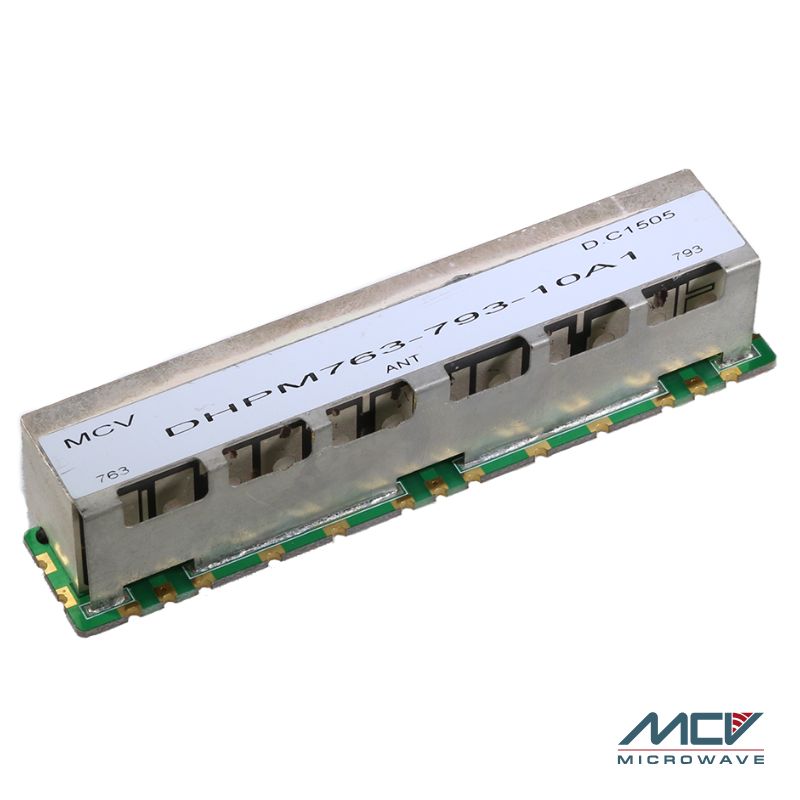
FAQ about Multiplexers
What is an RF multiplexer?
An RF multiplexer is a device that allows multiple radio frequency (RF) signals to share a single transmission path or antenna by combining or selecting signals based on frequency, time, or control logic.
How does an RF multiplexer work?
It works by routing one or more RF input signals to a single output (or vice versa) using switches, filters, or frequency-selective networks while maintaining signal integrity.
What is the difference between an RF multiplexer and a demultiplexer?
An RF multiplexer combines multiple signals into one path, while a demultiplexer separates a combined signal back into individual outputs.
What are common applications of RF multiplexers?
RF multiplexers are used in wireless communication systems, antenna sharing, test equipment, satellite systems, cellular base stations, and IoT devices.
What frequency ranges do RF multiplexers support?
Frequency ranges vary by design and application, typically from a few MHz up to several GHz, including VHF, UHF, and microwave bands.
What are the main types of RF multiplexers?
Common types include frequency-division multiplexers (FDM), time-division multiplexers (TDM), and switch-based RF multiplexers.
What is insertion loss in an RF multiplexer?
Insertion loss is the amount of signal power lost when the RF signal passes through the multiplexer, usually measured in decibels (dB).
Why is isolation important in RF multiplexers?
Isolation prevents unwanted signal leakage between channels, reducing interference and ensuring proper system performance.
What is return loss, and why does it matter?
Return loss measures how much signal is reflected back due to impedance mismatch. Good return loss ensures efficient power transfer and minimal signal degradation.
How are RF multiplexers controlled?
Control can be manual, digital (via GPIO, SPI, or I²C), or automatic depending on system requirements.
What materials are used in RF multiplexers?
They are typically built using semiconductor technologies like GaAs, CMOS, or SOI, along with passive components such as filters and transmission lines.
How do RF multiplexers affect signal quality?
Poor design can introduce noise, distortion, or phase imbalance, while high-quality multiplexers preserve signal integrity and linearity.
What factors should be considered when selecting an RF multiplexer?
Key factors include frequency range, insertion loss, isolation, power handling, switching speed, size, and control interface.
Can RF multiplexers handle high-power signals?
Some RF multiplexers are designed for high-power applications, but power handling capability must be checked in the device specifications.
How do RF multiplexers differ from RF switches?
RF switches typically route a single signal between multiple paths, while RF multiplexers often manage multiple signals and may include filtering or frequency-selective functions.
What is the difference between an RF multiplexer and a diplexer?
A diplexer is a specific type of RF multiplexer that combines or separates two different frequency bands onto a shared path or antenna. An RF multiplexer is a broader category that may support multiple channels, switching functions, or more complex signal-routing configurations.
Can RF multiplexers be used in 5G systems?
Yes. RF multiplexers are widely used in 5G infrastructure to support antenna sharing, band aggregation, and multi-band operation. They help reduce hardware complexity while maintaining signal performance in dense wireless networks.
What is channel isolation in an RF multiplexer?
Channel isolation refers to the ability of the multiplexer to prevent signals from leaking between different channels or ports. Higher isolation improves system performance by minimizing interference and crosstalk between RF paths.
Do RF multiplexers require impedance matching?
Yes. Most RF multiplexers are designed for standard 50-ohm impedance systems. Proper impedance matching minimizes reflections, improves return loss, and ensures efficient signal transfer throughout the RF chain.
How does switching speed impact RF multiplexer performance?
Switching speed determines how quickly the multiplexer can change signal paths or channels. Faster switching is important in applications such as automated RF testing, radar systems, and dynamic wireless communication networks where rapid signal routing is required.
How can I order multiplexers from MCV Microwave?
To place an order for multiplexers please contact us and we will help you!