
Directional Couplers
Engineered to sample RF signals with minimal disruption to the main signal path, directional couplers are essential components for signal monitoring, power measurements, and feedback control in RF systems. By coupling a defined fraction of the signal, they enable precise analysis and system diagnostics without affecting performance.
Directional Coupler by MCV
MCV directional couplers are designed for high accuracy, flat coupling, and excellent directivity across a broad frequency range. Available in multiple coupling values and connector options—including SMA, N-Type, and 2.92mm—they are ideal for use in test and measurement, telecommunications, military communications, and wireless infrastructure. Built to withstand harsh environments, MCV couplers offer consistent performance and rugged construction for both laboratory and field applications.
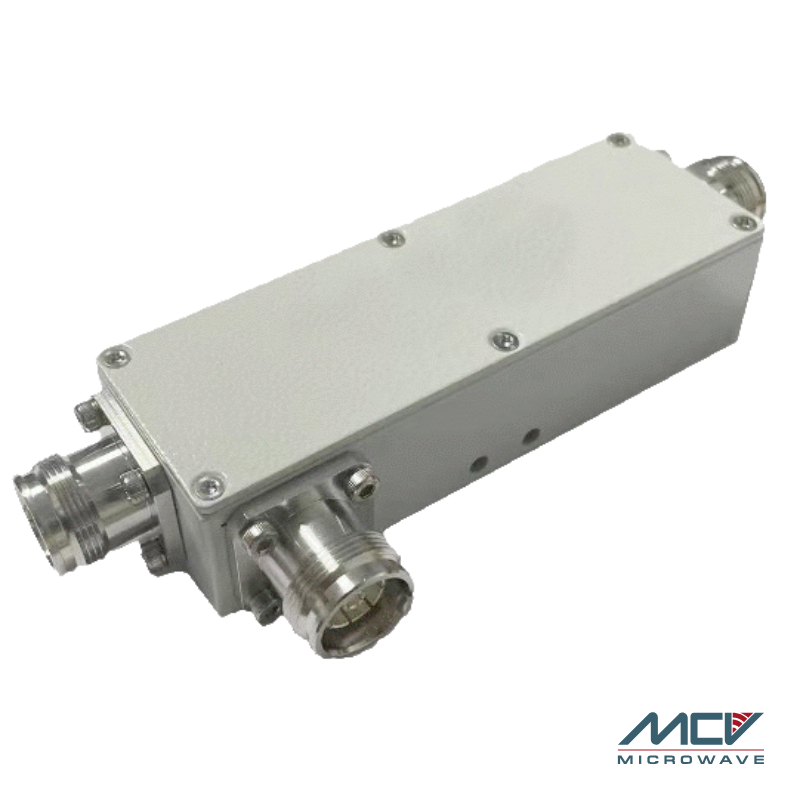
- Broadband – Covers 600 MHz to 6000 MHz
- Low Insertion Loss
- Low PIM Device, -160 dBc
- Coupling Values from 5-30 dB
- IBWave Supported
| MCV Model Number | DC5 | DC6 | DC8 | DC10 | DC13 | DC15 | DC20 | DC30 |
|---|---|---|---|---|---|---|---|---|
| Electrical | ||||||||
| Frequency Range (MHz) | 600 – 6000 MHz | |||||||
| Coupling | 5 | 6 | 8 | 10 | 13 | 15 | 20 | 30 |
| Flatness | ±1.3 | ±1.3 | ±1.4 | ±1.5 | ±1.5 | ±1.5 | ±1.5 | ±1.5 |
| Insertion Loss (dB) | ≤2.4 | ≤1.8 | ≤1.4 | ≤0.8 | ≤0.5 | ≤0.5 | ≤0.4 | ≤0.25 |
| Directivity, 600-2700 MHz (dB) | ≥20 | ≥20 | ≥20 | ≥20 | ≥20 | ≥20 | ≥20 | ≥20 |
| Directivity, 2700-3800 MHz (dB) | ≥17 | ≥17 | ≥17 | ≥17 | ≥17 | ≥17 | ≥17 | ≥17 |
| Isolation, 600-3800 MHz (dB) | ≥22 | ≥23 | ≥25 | ≥26 | ≥29 | ≥30 | ≥35 | ≥45 |
| Isolation, 3800-4800 MHz (dB) | ≥20 | ≥21 | ≥23 | ≥25 | ≥28 | ≥30 | ≥34 | ≥44 |
| Isolation, 4800-6000 MHz (dB) | ≥17 | ≥18 | ≥20 | ≥25 | ≥26 | ≥27 | ≥30 | ≥40 |
| Return Loss (dB) | ≥17 dB 600 – 2700 MHz, 16 dB 2700-6000 MHz | |||||||
| 3rd PIM (dBc) | ≤-160 @ 2×43 dBm | |||||||
| Average Power(W) | ≤300 | |||||||
| Impedance(Ω) | 50 | |||||||
| Mechanical | ||||||||
| Connector Type | See Connector Options Below | |||||||
| Dimension(mm) | 118.5×39.6×29.5(4.65×1.56×1.16) | |||||||
| Weight (kg) | 0.5 | |||||||
| Environmental | ||||||||
| Ingress Protection | IP-67 (Outdoor) | |||||||
| Finish | Black Paint | |||||||
| Operating Temp (℃) | -30 ~ +65 | |||||||
| Storage Temp. (℃) | -40 ~ +75 | |||||||
| Humidity | ≤95% | |||||||
Connector Options Available
-
3-10.0 Female (Add -43F to Model Number)
-
7/16 DIN Female (Add -DF to Model Number)
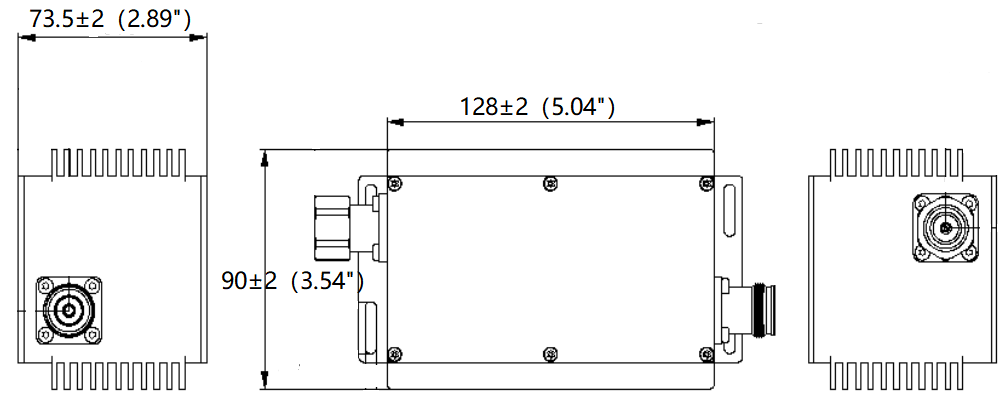
Outline Drawing DC Series Couplers
FAQ about Directional couplers
What is a directional coupler?
A directional coupler is a passive microwave or RF device that splits or combines signals based on their direction of travel. It samples a small portion of the power from a transmission line while maintaining signal flow in one main direction.
How does a directional coupler work?
It uses electromagnetic coupling between two or more transmission lines. Power traveling in one direction couples to a secondary line (the coupled port), while power traveling in the opposite direction is largely isolated.
What are the main ports of a directional coupler?
A typical 4-port directional coupler has:
-
Input port (Port 1) – where the signal enters
-
Transmitted port (Port 2) – main output
-
Coupled port (Port 3) – receives a small fraction of the input power
-
Isolated port (Port 4) – ideally receives no power
What is coupling factor?
The coupling factor (in dB) measures how much power is coupled from the main line to the coupled port. For example, a 10 dB coupler delivers 1/10th of the power (10%) to the coupled port.
What is directivity in a directional coupler?
Directivity indicates how well the coupler distinguishes between forward and reverse traveling waves. Higher directivity (e.g., >30 dB) means better isolation and more accurate signal sampling.
What is isolation in a directional coupler?
Isolation refers to how much power leaks into the isolated port. High isolation ensures minimal interference between ports and improves measurement accuracy.
What are the common applications of directional couplers?
Directional couplers are used for:
-
Power monitoring
-
VSWR and return loss measurement
-
Signal sampling in transmitters and receivers
-
Feedback loops in amplifiers
-
Antenna testing and calibration
What frequency ranges do directional couplers operate in?
They are available for a wide range—from kHz (audio/RF) to GHz (microwave and millimeter-wave) frequencies—depending on the design and materials used.
What is insertion loss in a directional coupler?
Insertion loss is the amount of signal power lost in the main transmission path when the coupler is inserted into a system. Lower insertion loss helps maintain overall system efficiency and signal strength.
What is the difference between forward and reverse coupling?
Forward coupling samples signals traveling from the input toward the output, while reverse coupling samples signals traveling in the opposite direction. This capability allows directional couplers to measure reflected power and VSWR.
Can directional couplers handle high RF power levels?
Yes, many directional couplers are designed for high-power applications. Power handling capability depends on the coupler design, materials, connector type, cooling conditions, and operating frequency.
Why is VSWR important in a directional coupler?
A low VSWR ensures proper impedance matching and minimizes signal reflections within the RF system. This improves measurement accuracy and overall signal integrity.
Can directional couplers be used for signal monitoring without interrupting transmission?
Yes. Directional couplers are specifically designed to sample a small portion of the signal while allowing the majority of the power to continue through the main transmission path with minimal disturbance.
What types of directional couplers exist?
Common types include:
-
Stripline couplers
-
Microstrip couplers
-
Coaxial couplers
-
Waveguide couplers
-
Hybrid couplers (e.g., 3 dB couplers)
How is a directional coupler different from a power splitter?
A power splitter divides power equally (or nearly equally) between outputs regardless of direction. A directional coupler, however, separates signals based on direction, providing isolation and directional sensitivity.
In which industries are MCV directional couplers typically used?
MCV directional couplers are commonly used in test and measurement setups, telecommunications networks, radar and military systems, wireless infrastructure, and RF power monitoring applications due to their high accuracy, flat coupling, and robust construction.
How can I order directional coupler from MCV Microwave?
To place an order for directional coupler or any other passive products please contact us and we will help you!