
Unequal Dividers
Engineered to split RF signals into two or more outputs with intentionally different power levels, unequal power dividers are critical in systems requiring asymmetrical signal distribution. These components allow precise control over signal routing while maintaining impedance balance and minimizing insertion loss.
Unequal Divider by MCV
MCV unequal power dividers are designed for high performance and reliability across a wide range of frequencies. Available in various power split ratios and connector types, they support diverse RF applications including wireless infrastructure, test systems, aerospace, and defense. Built with robust materials and precision engineering, our unequal dividers deliver consistent electrical performance and are ideal for both lab environments and field deployments where signal control and system efficiency are key.
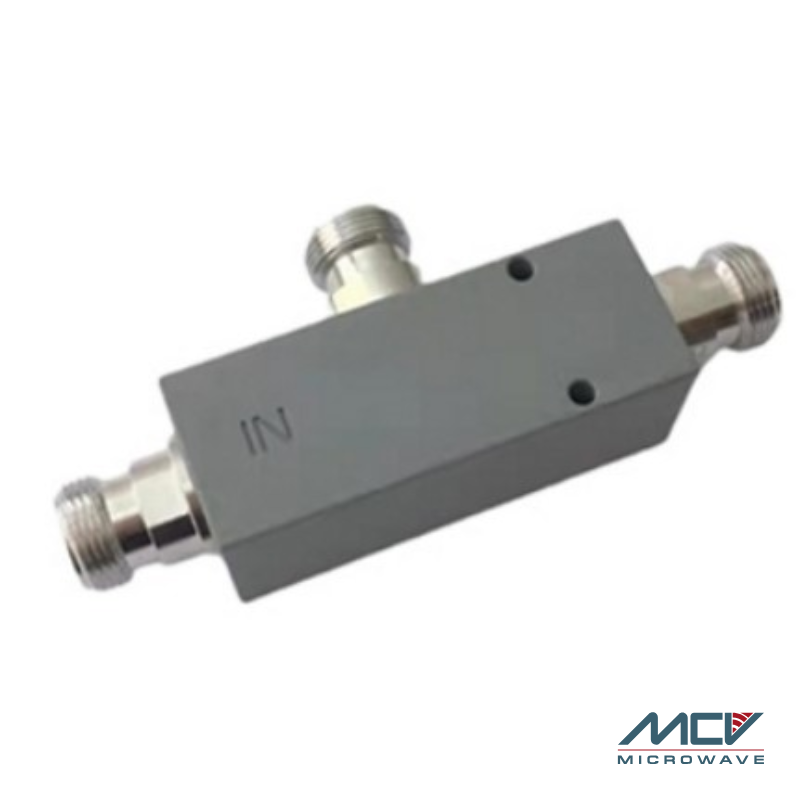
- Wideband – Covers 350 to 6000 MHz
- Low Insertion Loss
- Low PIM Device, -160 dBc
- Splits from 3dB to 20 dB
- IBWave Supported
| MCV Model Number | UD03 | UD05 | UD06 | UC08 | UD10 | UD13 | UD15 | UD20 |
| Electrical Specifications | ||||||||
| Frequency Range (MHz) | 340-960 & 1710-4000 & 5000-6000 MHz | |||||||
| Output Power Split(dB) / Ratio | 2:1/3 | 3:1/4.8 | 4:1/6.0 | 6:1/8.0 | 10:1/10 | 20:1/13 | 30:1/15 | 100:1/20 |
| Tap Loss (dB) J3/J2→J1 | -1.8/-4.8 | -1.3/-6.1 | -1.0/-7.0 | -0.7/-8.6 | -0.4/-10.4 | -0.2/-13.2 | -0.2/-15.1 | -0.2/-20.1 |
| Coupling Variance (dB) | ||||||||
| @ 340-520 MHz | ±1.5 | ±1.5 | ±1.5 | ±1.5 | ±1.5 | ±1.5 | ±1.5 | ±1.5 |
| @ 520-960 MHz | ±1.3 | ±1.3 | ±1.3 | ±1.3 | ±1.3 | ±1.3 | ±1.3 | ±1.3 |
| @ 1710-4000 MHz | ±1.0 | ±1.0 | ±1.0 | ±1.0 | ±1.0 | ±1.0 | ±1.0 | ±1.0 |
| @ 5000-6000 MHz | ±1.3 | ±1.3 | ±1.3 | ±1.3 | ±1.3 | ±1.3 | ±1.3 | ±1.3 |
| Return Loss (dB) | ≥14 | ≥15.6 | ≥16.5 | ≥18 | ≥18 | ≥18 | ≥18 | ≥18 |
| 3rd PIM(dBc) | ≤-160 @ 2×43 dBm | |||||||
| Average Power(W) | ≤300 | |||||||
| Impedance(Ω) | 50 | |||||||
| Mechanical Specifications | ||||||||
| Connector Type | See Options Below | |||||||
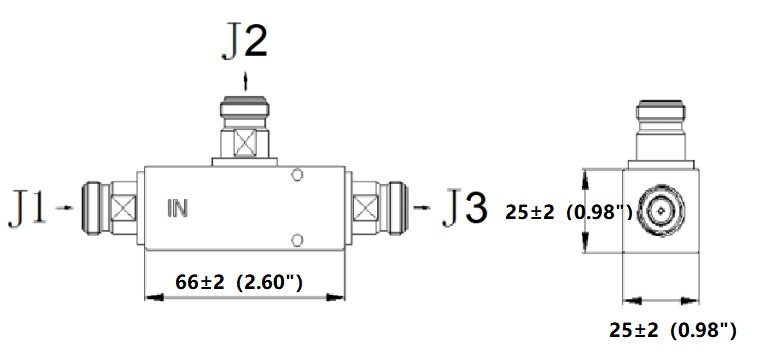
| Dimension(mm) | 66×25×25 (2.60×0.98×0.98 in) | |||||||
| Weight(kg) | 0.26 | |||||||
| Environmental Specifications | ||||||||
| Ingress Protection | IP67(Outdoor) | |||||||
| Finish | Grey | |||||||
| Operating Temp. (℃) | -30 to +65 | |||||||
| Storage Temp. (℃) | -40 to +75 | |||||||
| Humidity | ≤95% | |||||||
Connector Options Available
- 3-10.0 Female (Add -43F to Model Number)
- 7/16 DIN Female (Add -DF to Model Number)
Outline Drawing UD Series Unequal Dividers
FAQ about Unequal dividers
What is an unequal power divider?
An unequal power divider is a passive RF component that splits an input signal into two or more output signals with intentionally different power levels, as opposed to equal splits found in standard power dividers.
When would I use an unequal power divider instead of an equal one?
Unequal power dividers are used when different parts of a system require varying signal strengths, for example, to drive components with different input power needs or to manage coverage in antenna systems.
How is the power split ratio defined?
The power split ratio refers to the proportion of power delivered to each output. For example, a 10 dB / 90%–10% split means one output gets 90% of the power, and the other gets 10%.
What power ratios are available for unequal dividers?
MCV offers unequal dividers in a range of standard and custom power ratios (e.g., 10/90, 30/70, 40/60), depending on system requirements and frequency range.
What types of unequal power dividers are available?
Common types include:
-
Wilkinson unequal dividers
-
Resistive power dividers
-
T-junction or hybrid-based designs
They differ in complexity, isolation, and performance.
Do unequal dividers affect signal integrity?
High-quality unequal power dividers, like those from MCV, are designed to maintain signal integrity with minimal insertion loss and high isolation, even when splitting power unevenly.
Do unequal dividers provide isolation between output ports?
Some designs, like Wilkinson dividers, can provide good isolation between outputs if resistors are used correctly. Others, like resistive dividers, offer poor isolation but simpler implementation.
What are key design considerations for unequal power dividers?
Important factors include:
-
Power split ratio
-
Frequency range
-
Isolation
-
Insertion loss
-
Phase balance
-
Power handling capacity
Can unequal dividers be used across wide frequency ranges?
Yes, MCV unequal power dividers are engineered for broadband operation and are available for use across multiple frequency bands, from VHF to microwave applications.
Why is VSWR important in an unequal power divider?
A low VSWR ensures good impedance matching across all ports, minimizing signal reflections and maximizing power transfer efficiency within the RF system.
Do unequal power dividers maintain phase relationships between outputs?
Yes, many unequal power dividers are designed to maintain specific phase relationships between output ports. Phase balance is especially important in beamforming, phased-array, and coherent signal applications.
What connector types are available for unequal power dividers?
Unequal power dividers are available with a variety of RF connector options, including SMA, N-Type, TNC, BNC, and 2.92 mm connectors, depending on the operating frequency and application requirements.
Can unequal power dividers be customized for specific applications?
Yes, many manufacturers offer custom unequal power dividers with tailored split ratios, frequency ranges, connector configurations, and mechanical designs to meet specialized system requirements.
Are unequal power dividers suitable for harsh environments?
Yes, ruggedized unequal power dividers are available for aerospace, defense, industrial, and outdoor applications. These designs may include sealed housings, corrosion-resistant materials, and extended operating temperature ranges.
What are typical applications of unequal power dividers?
They are used in:
-
Phased array antennas
-
Beamforming networks
-
Multi-band and MIMO systems
-
Radar systems
-
Power monitoring or sampling circuits
Can unequal dividers be used in reverse to combine signals?
Technically yes, but only in specific conditions:
-
All ports must be impedance-matched
-
The divider must be designed to handle combining losses and reflections
Not all unequal dividers are reversible like Wilkinson types.
What is the typical insertion loss in an unequal power divider?
Insertion loss depends on:
-
Power split ratio
-
Design type (resistive vs. Wilkinson)
-
Operating frequency
Generally, insertion loss is higher than in equal dividers, especially for high split ratios or resistive designs.
How do I choose the right unequal divider for my system?
You should consider:
-
Required power split ratio (in dB or % per port)
-
Operating frequency band
-
Isolation requirements
-
Size and integration constraints
-
Power handling needs
How can I order unequal divider from MCV Microwave?
To place an order for unequal divider please contact us and we will help you!