
ATTENUATORS
Accuracy, repeatability and easy integration with microwave attenuator
We provide high-quality attenuators designed to deliver reliable signal management and performance across RF and microwave systems. Whether you need to reduce signal levels, match impedance, or protect sensitive components, our attenuators offer the precision and durability required in demanding environments.
-
Fixed Attenuators: Engineered for consistent performance, our fixed attenuators provide stable attenuation values across a wide frequency range, making them ideal for test setups, system balancing, and signal conditioning.
-
Digital Attenuators: Offering programmable attenuation control, our digital attenuators enable real-time signal adjustment for dynamic systems, automated test environments, and advanced communication applications.
Built for accuracy, repeatability, and ease of integration, our attenuators help ensure optimal system performance and signal integrity. Explore our range to find the right solution for your RF needs.
Explore MCV RF and microwave Attenuators
Fixed Attenuators
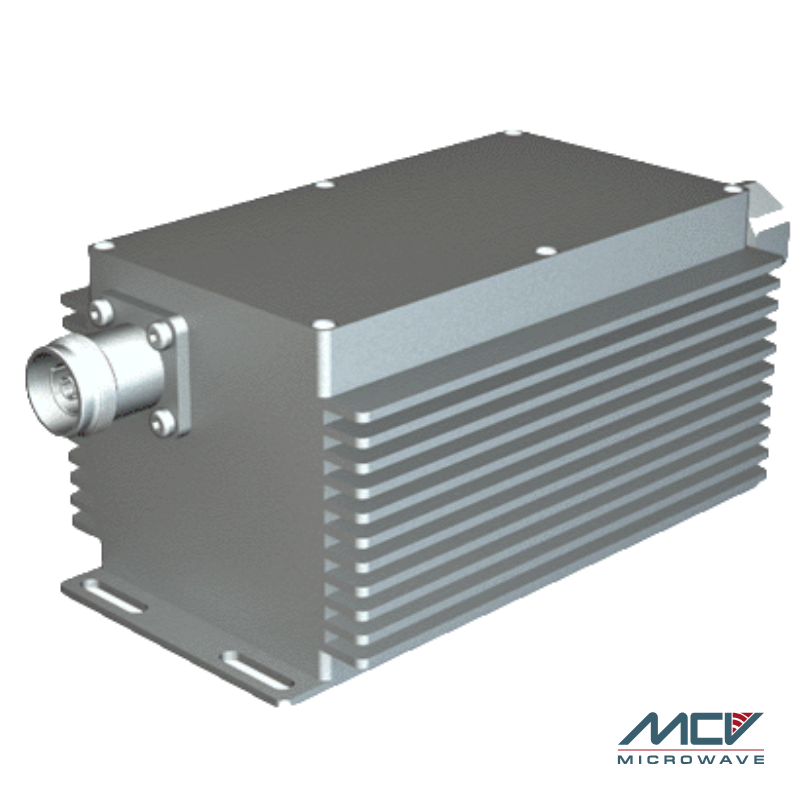
Digital Attenuators

FAQ about Attenuators
What is an attenuator?
An attenuator is a passive electronic device that reduces the power level or amplitude of a signal without significantly distorting its waveform. It’s commonly used to control signal levels in RF, microwave, and audio systems.
Why are attenuators used?
Attenuators are used to:
-
Protect sensitive equipment from high signal levels
-
Match impedances between circuit stages
-
Improve measurement accuracy in test setups
-
Set signal levels to desired values in communication systems
What are the main types of attenuators?
Common types include:
-
Fixed attenuators: Provide a constant attenuation level (e.g., 3 dB, 6 dB).
-
Variable attenuators: Allow manual or electronic adjustment of attenuation.
-
Step attenuators: Offer selectable discrete attenuation levels.
-
Programmable attenuators: Controlled digitally or via software for automation.
How is attenuation measured?
Attenuation is measured in decibels (dB), representing the ratio of input power to output power:
A 10 dB attenuator, for example, reduces the output power to one-tenth of the input.
What is impedance matching in attenuators, and why is it important?
Attenuators are typically designed for specific characteristic impedances (commonly 50 Ω or 75 Ω) to ensure maximum power transfer and minimal signal reflection. Mismatched impedance can lead to standing waves and measurement errors.
What are common construction types for attenuators?
-
Resistive (π or T networks): Simple, broadband, and widely used.
-
Coaxial attenuators: Used in RF/microwave test systems.
-
Thin-film or chip attenuators: Used in compact or surface-mount designs.
-
Digital or PIN diode attenuators: Used in high-speed or programmable systems.
What is the frequency range of attenuators?
The usable frequency range depends on the design and materials. RF attenuators typically operate from DC up to 50 GHz or higher, while audio attenuators work from 20 Hz to 20 kHz.
What is the difference between an attenuator and a resistor network?
While both use resistive elements, an attenuator is carefully designed to provide a specific attenuation and impedance match across a frequency range. A simple resistor network may not maintain consistent impedance or frequency response.
What is power handling in an attenuator and why does it matter?
Power handling defines the maximum input power an attenuator can safely dissipate without overheating or failing. Exceeding this limit can cause resistance drift, permanent damage, or inaccurate attenuation. High-power RF attenuators often use heat sinks or coaxial designs to manage thermal load.
What is attenuation accuracy and tolerance?
Attenuation accuracy refers to how closely the actual attenuation matches its rated value (e.g., ±0.1 dB). Tolerance becomes critical in precision measurement systems and calibration setups, where even small deviations can lead to significant measurement errors.
How do attenuators affect return loss and VSWR?
A well-designed attenuator improves system matching and typically lowers VSWR by absorbing reflected energy. Poor-quality or mismatched attenuators can introduce reflections, degrading signal integrity and measurement accuracy.
What is attenuation flatness over frequency?
Attenuation flatness describes how consistent the attenuation remains across the specified frequency range. Good flatness ensures uniform signal reduction, which is essential in wideband RF and microwave applications.
Do attenuators require calibration or maintenance?
Precision and programmable attenuators may require periodic calibration to maintain accuracy over time, especially in test and measurement environments. Factors such as temperature cycling, aging, and power stress can affect long-term stability.
What are typical applications of attenuators?
Attenuators are found in:
-
RF and microwave communication systems
-
Test and measurement setups (signal generators, spectrum analyzers)
-
Audio equipment for volume control
-
Radar and satellite systems
-
Laboratory calibration setups
How do you select the right attenuator for your application?
Consider:
-
Attenuation value (dB)
-
Frequency range
-
Impedance (e.g., 50 Ω or 75 Ω)
-
Power handling capability
-
Connector type (SMA, N-type, BNC, etc.)
-
Accuracy and flatness over frequency
How can I order attenuators from MCV Microwave?
To place an order for attenuators please contact us and we will help you!