
Wilkinson Power Dividers
Engineered to evenly split RF signals while maintaining impedance matching and minimizing signal loss, Wilkinson power dividers are essential passive components in modern RF systems. They offer high isolation between output ports and excellent return loss, making them ideal for applications that demand precise signal distribution without compromising performance or stability.
- Broadband – Up To 5850 MHz
- Low Insertion Loss
- Low PIM Device, -153 dBc
- 2, 3, 4 and 8 Way Dividers
- iBwave Supported
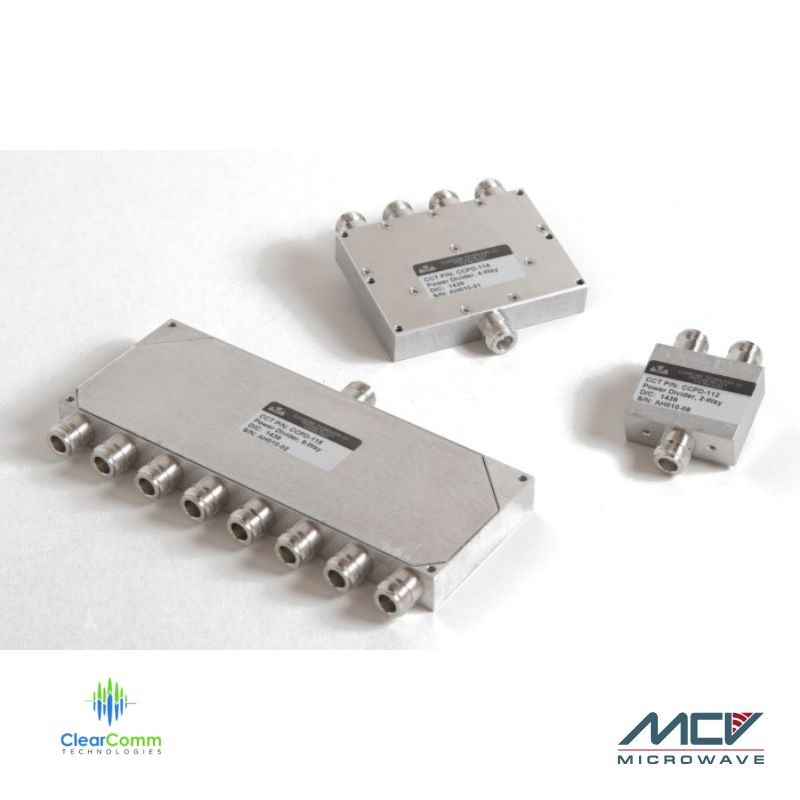
ClearComm Wilkinson Power Dividers by MCV
ClearComm MCV Wilkinson power dividers are designed for high-performance signal splitting across a wide range of frequencies. Utilizing carefully matched resistor networks and precision construction, our dividers ensure optimal phase and amplitude balance with minimal insertion loss.
Available in various configurations and rugged connectorized enclosures, they are well-suited for use in wireless infrastructure, test equipment, aerospace systems, and military communications.
Whether in lab environments or field deployments, MCV Wilkinson power dividers provide the reliability and accuracy engineers depend on for mission-critical RF applications.
Wilkinson Power Divider models and frequency range
| Model Number | Frequency Range |
| CCPD-112 Series | 380-2700 MHz |
| CCPD-113 Series | |
| CCPD-114 Series | |
| CCPD-115 Series | |
| CCPD-124 Series | 380-5850 MHz |
| CCPD-126 Series | 380-2900 MHz |
FAQ about Wilkinson power dividers
What is a Wilkinson power divider?
A Wilkinson power divider is a passive RF/microwave device that splits an input signal into two or more output signals with equal amplitude and phase, while maintaining impedance matching and providing high isolation between output ports.
How does a Wilkinson power divider work?
It uses quarter-wave transmission lines and a resistor (typically between the output ports) to achieve equal power division, input/output matching, and isolation. The resistor dissipates power from any imbalance or reflected signals between the outputs.
What is the main application of a Wilkinson power divider?
Wilkinson power dividers are widely used in RF and microwave circuits for:
-
Signal splitting or combining
-
Antenna feed networks
-
Test and measurement systems
-
Phased arrays
-
Power amplifiers
What makes the Wilkinson divider different from other power dividers?
Unlike basic resistive splitters, the Wilkinson divider offers:
-
Perfect impedance match at all ports
-
High isolation between output ports
-
Low insertion loss (ideally no power loss in balanced conditions)
What is port isolation in a Wilkinson power divider, and why is it important?
Port isolation is the ability to prevent signals from one output port from leaking into the other. In a Wilkinson divider, the isolation resistor ensures minimal crosstalk between output ports, protecting connected components and reducing interference.
Can Wilkinson power dividers be used in reverse as combiners?
Yes. Because they are passive and reciprocal, Wilkinson dividers can also combine two signals into one—as long as the signals are in-phase and of equal amplitude. However, if the inputs are unbalanced, the isolation resistor will dissipate the excess power.
What frequency range can Wilkinson power dividers operate in?
They are frequency-dependent and typically designed for a narrow bandwidth centered around a specific frequency. However, multi-section and broadband versions can cover wider frequency ranges.
What are the limitations of Wilkinson power dividers?
-
Narrow bandwidth (for single-section designs)
-
Complex design for multi-way or broadband versions
-
Not ideal for signals with large amplitude or phase differences when used as combiners
What is the role of the resistor in a Wilkinson power divider?
The resistor (usually between the output ports) provides isolation. It dissipates any power imbalance due to mismatches or unequal signals at the outputs, preventing it from reflecting back to the input.
What are typical characteristics to look for in a Wilkinson power divider?
Key specifications include:
-
Frequency range
-
Insertion loss
-
Return loss (matching)
-
Isolation between output ports
-
Phase and amplitude balance
How many output ports can a Wilkinson power divider have?
While the most common configuration is a 2-way divider, Wilkinson designs can be adapted for 3-way or more outputs, though with increased complexity. Custom configurations are available for specific system needs.
What is a quarter-wave transformer in a Wilkinson power divider?
A quarter-wave transformer is a transmission line section with a length equal to one-quarter of the signal wavelength at the design frequency. In a Wilkinson divider, it transforms impedances to ensure proper matching between the input and output ports.
How are Wilkinson power dividers implemented in practice?
They are commonly implemented using microstrip or stripline transmission lines on printed circuit boards (PCBs). At higher frequencies, precise layout, substrate material, and fabrication tolerances significantly impact performance.
What is amplitude and phase balance in a Wilkinson power divider?
Amplitude balance refers to equal power levels at each output, while phase balance ensures signals are in phase. Good balance is critical in applications like phased arrays and balanced amplifiers.
Can a Wilkinson power divider handle high power levels?
Yes, but power handling depends on the physical design, transmission line dimensions, and resistor rating. High-power versions often use larger structures and specialized resistors to dissipate excess energy safely.
What are multi-section Wilkinson power dividers?
Multi-section designs use multiple quarter-wave sections to increase bandwidth. While they improve performance over a wider frequency range, they also increase size, complexity, and design effort.
What is the difference between a Wilkinson power divider and a resistive power divider?
A Wilkinson power divider uses quarter-wave transmission lines and an isolation resistor to achieve low insertion loss, excellent impedance matching, and high isolation between output ports. A resistive power divider is simpler and operates over a wider bandwidth but introduces significantly higher insertion loss and does not provide the same level of isolation.
How do I choose the right Wilkinson power divider?
When selecting a Wilkinson power divider, consider the operating frequency range, bandwidth, number of output ports, insertion loss, isolation, return loss, power handling, phase and amplitude balance, connector type, and environmental requirements. The right choice depends on your application’s performance and mechanical constraints.
Can Wilkinson power dividers be customized?
Yes. Wilkinson power dividers can be custom-designed for specific frequency bands, bandwidths, impedance values, power levels, connector configurations, and multi-way output requirements. Custom solutions are commonly used in defense, aerospace, satellite communications, and advanced wireless systems.
What industries use Wilkinson power dividers?
Wilkinson power dividers are used across many industries, including telecommunications, aerospace, defense, satellite communications, radar systems, wireless infrastructure, research laboratories, and RF test and measurement equipment.
How reliable are Wilkinson power dividers?
Wilkinson power dividers are highly reliable passive components with no active electronics. When operated within their specified power and environmental limits, they provide long service life with minimal maintenance. High-quality designs use precision transmission lines and robust isolation resistors to ensure stable performance over time.
How can I order ClearComm Wilkinson power divider from MCV Microwave?
To place an order for ClearComm Wilkinson power divider or any other RF products please contact us and we will help you!