
Dual Band Combiners
Designed to combine signals from two distinct frequency bands into a single path, Dual Band Combiners are critical passive components for optimizing RF system architecture. They enable the simultaneous transmission or reception of multiple bands, reducing the need for separate antennas and minimizing system complexity — all while preserving signal integrity.
- Provides low-loss splitting (or combining) of separate frequency bands
- High Isolation / Low Loss
- Outdoor and indoor configurations
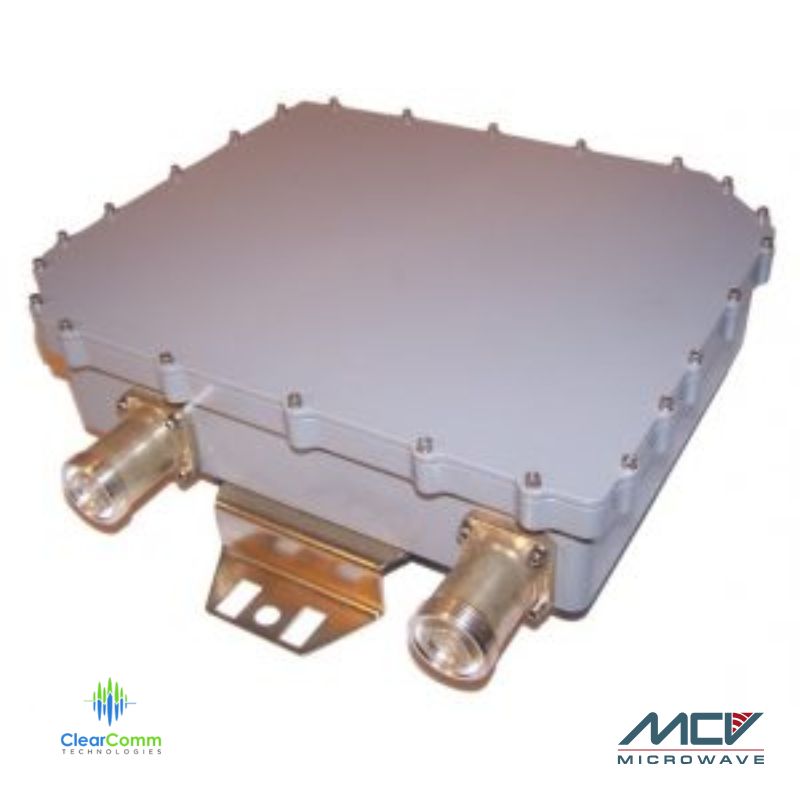
ClearComm Dual Band Combiners by MCV
ClearComm Dual Band Combiners by MCV deliver high isolation, low insertion loss, and excellent return loss across a wide range of frequency combinations. Engineered for performance and reliability, these combiners are housed in durable connectorized enclosures and built to operate in demanding environments such as wireless infrastructure, public safety communications, in-building DAS, and defense systems.
With precise filtering and rugged construction, MCV’s dual band combiners ensure efficient spectrum utilization and long-term performance in compact, high-demand RF deployments.
Dual Band Combiner models and band types
| Model Number | BAND 1 | BAND 2 |
| CCDP-902 | FM-960 | AWS-BRS |
| CCDP-802 | 600-850 | AWS-BRS |
| CCDP-836 | 700-800 | Public Safety |
| CCDP-665 | 600–700 | 850 |
| CCFA-430 | 700+AWS | 850+1900 |
| CCDP-234 | AWS | 1900 |
| CCDP-900 | 1900 | AWS+BRS+WCS |
| CCDP-844 | 1900 | WCS |
| CCDP-826 | 1900 | BRS |
| CCFA-815 | 700+AWS | WCS–BRS |
| CCDP-924 | L1 (basic GPS band) | L2 (Precision GPS Band) |
FAQ about dual band combiners
What is a dual band combiner?
A dual band combiner is a passive RF (radio frequency) device that allows two different frequency bands to share a single antenna or transmission line without interfering with each other. It is commonly used in telecom and wireless infrastructure.
How does a dual band combiner work?
It uses filtering technology (typically bandpass or band-reject filters) to separate two distinct frequency bands. Each input is filtered to allow only its designated frequency band to pass, preventing signal overlap.
What are the typical applications of a dual band combiner?
Dual band combiners are widely used in:
-
Cellular base stations (e.g., combining 700 MHz and 2100 MHz)
-
Distributed Antenna Systems (DAS)
-
RF testing setups
-
Public safety and commercial radio systems
What frequency bands can a dual band combiner handle?
It depends on the specific design. Common combinations include:
-
700/850 MHz
-
800/1900 MHz
-
1800/2600 MHz
What are the benefits of using a dual band combiner?
-
Space-saving: Reduces the number of antennas or cables needed.
-
Cost-effective: Fewer components and installation requirements.
-
Improved efficiency: Better signal routing and reduced losses.
Can dual band combiners handle high power levels?
Yes, many dual band combiners are designed to handle high RF power, often in the range of 50W to several hundred watts, depending on the application and design.
Are dual band combiners bidirectional?
Yes, they are generally bidirectional, meaning they can support signal flow in both directions, which is crucial for systems that transmit and receive on both bands.
What's the difference between a dual band combiner and a diplexer?
Technically, a dual band combiner is a type of diplexer. A diplexer separates or combines two frequency bands. “Dual band combiner” typically refers to telecom-grade diplexers used in combining base station signals.
How do you select the right dual band combiner?
Key selection criteria include:
-
Supported frequency bands
-
Insertion loss
-
Isolation between bands
-
Power handling capability
-
Connector type (e.g., N, DIN, SMA)
-
Environmental ratings (for outdoor or indoor use)
Do dual band combiners require power or maintenance?
No, they are passive components, meaning they do not require electrical power to operate and typically require little to no maintenance.
What is the typical insertion loss of a dual band combiner?
Insertion loss depends on frequency and design but typically ranges from 0.2 dB to 0.7 dB per band for high-quality telecom-grade combiners. Lower insertion loss improves overall system efficiency and helps maintain transmit power and receiver sensitivity.
How much isolation is required between the two bands?
High isolation is critical to prevent interference between bands. Telecom-grade dual band combiners typically provide 50–80 dB of isolation between frequency paths. Higher isolation is especially important in multi-carrier and high-power base station environments.
Do dual band combiners generate Passive Intermodulation (PIM)?
In high-power systems, PIM performance is an important consideration. Premium dual band combiners designed for cellular infrastructure are built with low-PIM materials and construction techniques, often achieving -150 dBc or better, ensuring minimal impact on receiver sensitivity.
Are dual band combiners weatherproof for outdoor installations?
Many dual band combiners are available in IP-rated enclosures for outdoor use. These models are designed to withstand temperature extremes, humidity, vibration, and UV exposure—making them suitable for tower-mounted and rooftop installations.
What impedance do dual band combiners use?
Most dual band combiners are designed for 50-ohm impedance systems, which is standard in RF and telecom applications. Proper impedance matching ensures minimal signal reflection (low VSWR) and optimal RF performance.
Can a dual band combiner be used with a single antenna?
Yes. One of the primary purposes of a dual band combiner is to allow two different frequency bands to share a single antenna. This reduces antenna count, lowers installation costs, and simplifies site infrastructure while maintaining signal separation between bands.
What connector options are available for dual band combiners?
Dual band combiners are available with a variety of connector types, including N-Type, 7/16 DIN, 4.3-10, SMA, and custom configurations. The appropriate connector depends on the frequency range, power requirements, and installation environment.
What is VSWR and why is it important in a dual band combiner?
VSWR (Voltage Standing Wave Ratio) measures how well the combiner is impedance-matched to the RF system. A low VSWR indicates minimal signal reflections, improved power transfer, and better overall system performance. High-quality dual band combiners typically provide excellent VSWR across their operating bands.
Can a dual band combiner be customized for specific frequency bands?
Yes. Custom dual band combiners can be designed to support specific frequency combinations, power levels, connector types, and environmental requirements. Customization is often required for private networks, military communications, public safety systems, and specialized wireless infrastructure.
How does a dual band combiner improve network deployment efficiency?
By combining multiple frequency bands onto a single antenna feed, a dual band combiner reduces tower loading, minimizes cable runs, lowers installation complexity, and helps operators maximize existing infrastructure. This makes network upgrades and multi-band deployments more cost-effective and efficient.
How do MCV’s ClearComm dual band combiners stand out?
MCV’s ClearComm dual band combiners offer precision filtering, robust environmental performance, and high power handling in compact connectorized enclosures—making them ideal for mission-critical and high-density RF deployments.
How can I order ClearComm Dual Band Combiner from MCV Microwave?
To place an order for ClearComm Dual Band Combiner or any other RF products please contact us and we will help you!