
Transmit Filters
Designed to suppress unwanted harmonics and out-of-band emissions, transmit filters are essential components in maintaining spectral integrity and regulatory compliance in RF transmission systems. They ensure that only the desired frequencies are transmitted, protecting both the system itself and nearby communication channels from interference.
- Provide out of band rejection
- Low loss Designs
- Outdoor and indoor configurations
- Prevent Receiver desensitizing
- Remove Harmonics effective package
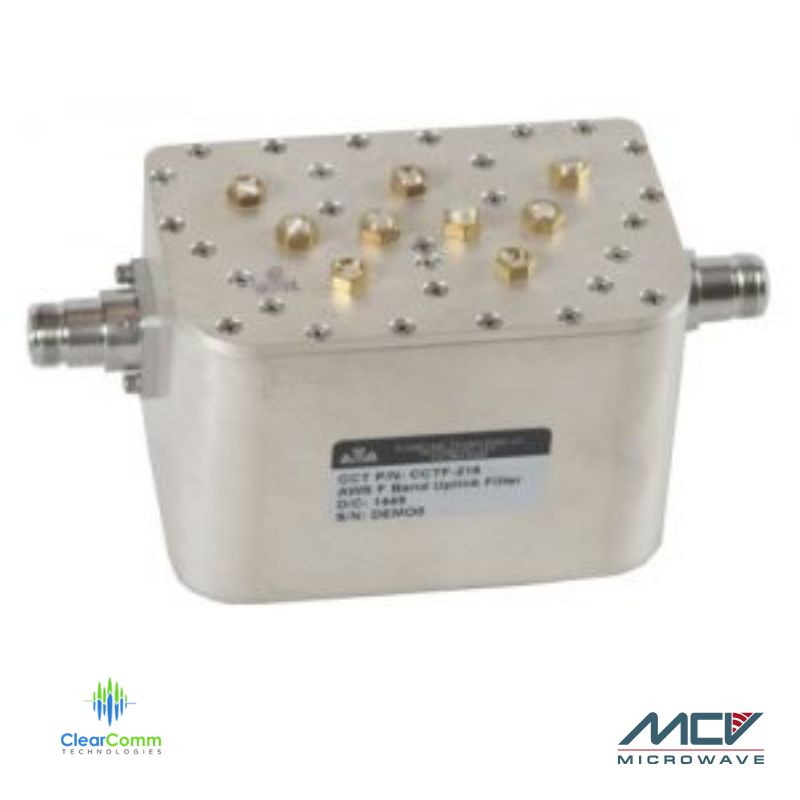
ClearComm Transmit Filters (Downlink) by MCV
ClearComm transmit filters by MCV deliver superior selectivity, low insertion loss, and high power-handling capability across a wide range of frequency bands. Built for performance and durability, our filters are available in cavity, LC, and ceramic configurations, tailored for wireless infrastructure, defense communications, aerospace platforms, and high-power broadcast systems.
Housed in rugged connectorized enclosures, MCV transmit filters are engineered to meet the stringent demands of mission-critical and high-reliability RF environments, ensuring clean and efficient signal transmission.
Transmit Filter models and band types
FAQ about transmit filters
What is a transmit filter?
A transmit filter is an electronic component used in RF (radio frequency) and communication systems to limit the frequency range of a transmitted signal. It ensures that only desired frequencies are sent while blocking unwanted out-of-band signals.
Why are transmit filters important in communication systems?
Transmit filters prevent interference with other channels or systems by removing harmonics and spurious emissions. This helps comply with regulatory standards (like FCC, ETSI) and improves overall system performance.
Where are transmit filters commonly used?
They are used in various systems including:
-
Cellular base stations
-
Satellite communication
-
Wireless LANs (Wi-Fi)
-
Military and aerospace communications
-
Broadcasting transmitters
How does a transmit filter differ from a receive filter?
A transmit filter is placed before the antenna in the transmitter path to clean the outgoing signal. A receive filter, in contrast, is placed in the receiver path to select and pass desired incoming frequencies while rejecting unwanted ones.
What types of transmit filters are there?
Common types include:
-
Low-pass filters: Pass frequencies below a cutoff
-
Band-pass filters: Allow a specific frequency range
-
High-pass filters: Pass frequencies above a certain point
-
Notch filters: Block a narrow band of frequencies
What are typical performance parameters for a transmit filter?
Key parameters include:
-
Insertion loss: Signal loss within the passband
-
Return loss: Reflection at the filter input
-
Rejection/attenuation: Suppression of out-of-band signals
-
Group delay: Signal distortion due to filtering
Can transmit filters be tuned?
Some transmit filters are tunable, especially in software-defined radios (SDRs) or military applications. Others are fixed-frequency and designed for specific bands.
What materials are used to make transmit filters?
Common materials include:
-
Ceramic and dielectric resonators
-
Cavity filters (metal enclosures for high power and stability)
-
SAW/BAW filters (Surface/Bulk Acoustic Wave) for compact designs
-
LC filters (inductors and capacitors) in low-cost applications
How do transmit filters help with regulatory compliance?
Transmit filters limit spurious emissions and harmonics, ensuring that the transmitter meets spectral mask requirements set by regulatory bodies like the FCC, ITU, or ETSI.
Can a poorly designed transmit filter damage a system?
Yes. A filter with high insertion loss or poor rejection can degrade signal quality, reduce transmitter efficiency, cause overheating, or even interfere with nearby equipment.
How do transmit filters reduce harmonic emissions?
Transmit filters attenuate harmonics generated by the transmitter’s power amplifier. By suppressing these unwanted frequencies, they help prevent interference with adjacent services and ensure compliance with regulatory emission limits.
Can one transmit filter support multiple frequency bands?
Some wideband or multiband transmit filters are designed to operate across multiple frequency bands. However, for applications requiring high selectivity and low insertion loss, dedicated filters optimized for specific frequency bands typically provide the best performance.
How does temperature affect transmit filter performance?
Temperature changes can slightly shift a filter’s center frequency and affect insertion loss or rejection characteristics. High-quality transmit filters are designed with temperature-stable materials to maintain consistent performance across a wide operating range.
What is the difference between a cavity transmit filter and a ceramic transmit filter?
Cavity transmit filters offer excellent power handling, low insertion loss, and high rejection, making them ideal for base stations, radar, and broadcast systems. Ceramic transmit filters are smaller and lighter, making them better suited for compact wireless equipment where space is limited.
How long do transmit filters typically last?
Transmit filters are highly reliable passive components and can operate for many years when used within their specified electrical and environmental limits. Their service life depends on factors such as power levels, operating temperature, humidity, vibration, and overall system maintenance.
How do you choose the right transmit filter for an application?
Selection depends on factors such as operating frequency, bandwidth, power level, size constraints, and required rejection levels. Designers also consider environmental conditions (temperature, vibration) and regulatory requirements when choosing a filter type.
What is power handling in a transmit filter, and why does it matter?
Power handling refers to the maximum RF power a filter can safely process without degradation or failure. High-power applications like base stations or radar systems require robust designs (e.g., cavity filters) to avoid overheating or signal distortion.
What is the difference between passive and active transmit filters?
Most transmit filters are passive, meaning they use components like inductors and capacitors and do not require external power. Active filters use amplifying components and are less common in high-frequency transmit paths due to noise and linearity limitations.
How does filter design affect signal linearity and distortion?
A poorly designed filter can introduce nonlinear effects, especially at high power levels, leading to intermodulation distortion. This can create unwanted signals that interfere with adjacent channels and reduce overall system performance.
What are the trade-offs between filter size and performance?
High-performance filters (e.g., cavity filters) tend to be larger and more expensive but offer better selectivity and lower loss. Compact filters (e.g., SAW/BAW) are smaller and cheaper but may have higher insertion loss and limited power handling.
What makes MCV’s transmit filters stand out?
MCV transmit filters offer excellent insertion loss, high rejection, and robust mechanical design, ensuring dependable operation in harsh environments and mission-critical systems.
How can I order ClearComm transmit filters from MCV Microwave?
To place an order for ClearComm transmit filters or any other RF products please contact us and we will help you!