
Multi-Band Combiners
Engineered to combine signals from multiple frequency bands into a single path, Multi-Band Combiners are critical passive components for optimizing RF system architecture. These devices allow operators to reduce infrastructure complexity and cost by enabling multiple services or technologies to share the same antenna system without interference or performance degradation.
- Provide low-loss splitting (or combining) of 3, 4 or 5 separate bands
- High Isolation/ Low Loss
- Covers Common Cellular Bands
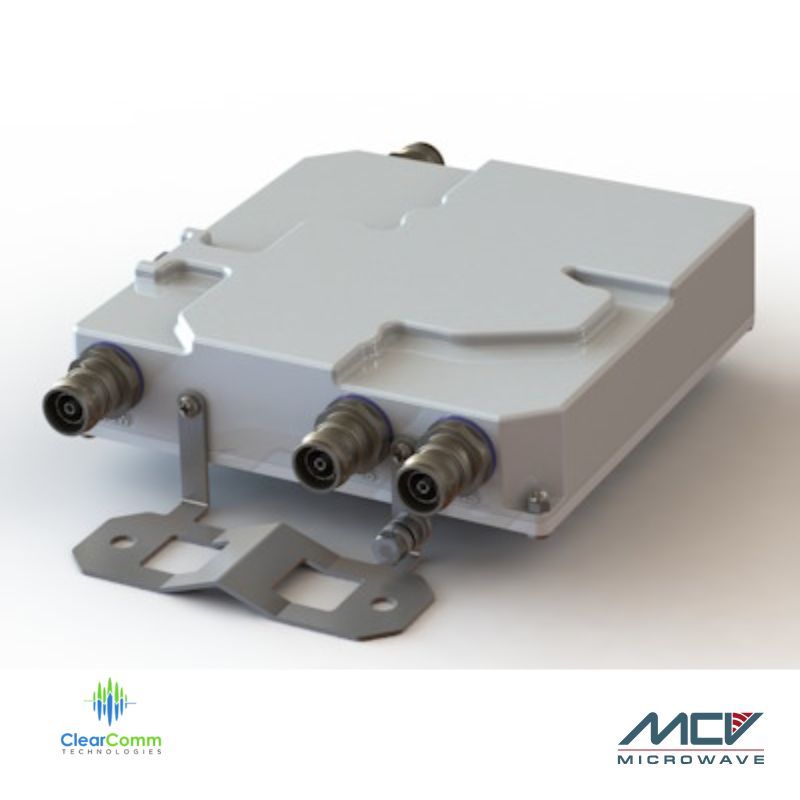
ClearComm Multi-Band Combiners by MCV
ClearComm multi-band combiners by MCV are designed for outstanding isolation, low insertion loss, and superior return loss across a wide range of frequency bands.
Precision-built for high-performance, multi-band operation, our combiners support demanding RF environments such as wireless networks, public safety systems, aerospace communications, and telecom infrastructure.
With rugged, connectorized enclosures and field-proven reliability, MCV’s multi-band combiners deliver compact, efficient, and robust signal management for mission-critical applications where space, performance, and reliability matter most.
We offer 3-band, 4-band, 5-band and 6-band combiners.
3-Band Combiners
| Model Number | BAND 1 | BAND 2 | BAND 3 |
| CCFA-386 | 700 | 850 | 1900-BRS |
| CCFA-332 | 700 | 800-850 | AWS |
| CCFA-546 | 700 | 850 | 1900+AWS1 |
| CCFA-501 | 700 | 850+1900 | AWS1 |
| CCFA-573 | 700 LBC | 700 UC | 850 |
| CCFA-675 | 700+850 | 1900 | AWS1 |
| CCFA-652 | 600+700+850 | 1900+AWS1 | WCS+BRS |
| CCFA-729 | 700–AWS | WCS | BRS |
| CCFA-803 | 800-850 | 1900 | BRS |
| CCFA-804 | 600–700 | 1900 | AWS |
| CCFA-834 | 600-850 | 1900 | AWS |
| CCFA-604 | 1900 | AWS | WCS |
6-Band Combiners
| Model Number | BAND 1 | BAND 2 | BAND 3 | BAND 4 | BAND 5 | BAND 6 |
| CCFA-828 | 700 | 850 | 1900 | AWS1 | AWS3 | WCS |
FAQ about multi-band combiners
What is a Multi-band Combiner?
A Multi-band Combiner is an RF device that allows signals from different frequency bands (e.g., GSM, LTE, 5G) to be combined and transmitted through a single antenna or transmission line without interference.
How is a Multi-band Combiner different from an In-band Combiner?
-
Multi-band Combiners handle signals in different frequency bands, using bandpass filters to separate them.
-
In-band Combiners handle multiple signals within the same frequency band, requiring more isolation and filtering to avoid interference.
What are the key applications of Multi-band Combiners?
They are widely used in:
-
Cellular base stations (multi-technology sites)
-
Distributed antenna systems (DAS)
-
Repeater systems
-
Indoor/outdoor wireless infrastructure
What are the benefits of using a Multi-band Combiner?
-
Reduces infrastructure (fewer antennas and feeders)
-
Lowers cost and tower space usage
-
Simplifies deployment for multi-technology networks
-
Improves aesthetics and zoning compliance
How do Multi-band Combiners affect system performance?
When properly designed, they maintain high isolation between bands and minimal insertion loss, ensuring negligible impact on overall system performance. However, poor-quality combiners can degrade signal quality and reduce coverage.
Are Multi-band Combiners compatible with existing network infrastructure?
Yes, most are designed to integrate with standard RF components such as antennas, feeders, and base station equipment. Compatibility depends on connector types, frequency ranges, and power levels.
What frequency bands can Multi-band Combiners support?
This depends on the design, but typical combinations include:
-
700 MHz / 850 MHz / 900 MHz
-
1800 MHz / 2100 MHz / 2600 MHz
-
Sub-6 GHz 5G bands
Some units can support more than 4 bands simultaneously.
Can Multi-band Combiners handle both transmit and receive paths?
Yes. Most are designed to support full-duplex operation, meaning they can handle simultaneous transmission and reception on all supported bands.
Do Multi-band Combiners introduce signal loss?
Yes, like all passive components, they introduce some insertion loss, typically between 0.2 – 0.5 dB per path, depending on the frequency and quality of the combiner.
Are Multi-band Combiners active or passive devices?
They are usually passive devices, meaning they do not require external power and rely solely on RF filtering and combining techniques.
What is the typical power handling capability of a Multi-band Combiner?
Power handling varies by model, but typical units support anywhere from a few watts (for indoor DAS) up to several hundred watts (for macro base stations). Always match the combiner rating to your system requirements.
Can Multi-band Combiners be used in outdoor environments?
Yes, many are designed for outdoor deployment with weatherproof (IP-rated) enclosures, temperature tolerance, and protection against humidity, dust, and corrosion.
Do Multi-band Combiners require maintenance or calibration?
As passive devices, they generally require minimal maintenance. However, periodic inspection and testing (e.g., checking VSWR and insertion loss) are recommended to ensure optimal long-term performance.
How much isolation is provided between frequency bands?
Multi-band combiners are designed to provide high isolation between supported frequency bands, preventing signals from one band from interfering with another. The required isolation level depends on the application, but higher isolation generally improves overall network performance and reliability.
Can a Multi-band Combiner support 5G networks?
Yes. Many modern multi-band combiners are designed to support both legacy technologies (such as GSM, UMTS, and LTE) and Sub-6 GHz 5G frequency bands. This allows operators to deploy multiple wireless technologies through a shared antenna infrastructure while simplifying site upgrades.
Can multiple operators share the same antenna using a Multi-band Combiner?
In certain network-sharing or neutral-host deployments, multi-band combiners can be used to combine services from different operators onto a common antenna system. Proper frequency planning, isolation, and system design are essential to ensure reliable operation and regulatory compliance.
What is intermodulation distortion (IMD) and why is it important?
Intermodulation distortion occurs when multiple RF signals interact within nonlinear components, generating unwanted frequencies. Low IMD performance is particularly important in multi-band cellular systems where multiple high-power carriers operate simultaneously. High-quality combiners are designed to minimize IMD and maintain network performance.
Can a Multi-band Combiner be expanded as network requirements grow?
Many multi-band combiner solutions can be designed with future expansion in mind. Additional frequency bands or technologies may be incorporated through modular or customized configurations, helping operators accommodate network evolution while maximizing existing infrastructure investments.
What are the key technical parameters to consider when selecting a Multi-band Combiner?
-
Frequency band support
-
Insertion loss
-
Isolation between ports
-
VSWR (Voltage Standing Wave Ratio)
-
Power handling capability
-
Connector type and form factor
Can Multi-band Combiners be customized for specific network requirements?
Yes, we offer custom-designed solutions tailored to operator-specific band combinations, power levels, and environmental requirements (e.g., indoor, outdoor, IP-rated enclosures).
What should I consider when selecting a multi-band combiner?
Key considerations include frequency band support, insertion loss, isolation, return loss, power handling capacity, and physical form factor for system integration.
What makes MCV’s ClearComm multi-band combiners stand out?
MCV’s ClearComm combiners offer excellent band isolation, low loss, and rugged construction—designed to deliver consistent performance in demanding environments like telecom towers, mission-critical communication systems, and harsh outdoor deployments.
How can I order ClearComm Multi-Band Combiner from MCV Microwave?
To place an order for ClearComm Multi-band Combiner or any other RF products please contact us and we will help you!